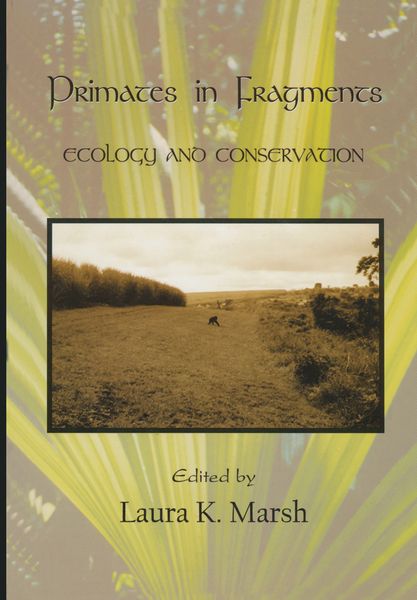
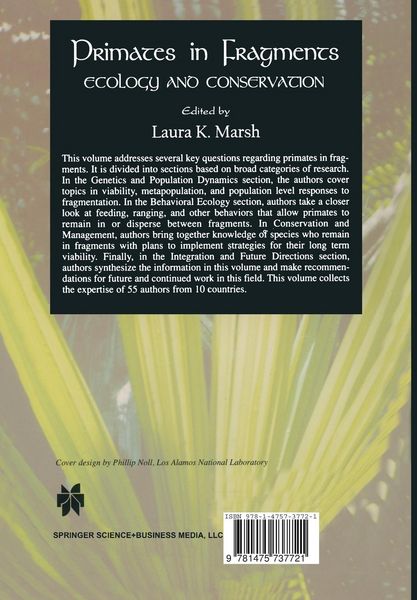
Primates in Fragments Ecology and Conservation
Aus der Reihe
Developments in Primatology: Progress and Prospects
-
- Hardcover
- Taschenbuch ausgewählt
- eBook
-
Sprache:Englisch
-
Auflage:Softcover reprint of the original 1st ed. 2003
Fr. 73.90
inkl. gesetzl. MwSt.,
Beschreibung
Produktdetails
Einband
Taschenbuch
Erscheinungsdatum
02.05.2013
Abbildungen
XXIV, 87 illus., schwarz-weiss Illustrationen
Herausgeber
Laura K. MarshVerlag
Springer UsSeitenzahl
404
Maße (L/B/H)
24.4/17/2.4 cm
Gewicht
741 g
Auflage
Softcover reprint of the original 1st ed. 2003
Sprache
Englisch
ISBN
978-1-4757-3772-1
This volume was created initially from a symposium of the same name presented at the International Primatological Society's XVIII Congress in Adelaide. South Australia. 6-12 January 2000. Many of the authors who have contributed to this text could not attend the symposium. so this has become another vehicle for the rapidly growing discipline of Fragmentation Science among primatologists. Fragmentation has quickly become a field separate from general ecology. which underscores the severity of the situation since we as a planet are rapidly losing habitat of all types to human disturbance. Getting ecologists. particularly primatologists. to admit that they study in fragments is not easy. In the field of primatology. one studies many things. but rarely do those things (genetics. behavior. population dynamics) get called out as studies in fragmentation. For some reason "fragmentation primatologists" fear that our work is somehow "not as good" as those who study in continuous habitat. We worry that perhaps our subjects are not demonstrating as robust behaviors as they "should" given fragmented or disturbed habitat conditions. I had a colleague openly state that she did not work in fragmented forests. that she merely studied behavior when it was clear that her study sites. everyone of them. was isolated habitat. Our desire to be just another link in the data chain for wild primates is so strong that it makes us deny what kinds of habitats we are working in. However.
Noch keine Bewertungen vorhanden
Verfassen Sie die erste Bewertung zu diesem Artikel
Helfen Sie anderen Kundinnen und Kunden durch Ihre Meinung.