• Produktbild: Thinking Italian Animals
  • Produktbild: Thinking Italian Animals

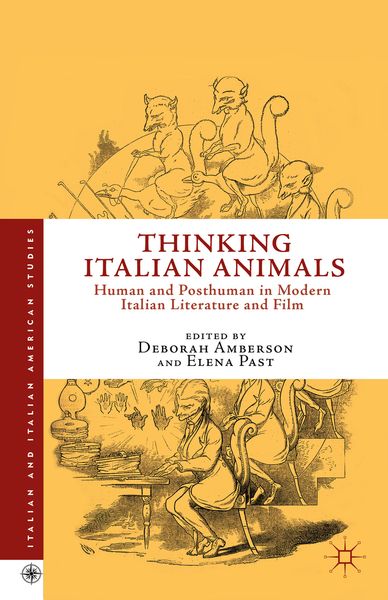
Thinking Italian Animals Human and Posthuman in Modern Italian Literature and Film

Fr. 71.90

inkl. gesetzl. MwSt., Versandkostenfrei


Beschreibung

Produktdetails

Einband

Gebundene Ausgabe

Erscheinungsdatum

18.09.2014

Herausgeber

D. Amberson + weitere

Verlag

Palgrave Macmillan US

Seitenzahl

263

Maße (L/B/H)

21.6/14/2.3 cm

Gewicht

454 g

Auflage

2014

Sprache

Englisch

ISBN

978-1-137-45475-1

Beschreibung

Rezension

"Animals and the Posthuman in Italian Literature and Film is an elegant and musing collection on what it means to be alive and thinking today. The volume contains a wonderful preface by Italian philosopher, Roberto Marchesini , who sets out the stakes of the work beautifully. Indeed, it has been a long time since I've come across such a powerful combination of erudition, cutting-edge readings of continential philosophy, and, though this may seem surprising given the title, humanity." - Timothy Campbell, Professor of Italian Studies and Chair of Romance Studies, Cornell University, USA

Produktdetails

Einband

Gebundene Ausgabe

Erscheinungsdatum

18.09.2014

Herausgeber

Verlag

Palgrave Macmillan US

Seitenzahl

263

Maße (L/B/H)

21.6/14/2.3 cm

Gewicht

454 g

Auflage

2014

Sprache

Englisch

ISBN

978-1-137-45475-1

Herstelleradresse

Libri GmbH
Europaallee 1
36244 Bad Hersfeld
DE

Email: GPSR Kontakt

Noch keine Bewertungen vorhanden

Verfassen Sie die erste Bewertung zu diesem Artikel

Helfen Sie anderen Kundinnen und Kunden durch Ihre Meinung.

Kundinnen und Kunden meinen

Bewertungen (0)

  • Produktbild: Thinking Italian Animals
  • Produktbild: Thinking Italian Animals
  • Preface: Mimesis: The Heterospecific as Ontopoetic Epiphany; Roberto Marchesini Introduction: Thinking Italian Animals; Deborah Amberson and Elena Past PART I: ONTOLOGIES AND THRESHOLDS 1. Confronting the Specter of Animality: Tozzi and the Uncanny Animal of Modernism; Deborah Amberson 2. Cesare Pavese, Posthumanism, and the Maternal Symbolic; Elizabeth Leake 3. Montale's Animals: Rhetorical Props or Metaphysical Kin?; Gregory Pell 4. The Word Made Animal Flesh: Tommaso Landolfi's Bestiary; Simone Castaldi 5. Animal Metaphors, Biopolitics, and the Animal Question: Mario Luzi, Giorgio Agamben, and the Human-Animal Divide; Matteo Gilebbi PART II: BIOPOLITICS AND HISTORICAL CRISIS 6. Creatureliness and Posthumanism in Liliana Cavani's The Night Porter and Pier Paolo Pasolini's Salò; Alexandra Hills 7. Elsa Morante at the Biopolitical Turn: Becoming-Woman, Becoming-Animal, Becoming-Imperceptible; Giuseppina Mecchia 8. Foreshadowing the Posthuman: Hybridization, Apocalypse, and Renewal in Paolo Volponi; Daniele Fioretti 9. The Post-Apocalyptic Cookbook: Animality, Posthumanism, and Meat in Laura Pugno and Wu Ming; Valentina Fulginiti PART III: ECOLOGIES AND HYBRIDIZATIONS 10. The Monstrous Meal: Flesh Consumption and Resistance in the European Gothic; David Del Principe 11. Contemporaneità and Ecological Thinking in Carlo Levi's Writing; Giovanna Faleschini Lerner 12. Hybriditales: Posthumanizing Calvino; Serenella Iovino 13. (Re)membering Kinship: Living with Goats in The Wind Blows Round and Le quattro volte; Elena Past