Gutscheinbedingungen

*Gültig bis 20.07.2026 auf alle Bücher. Ausgeschlossen sind Zeitschriften, Prozentbücher und Abos | Einlösbar in allen Buchhandlungen von Orell Füssli, Barth Bücher, Buchladen Rapunzel, Papeterie Köhler, Schuler Orell Füssli, Stauffacher und ZAP unter Vorweisung des Gutscheins, auf www.orellfüssli.ch durch Eingabe des Gutscheincodes. Beim Service „eBooks verschenken“ und bei eBook-Käufen via eReader nicht einlösbar | Mindesteinkaufswert: Fr. 30.- | Nicht mit anderen Rabatten kumulierbar.

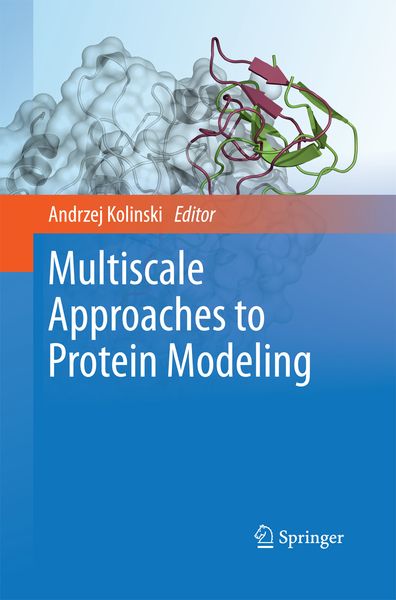
  • Produktbild: Multiscale Approaches to Protein Modeling
  • Produktbild: Multiscale Approaches to Protein Modeling

Multiscale Approaches to Protein Modeling

Fr. 192.00

inkl. gesetzl. MwSt., Versandkostenfrei


Beschreibung

Produktdetails

Einband

Taschenbuch

Erscheinungsdatum

19.09.2014

Herausgeber

Andrzej Kolinski

Verlag

Springer Us

Seitenzahl

355

Maße (L/B/H)

23.5/15.5/2 cm

Gewicht

557 g

Auflage

2011

Sprache

Englisch

ISBN

978-1-4899-8236-0

Beschreibung

Produktdetails

Einband

Taschenbuch

Erscheinungsdatum

19.09.2014

Herausgeber

Andrzej Kolinski

Verlag

Springer Us

Seitenzahl

355

Maße (L/B/H)

23.5/15.5/2 cm

Gewicht

557 g

Auflage

2011

Sprache

Englisch

ISBN

978-1-4899-8236-0

Herstelleradresse

Springer-Verlag KG
Sachsenplatz 4-6
1201 Wien
AT

Email: GPSR Kontakt

Noch keine Bewertungen vorhanden

Verfassen Sie die erste Bewertung zu diesem Artikel

Helfen Sie anderen Kundinnen und Kunden durch Ihre Meinung.

Kundinnen und Kunden meinen

Bewertungen (0)

  • Produktbild: Multiscale Approaches to Protein Modeling
  • Produktbild: Multiscale Approaches to Protein Modeling
  • Preface.- Lattice polymers and protein models.- Multiscale approach to protein and peptide docking.- Coarse-grained models of proteins: theory and applications.- Coarse-grained modeling of biomolecules with transferable force field.- Effective all-atom potentials for protein studies.- Statistical contact potentials in protein coarse-grained modeling: From pair to multi-body potentials.- Bridging the atomic and coarse-grained descriptions of collective motions in proteins.- Structure-based models of biomolecules: stretching of proteins, dynamics of knots, hydrodynamic effects, and indentation of virus capsids.- Sampling protein energy landscapes –the quest for efficient algorithms.- Protein structure prediction: from recognition of matches with known structures to recombination of fragments.- Genome-wide protein structure prediction using template fragment reassembly.- Multiscale approach to protein folding dynamics.- Error estimation of template-based protein structure models.- Evaluation of protein structure prediction methods: issues and strategies.- Index.