Gutscheinbedingungen

*Gültig bis 20.07.2026 auf alle Bücher. Ausgeschlossen sind Zeitschriften, Prozentbücher und Abos | Einlösbar in allen Buchhandlungen von Orell Füssli, Barth Bücher, Buchladen Rapunzel, Papeterie Köhler, Schuler Orell Füssli, Stauffacher und ZAP unter Vorweisung des Gutscheins, auf www.orellfüssli.ch durch Eingabe des Gutscheincodes. Beim Service „eBooks verschenken“ und bei eBook-Käufen via eReader nicht einlösbar | Mindesteinkaufswert: Fr. 30.- | Nicht mit anderen Rabatten kumulierbar.

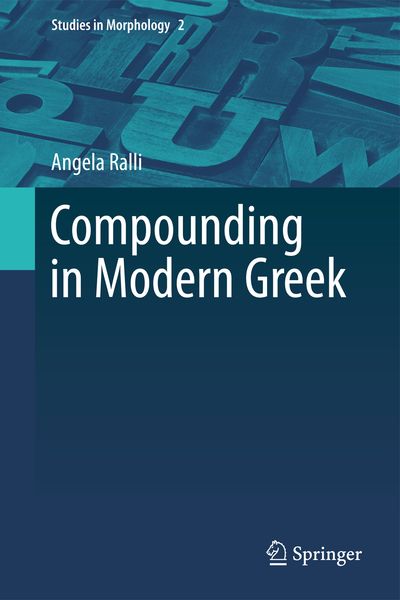
  • Produktbild: Compounding in Modern Greek
  • Produktbild: Compounding in Modern Greek
Band 2

Compounding in Modern Greek

Aus der Reihe Studies in Morphology

Fr. 138.00

inkl. gesetzl. MwSt., Versandkostenfrei


Beschreibung

Produktdetails

Einband

Taschenbuch

Erscheinungsdatum

09.11.2014

Verlag

Springer Netherland

Seitenzahl

302

Maße (L/B/H)

23.5/15.5/1.8 cm

Gewicht

482 g

Auflage

2013

Sprache

Englisch

ISBN

978-94-017-8272-2

Beschreibung

Produktdetails

Einband

Taschenbuch

Erscheinungsdatum

09.11.2014

Verlag

Springer Netherland

Seitenzahl

302

Maße (L/B/H)

23.5/15.5/1.8 cm

Gewicht

482 g

Auflage

2013

Sprache

Englisch

ISBN

978-94-017-8272-2

Herstelleradresse

Springer-Verlag KG
Sachsenplatz 4-6
1201 Wien
AT

Email: GPSR Kontakt

Noch keine Bewertungen vorhanden

Verfassen Sie die erste Bewertung zu diesem Artikel

Helfen Sie anderen Kundinnen und Kunden durch Ihre Meinung.

Kundinnen und Kunden meinen

Bewertungen (0)

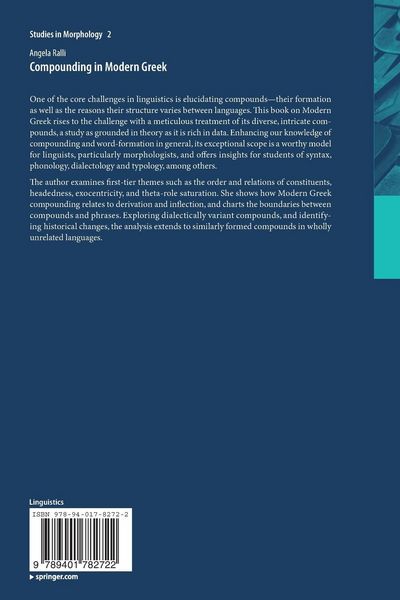
  • Produktbild: Compounding in Modern Greek
  • Produktbild: Compounding in Modern Greek
  • Acknowledgments .- Abbreviations .- Tables .- Introduction .- 1. Defining a Greek compound . 1.1 Introduction . 1.2 Greek as a stem-based language . 1.3 In search of a definition . 1.3.1Single stress . 1.3.2 Bound constituents . 1.3.3 Structural position . 1.3.4 Linking element . 1.3.5 Semantic opacity . 1.3.6 Lexical integrity . 1.3.7 Graphic unity . 1.3.8 Compounds versus syntactic constructions .1.4 Summary . 1.5 References .- 2. Grammatical category and constituents . 2.1 Introduction . 2.2 Nouns . 2.3 Adjectives . 2.4 Verbs . 2.5 Other categories . 2.5.1 Adverbs . 2.5.2 Compounds with a pronoun or a cardinal number . 2.6 Summary . 2.7 References .- 3 Compound marking . 3.1 Introduction . 3.2 Properties . 3.2.1 Stem-driven presence . 3.2.2 Lexically-marked absence . 3.3 Linking elements cross-linguistically . 3.4 Previous analyses . 3.5 Morphological status . 3.6. The parameter of overtly expressed paradigmatic inflection . 3.7 Position . 3.8 The morphological-category parameter . 3.9 Origin . 3.10 Summary . 3.11 References .- 4 Stress and morphological structure . 4.1 Introduction . 4.2 The type of inflection .       4.3 The position of stress . 4.4 Special categories . 4.4.1 Verbal compounds .    4.4.2 Compounds ending in a derived item . 4.4.3 Neuters in –i . 4.5 More compound structures . 4.6 Recursion in compounding . 4.7 Summary . 4.8 References .- 5. Headedness and classification . 5.1 Introduction . 5.2 Classification . 5.3 Headedness . 5.3.1 The notion of head . 5.3.2 Position . 5.3.3 Exocentricity . 5.4 Summary . 5.5 References .- 6. Constraints, allomorphy and form of constituents . 6.1 Introduction . 6.2 The Bare-stem constraint . 6.3 Apparent counter-examples . 6.3.1 Allomorphy . 6.3.2 Allomorphy in compounding . 6.4 Allomorphs of Ancient Greek origin . 6.4.1 Compound types . 6.4.2 –learned compound constituents . 6.4.3. +learned compound constituents . 6.4.4 Mixed types . 6.5 Summary . 6.6  References .- 7. Coordinative compounds . 7.1 Introduction . 7.2 What is a coordinative compound? . 7.3 Classification . 7.4 Headedness . 7.5 Historical development . 7.6 Coordinative compounds in Modern Greek dialects . 7.7 Summary . 7.8 References .- 8. Verbal and deverbal compounds . 8.1 Introduction . 8.2 Categories . 8.2.1 Exocentric formations . 8.2.2 Endocentric formations . 8.3 Compound-internal theta-role saturation . 8.4 Configurations . 8.5 Meaning . 8.6 Summary . 8.7 References .- 9. Deverbal compounds with bound stems . 9.1 Introduction . 9.2 State of the art . 9.3 Compounds or derived words? . 9.4 Grammatical category of bound stems . 9.5 Headedness and restrictions . 9.6 Productivity . 9.7 Summary . 9.8 References .-  10. Compounding versus derivation and inflection . 10.1 Introduction . 10.2 Compounding versus derivation . 10.2.1 Order of application . 10.2.2 Affixoids . 10.3 Compounding versus inflection . 10.4 Summary 10.5 References .- 11. Compounds versus phrases . 11.1 Introduction . 11.2 Properties of NPs . 11.3 Properties of compounds . 11.4 Phrasal compounds . 11.5 Phrasal-compound like phrases .11.6 Constructs . 11.7 Phrasal compounds versus syntactic formations . 11.8 Summary . 11.9 References .- Appendix I Greek: a brief history . 1. Periodization . 2. Geography – Dialectal variation . 3. References .- Appendix II       Greek inflection: an overview . 1. Verbal inflection . 2. Nominal inflection . 3. References .- Appendix III List of compounds .- Subject Index