• Produktbild: Democracy Promotion and Foreign Policy
  • Produktbild: Democracy Promotion and Foreign Policy

Democracy Promotion and Foreign Policy Identity and Interests in US, EU and Non-Western Democracies

Fr. 73.90

inkl. gesetzl. MwSt., Versandkostenfrei


Beschreibung

Produktdetails

Einband

Gebundene Ausgabe

Erscheinungsdatum

19.05.2015

Verlag

Palgrave Macmillan UK

Seitenzahl

241

Maße (L/B/H)

21.6/14/1.6 cm

Gewicht

445 g

Auflage

2015

Sprache

Englisch

ISBN

978-1-137-41446-5

Beschreibung

Rezension

“This book is a terrific addition to the understanding of democracy promotion as a foreign policy goal. … This study offers paths toward future rigorous research. Summing Up: Recommended. Upper-division undergraduates and above.” (S. L. McMillan, Choice, Vol. 53 (5), January, 2016)

“The book addresses important gaps in international relations (IR) theory in general and in the study of democracy promotion in particular. It is a useful read for scholars and practitioners interested in democracy promotion but also in IR theory.” (May Darwich, Democratization, Vol. 23 (4), September, 2015)

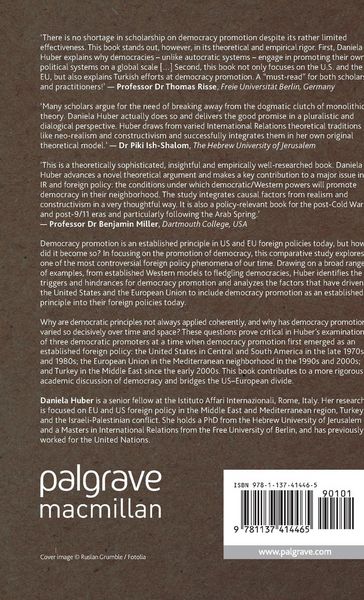
''There is no shortage in scholarship on democracy promotion despite its rather limited effectiveness. This book stands out, however, in its theoretical and empirical rigor. First, Daniela Huber explains why democracies unlike autocratic systems engage in promoting their own political systems on a global scale. She argues, 'it's identity, stupid!' Second, this book not only focuses on the U.S. and the EU, but also explains Turkish efforts at democracy promotion. A 'must-read' for both scholars and practitioners!'' - Professor Dr Thomas Risse, Freie Universität Berlin

''Many scholars argue for the need of breaking away from the dogmatic clutch of monolithic theory. Daniela Huber actually does so and delivers the good promise in a pluralistic and dialogical perspective. Huber draws from varied International Relations theoretical traditions like neo-realism and constructivism and successfully integrates them in her own original theoretical model. By combining strategic, identitive, and normative reasoning, Huber's theoretical model forcefully explains U.S., EU and Turkey's democratization policies within their neighborhoods, and thus offers some policy-relevant insights for the post Arab Spring world.'' - Dr Piki Ish-Shalom,The Hebrew University of Jerusalem


''This is a theoretically sophisticated, insightful and empirically well-researched book. Daniela Huber advances a novel theoretical argument and makes a key contribution to a major issue in IR and foreign policy: the conditions under which democratic/Western powers will promote democracy in their neighborhood. The study integrates causal factors from realism and constructivism in a very thoughtful way. It is also a policy-relevant book for the post-Cold War and post-9/11 eras and particularly following the Arab Spring.'' - Professor Dr Benjamin Miller, Dartmouth College

Produktdetails

Einband

Gebundene Ausgabe

Erscheinungsdatum

19.05.2015

Verlag

Palgrave Macmillan UK

Seitenzahl

241

Maße (L/B/H)

21.6/14/1.6 cm

Gewicht

445 g

Auflage

2015

Sprache

Englisch

ISBN

978-1-137-41446-5

Herstelleradresse

Libri GmbH
Europaallee 1
36244 Bad Hersfeld
DE

Email: gpsr@libri.de

Kundinnen und Kunden meinen

0 Bewertungen

Informationen zu Bewertungen

Zur Abgabe einer Bewertung ist eine Anmeldung im Konto notwendig. Die Authentizität der Bewertungen wird von uns nicht überprüft. Wir behalten uns vor, Bewertungstexte, die unseren Richtlinien widersprechen, entsprechend zu kürzen oder zu löschen.

Die Bewertungen sind nach Format, Anzahl Sterne und Datum sortiert.

Verfassen Sie die erste Bewertung zu diesem Artikel

Helfen Sie anderen Kund*innen durch Ihre Meinung

Kundinnen und Kunden meinen

0 Bewertungen filtern

  • Produktbild: Democracy Promotion and Foreign Policy
  • Produktbild: Democracy Promotion and Foreign Policy
  • PART I: DEMOCRACY PROMOTION WHO DOES WHAT AND WHY? 1. Who Promotes Democracy? The Protagonists 2. What is Democracy Promotion? The Explanandum 3. Why is Democracy Promoted? The Argument PART II: THE US AND DEMOCRACY PROMOTION IN CENTRAL AND SOUTH AMERICA IN THE LAST PERIOD OF THE COLD WAR 4. The Return of Democracy Promotion to US Foreign Policy 5. A Decade of Crisis in Central and South America 6. The Unearthing of a Democratic Role Identity and its Activation in a Grand Foreign Policy Debate PART III: THE EU AND DEMOCRACY PROMOTION IN THE MEDITERRANEAN REGION SINCE THE END OF THE COLD WAR 7. The EU's Approach to Democracy Promotion and its Ups and Downs in the Mediterranean Region 8. The EU's New Security Environment 9. The Formation of a Democratic Role Identity, its Hype and Subsequent Stumbling PART IV: TURKEY AND DEMOCRACY PROMOTION IN THE MEDITERRANEAN REGION SINCE THE EARLY 2000S 10. The Emergence of Democracy Promotion in Turkish Foreign Policy 11. The De-securitization of Foreign Policy 12. Turkey's Evolving Democratic Role Identity and its Activation Through Two Relevant Others Conclusions