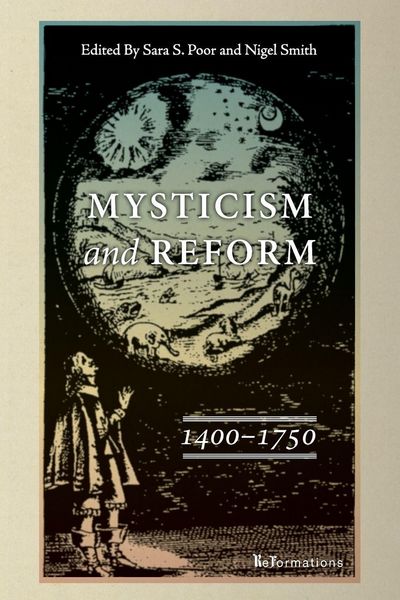
Mysticism and Reform, 1400-1750
-
- Hardcover
- Taschenbuch ausgewählt
- eBook
-
Sprache:Englisch
Fr. 71.90
inkl. gesetzl. MwSt.,
Beschreibung
Produktdetails
Einband
Taschenbuch
Erscheinungsdatum
15.05.2015
Herausgeber
Sara S. Poor + weitereVerlag
University of Notre Dame PressSeitenzahl
420
Maße (L/B/H)
22.9/15.2/2.3 cm
Gewicht
605 g
Sprache
Englisch
ISBN
978-0-268-03898-4
The apparent disappearance of mysticism in the Protestant world after the Reformation used to be taken as an example of the arrival of modernity. However, as recent studies in history and literary history reveal, the "Reformation" was not experienced in such a drastically transformative manner, not least because the later Middle Ages itself was marked by a series of reform movements within the Catholic Church in which mysticism played a central role. In Mysticism and Reform, 1400-1750, contributors show that it is more accurate to characterize the history of early modern mysticism as one in which relationships of continuity within transformations occurred. Rather than focus on the departures of the sixteenth-century Reformation from medieval traditions, the essays in this volume explore one of the most remarkable yet still under-studied chapters in its history: the survival and transformation of mysticism between the late Middle Ages and the early modern period. With a focus on central and northern Europe, the essays engage such subjects as the relationship of Luther to mystical writing, the visual representation of mystical experience in fifteenth- and sixteenth-century art, mystical sermons by religious women of the Low Countries, Valentin Weigel's recasting of Eckhartian gelassenheit for a Lutheran audience, and the mysticism of English figures such as Gertrude More, Jane Lead, Elizabeth Hooten, and John Austin, the German Catharina Regina von Greiffenberg, and the German American Marie Christine Sauer.
Noch keine Bewertungen vorhanden
Verfassen Sie die erste Bewertung zu diesem Artikel
Helfen Sie anderen Kundinnen und Kunden durch Ihre Meinung.