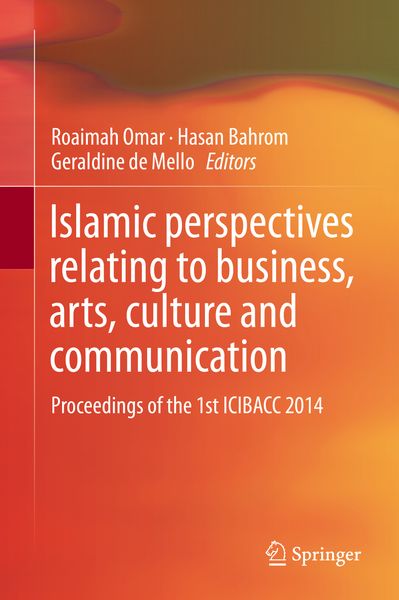
Produktbild: Islamic perspectives relating to business, arts, culture and communication

Islamic perspectives relating to business, arts, culture and communication Proceedings of the 1st ICIBACC 2014

Fr. 192.00

inkl. gesetzl. MwSt., Versandkostenfrei


Beschreibung

Produktdetails

Einband

Gebundene Ausgabe

Erscheinungsdatum

25.06.2015

Abbildungen

XIX, 105 illus., 33 illus. in color., farbige Illustrationen, schwarz-weiss Illustrationen

Herausgeber

Roaimah Omar + weitere

Verlag

Springer Singapore

Seitenzahl

483

Maße (L/B/H)

24.1/16/3.3 cm

Gewicht

916 g

Auflage

2015

Sprache

Englisch

ISBN

978-981-287-428-3

Beschreibung

Portrait

Dr. Roaimah Omar is an Associate Professor at the Universiti Teknologi MARA Melaka, Malaysia. She has served the Faculty of Business Management for more than 22 years and is currently the Deputy Rector of Research and Industrial Linkages and Alumni. Dr. Omar majored in Operation Management and Supply Chain and Marketing, and her interests are in Criminology and Green Technology.

Dr. Hasan bin Bahrom is an Associate Professor at the Universiti Teknologi MARA Shah Alam, Selangor, Malaysia. He has served the Academy of Contemporary Islamic Studies (ACIS) Shah Alam for many years, and his areas of interests are in the field of Islamic Law and Political Science, Alms, Islamic Family Law and Islamic Management. Dr. Bahrom is an active member of the research community and has many publications in his academic portfolio.

Dr. Geraldine De Mello is a senior lecturer at the Academy of Language studies, Universiti Teknologi MARA Melaka, Malaysia. She has been a MUET presenter for schools and a Language trainer for government and private organisations for the past 6 years. Her research interests are in English Language Teaching and English for Workplace Communication. She has published several books and journal articles.

Produktdetails

Einband

Gebundene Ausgabe

Erscheinungsdatum

25.06.2015

Abbildungen

XIX, 105 illus., 33 illus. in color., farbige Illustrationen, schwarz-weiss Illustrationen

Herausgeber

Verlag

Springer Singapore

Seitenzahl

483

Maße (L/B/H)

24.1/16/3.3 cm

Gewicht

916 g

Auflage

2015

Sprache

Englisch

ISBN

978-981-287-428-3

Herstelleradresse

Springer-Verlag KG
Sachsenplatz 4-6
1201 Wien
AT

Email: ProductSafety@springernature.com

Kundinnen und Kunden meinen

0 Bewertungen

Informationen zu Bewertungen

Zur Abgabe einer Bewertung ist eine Anmeldung im Konto notwendig. Die Authentizität der Bewertungen wird von uns nicht überprüft. Wir behalten uns vor, Bewertungstexte, die unseren Richtlinien widersprechen, entsprechend zu kürzen oder zu löschen.

Die Bewertungen sind nach Format, Anzahl Sterne und Datum sortiert.

Verfassen Sie die erste Bewertung zu diesem Artikel

Helfen Sie anderen Kund*innen durch Ihre Meinung

Kundinnen und Kunden meinen

0 Bewertungen filtern

Die Leseprobe wird geladen.
  • Produktbild: Islamic perspectives relating to business, arts, culture and communication
  • Part I: Islamic Studies and Communication.- Chapter 1: Development of Ethno-mathematics of Al-Qur’an, Al-Hadith and Jawi Scripts for Computer Security.- Chapter 2: Is an Islamic Scientific Study of Religion Possible? A Preliminary Discourse with Reference to the Muslim Scholarship in Religionswissenschaft.- Chapter 3: Terrorism and Islamophobic: Media Representation on Islam and Middle East.- Chapter 4: Metaphorical Visual Persuasion: The Perception of Malay Products in Press Advertisements.- Chapter 5: Role of Social Media in Disseminating Dakwah.- Part II: Art and Culture.- Chapter 6: A Comparative Study of Brocade Weaving Art Motifs and Designs in Iran and Malaysia.- Chapter 7: Decision to have Children from the Perspective of Young Malay Muslim Academic Women.- Chapter 8: Factors associated with the Adoption of Sexual Abstinence and Contraception among Moshood Abiola Polytechnic Students in Abeokuta, Nigeria.- Chapter 9: “Light” in Malay Songket. Is it Real?.- Chapter 10: “Light”: Visible to a Person can be Hidden from Others.- Chapter 11: Linking  Neuropolitics to the Politics of Reconciliation in Relation to Political Non-Apology: A Case of Malaysia.- Chapter 12: Marginalised Malay Females: A Socio-demographic Analysis on Female Prisoners in the Malaysian Prisons.- Chapter 13: Structural-Semantic Analysis: A Method towards a Classification of Malaysian Folktale.- Chapter 14: Sustaining Cultural Heritage through Heritage-led Regeneration.- Chapter 15: The Design and Environmental Aspects of the Prayer Room.- Chapter 16: The Effects of Cultural Values on Traditional Islamic-Arabic Houses in the Middle-East.- Chapter 17: The Influence of Foreign and Local Cultures on Traditional Mosques in Indonesia.- Chapter 18: The Influence of Malays’ Social Hierarchy in the Implementation of a Western-based Participatory Action Research Project in Malaysia.- Chapter 19: The Perils of Drug Trafficking: Endangering the Malay and Muslim Society.- Chapter 20: The Practice of Modern Family Planning Methods amongst Married Muslim Women in Katsina, Katsina State, Nigeria.- Chapter 21: The Tubau: Symbol of Unity.- Chapter 22: Traditional Craftsmanship: The Origin, Culture and Challenges of Batik Industry in Malaysia.- Chapter 23: Traditional House of Negeri Sembilan: Interior Layout Plan and Relation to Compatibility Islamic Principles and Matrilineal.- Part III: Business.- Chapter 24: Attitude and Perceptions of Malay Muslim Students towards Educational Loan Repayment: A Qualitative Approach.- Chapter 25: Bumiputra Entrepreneurs’ Perception and Propensity to Sustainable Entrepreneurship.- Chapter 26: Determinants of Savings Behaviour among Muslims in Malaysia: An Empirical Investigation.- Chapter 27: Financing Higher Education Students in Malaysia using Islamic Student Loan-backed Securitisation: An Empirical Analysis.- Chapter 28: Grievances on Islamic Banks: A Survey.- Chapter 29:  How Islamic Banking do Justice to Malaysian Society?.- Chapter 30:  Integrating Zakat Institutions into the Mainstream Economy: Evidence from Malaysia.- Chapter 31: Islamic Perspective of Human Talent Identification and Organisational Justice: Evidence from Government-linked Companies in Malaysia.- Chapter 32: Overview of Production and Tendency on Halal Products and Services in Malaysia and Global Market.- Chapter 33: Relationship between Leaders’ Role and Lecturers’ Innovative Work Behaviour in UiTM Cawangan Melaka.- Chapter 34: Sense of Community among Malay Customers: Evidence from Western Food Outlets in Malaysia using Structural Equation Modeling Approach (SEM).- Chapter 35: Students’ Satisfaction with the University Cafetaria: Structural Relationships of Food Quality, Staff, Price Fairness and Ambiance.- Chapter 36: The Business Web Genre - A Genre Analysis on the Websites of Selected Malaysian Small and Medium Enterprises (SMEs).- Chapter 37: The Effectiveness of Service Quality by Jabatan Agama Islam Wilayah Persekutuan (Jawi) towards Customer Satisfaction.- Chapter 38: The Performance of Married and Single Mother Entrepreneurs: Evidence from Malaysia.- Chapter 39: Why Brand Equity Matters in Globalised Malay and Islamic Country, Malaysia?.- Part IV: Law and Policy.- Chapter 40: A Survey to Assess the Female Sexual Harassment in the Higher Educational Institutes of Karachi, Pakistan.- Chapter 41: E-Participation among Members of Parliament in Malaysia: Evaluation of Social Factors.- Chapter 42: In the Purview of an Oath from the Jurisprudential Method of Islamic Law of Evidence.- Chapter 43:  A Study of Syariah Whipping as Punishment for Drug Dependants in Malaysia.