Gutscheinbedingungen

*Gültig bis 05.07.2026 auf (fast) alles. Ausgeschlossen sind Smartboxen, Zeitschriften, Tickets, Lebensmittel, Gaming-Elektroartikel, Tinte/Toner, Gutscheine, Geschenkkarten, Blumen und Abos | Einlösbar in allen Buchhandlungen von Orell Füssli, Barth Bücher, Buchladen Rapunzel, Papeterie Köhler, Schuler Orell Füssli, Stauffacher und ZAP unter Vorweisung des Gutscheins, auf www.orellfüssli.ch durch Eingabe des Gutscheincodes. Beim Service „eBooks verschenken“ und bei eBook-Käufen via eReader nicht einlösbar | Mindesteinkaufswert: Fr. 30.- | Nicht mit anderen Rabatten kumulierbar.

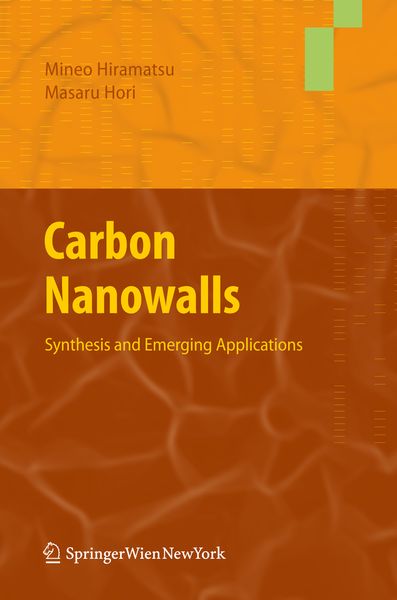
Produktbild: Carbon Nanowalls

Carbon Nanowalls Synthesis and Emerging Applications

Fr. 138.00

inkl. gesetzl. MwSt., Versandkostenfrei


Beschreibung

Produktdetails

Einband

Taschenbuch

Erscheinungsdatum

28.11.2014

Verlag

Springer Wien

Seitenzahl

161

Maße (L/B/H)

23.5/15.5/1 cm

Gewicht

271 g

Auflage

2010

Sprache

Englisch

ISBN

978-3-7091-1663-0

Beschreibung

Produktdetails

Einband

Taschenbuch

Erscheinungsdatum

28.11.2014

Verlag

Springer Wien

Seitenzahl

161

Maße (L/B/H)

23.5/15.5/1 cm

Gewicht

271 g

Auflage

2010

Sprache

Englisch

ISBN

978-3-7091-1663-0

Herstelleradresse

Springer-Verlag KG
Sachsenplatz 4-6
1201 Wien
AT

Email: GPSR Kontakt

Noch keine Bewertungen vorhanden

Verfassen Sie die erste Bewertung zu diesem Artikel

Helfen Sie anderen Kundinnen und Kunden durch Ihre Meinung.

Kundinnen und Kunden meinen

Bewertungen (0)

  • Produktbild: Carbon Nanowalls
  • 1. Introduction
    1.1 Discovery of two-dimensional carbon nanostructures
    1.2 Brief description of carbon nanowalls
    1.3 Research on carbon nanowalls

    2. Synthesis methods
    2.1 Microwave plasma enhanced chemical vapor deposition
    2.2 Inductively coupled plasma enhanced chemical vapor deposition
    2.3 Capacitively coupled plasma enhanced chemical vapor deposition with radical injection
    2.3.1 RF plasma-enhanced CVD with H radical injection
    2.3.2 VHF plasma-enhanced CVD with H radical injection
    2.4 Electron-beam-excited plasma enhanced chemical vapor deposition
    2.5 Hot filament chemical vapor deposition
    2.6 Atmospheric plasma CVD
    2.7 Sputtering

    3. Physics of carbon nanowalls
    3.1 Characterization of carbon nanowalls
    3.1.1 SEM and TEM observation
    3.1.2 Raman spectra of carbon nanowalls
    3.1.3 Grazing incidence in-plane X-ray diffraction
    3.2 Electrical properties of carbon nanowalls
    3.2.1 Field emission properties of carbon nanowalls
    3.2.2 Electrical conduction of carbon nanowalls
    3.3.3 Electrode for electrochemistry

    4. Fabrication of carbon nanowalls using radical injection plasma enhanced CVD
    4.1 Concept of radical-controlled processing
    4.2 RF plasma-enhanced CVD with H radical injection
    4.2.1 Experimental setup for RF plasma-enhanced CVD with H radical injection
    4.2.2 Measurement of radical densities in the capacitively coupled plasma region
    4.2.3 Effect of carbon source gases and H radicals on carbon nanowall growth
    4.2.4 Fabrication of straight and aligned carbon nanowalls with regular spacing
    4.3 VHF plasma-enhanced CVD with H radical injection
    4.3.1 Experimental setup of VHF plasma-enhanced CVD with H radical injection
    4.3.2 Chamber cleaning for carbon nanowall growth with high reproducibility
    4.3.3 Electrical conduction control of carbon nanowalls
    4.3.4 Fabrication of monolithic self-sustaining graphene sheets

    5. Growth mechanism of carbon nanowalls
    5.1 Measurement of radical densities in the plasma used for the fabrication of carbon nanowalls
    5.1.1 Radicals in microwave plasma-enhanced CVD with CH4/H2 mixture
    5.1.2 Radicals in fluorocarbon plasma with H radical injection
    5.1.3 Discussion
    5.2 Steady state growth of carbon nanowalls
    5.2.1 RF plasma-enhanced CVD with H radical injection employing C2F6/H2 system
    5.2.2 Inductively coupled plasma (ICP) enhanced CVD employing CH4/Ar system
    5.2.3 Electron-beam-excited plasma (EBEP) enhanced CVD employing CH4/H2 system
    5.2.4 VHF plasma-enhanced CVD with H radical injection employing C2F6/H2 system
    5.2.5 Discussion
    5.3 Nucleation of carbon nanowalls
    5.3.1 Investigation of nucleation stage of carbon nanowall growth employing C2F6/H2
    5.3.2 Comparison of carbon nanowall growth employing C2F6/H2 with and without O2 gas addition
    5.3.3 Nucleation model of carbon nanowalls
    5.4 Nucleation mechanism of carbon nanowall growth under ion irradiation
    5.4.1 Carbon nanowall growth using multi-beam CVD technique
    5.4.2 Effect of ions on the growth of carbon nanowalls
    5.5 Area-selective growth of carbon nanowalls

    6. Field emission
    6.1 Field emission properties of as-grown carbon nanowalls
    6.2 Surface treatment for improvement of field emission properties
    6.2.1 Surface coating
    6.2.2 Metal/carbon nanowall composites
    6.2.3 Plasma surface treatment

    7. Using carbon nanowalls as templates
    7.1 Fabrication of nanostructured materials using carbon nanowalls as templates
    7.1.1 Decoration of carbon nanowalls
    7.1.2 Fabrication of nanostructured materials on carbon nanowall templates
    7.2 Synthesis of Pt nanoparticles on carbon nanowall surface using supercritical fluid chemical deposition
    7.2.1 Introduction
    7.2.2 Synthesis of Pt nanoparticles by plating
    7.2.3 Synthesis of Pt nanoparticles by sputtering
    7.2.4 Supercritical fluids
    7.2.5 Experimental procedure of metal-organic chemical fluid deposition using supercritical carbon dioxide
    7.2.6 Characterization of platinum nanoparticles formed by metal-organic chemical fluid deposition using supercritical carbon dioxide
    7.2.7 Mechanism of platinum nanoparticle formation by metal-organic chemical fluid deposition using supercritical carbon dioxide
    7.3 Pattern transfer from carbon nanowall into SiO2 film

    8. Future perspective for emerging applications using carbon nanowalls