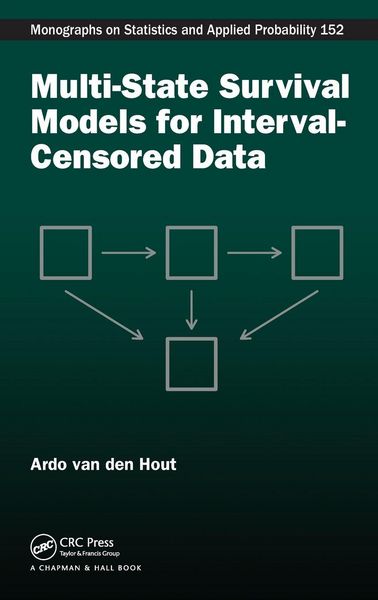
• Produktbild: Multi-State Survival Models for Interval-Censored Data
  • Produktbild: Multi-State Survival Models for Interval-Censored Data

Multi-State Survival Models for Interval-Censored Data

Fr. 163.00

inkl. gesetzl. MwSt., Versandkostenfrei


Beschreibung

Produktdetails

Einband

Gebundene Ausgabe

Erscheinungsdatum

02.12.2016

Abbildungen

schwarz-weiss Illustrationen, Tabellen, schwarz-weiss

Verlag

Taylor & Francis

Seitenzahl

256

Maße (L/B/H)

24/16.1/1.9 cm

Gewicht

476 g

Sprache

Englisch

ISBN

978-1-4665-6840-2

Beschreibung

Rezension

"This book introduces Markov models for studying transitions between states over time, when the exact times of transitions are not always observed. Such data are common in medicine, epidemiology, demography, and social sciences research. The multi-state survival modeling framework can be useful for investigating potential associations between covariates and the risk of moving between states and for prediction of multi-state survival processes. The book is appropriate for researchers with a bachelor's or master's degree knowledge of mathematical statistics. No prior knowledge of survival analysis or stochastic processes is assumed. ...
Multi-State Survival Models for Interval-Censored Data serves as a useful starting point for learning about multi-state survival models."
-Li C. Cheung, National Cancer Institute, in the Journal of the American Statistical Association, January 2018

"This book aims to provide an overview of the key issues in multistate models, conduct and analysis of models with interval censoring. Applications of the book concern on longitudinal data and most of them are subject to interval censoring. The book contains theoretical and applicable examples of different multistate models. ... In summary, this book contains an excellent theoretical coverage of multistate models concepts and different methods with practical examples and codes, and deals with other topics relevant this kind of modelling in a comprehensive but summarised way."
- Morteza Hajihosseini, ISCB News, May 2017

"This is the first book that I know of devoted to multi-state models for intermittently-observed data. Even though this is a common situation in medical and social statistics, these methods have only previously been covered in scattered papers, software manuals and book chapters. The level is approximately suitable for a postgraduate statistics student or applied statistician. The structure is clear, gradually building up

Produktdetails

Einband

Gebundene Ausgabe

Erscheinungsdatum

02.12.2016

Abbildungen

schwarz-weiss Illustrationen, Tabellen, schwarz-weiss

Verlag

Taylor & Francis

Seitenzahl

256

Maße (L/B/H)

24/16.1/1.9 cm

Gewicht

476 g

Sprache

Englisch

ISBN

978-1-4665-6840-2

Herstelleradresse

Libri GmbH
Europaallee 1
36244 Bad Hersfeld
DE

Email: gpsr@libri.de

Noch keine Bewertungen vorhanden

Verfassen Sie die erste Bewertung zu diesem Artikel

Helfen Sie anderen Kundinnen und Kunden durch Ihre Meinung.

Kundinnen und Kunden meinen

Bewertungen (0)

Die Leseprobe wird geladen.
  • Produktbild: Multi-State Survival Models for Interval-Censored Data
  • Produktbild: Multi-State Survival Models for Interval-Censored Data
  • Preface

    Introduction
    Multi-state survival models
    Basic concepts
    Examples
    Overview of methods and literature
    Data used in this book

    Modelling Survival Data
    Features of survival data and basic terminology
    Hazard, density and survivor function
    Parametric distributions for time to event data
    Regression models for the hazard
    Piecewise-constant hazard
    Maximum likelihood estimation
    Example: survival in the CAV study

    Progressive Three-State Survival Model
    Features of multi-state data and basic terminology
    Parametric models
    Regression models for the hazards
    Piecewise-constant hazards
    Maximum likelihood estimation
    A simulation study
    Example

    General Multi-State Survival Model
    Discrete-time Markov process
    Continuous-time Markov processes
    Hazard regression models for transition intensities
    Piecewise-constant hazards
    Maximum likelihood estimation
    Scoring algorithm
    Model comparison
    Example
    Model validation
    Example

    Frailty Models
    Mixed-effects models and frailty terms
    Parametric frailty distributions
    Marginal likelihood estimation
    Monte-Carlo Expectation-Maximisation algorithm
    Example: frailty in ELSA
    Non-parametric frailty distribution
    Example: frailty in ELSA (continued)

    Bayesian Inference for Multi-State Survival Models
    Introduction
    Gibbs sampler
    Deviance Information Criterion (DIC)
    Example: frailty in ELSA (continued)
    Inference using the BUGS software

    Redifual State-Specific Life Expectancy
    Introduction
    Definitions and data considerations
    Computation: integration
    Example: a three-state survival process
    Computation: micro-simulation
    Example: life expectancies in CFAS

    Further Topics
    Discrete-time models for continuous-time processes
    Using cross-sectional data
    Missing state data
    Modelling the first observed state
    Misclassification of states
    Smoothing splines and scoring
    Semi-Markov models

    Matrix P(t) When Matrix Q is Constant
    Two-state models
    Three-state models
    Models with more than three states

    Scoring for the Progressive Three-State Model

    Some Code for the R and BUGS Software
    General-purpose optimiser
    Code for Chapter 2
    Code for Chapter 3
    Code for Chapter 4
    Code for numerical integration
    Code for Chapter 6

    Bibliography

    Index