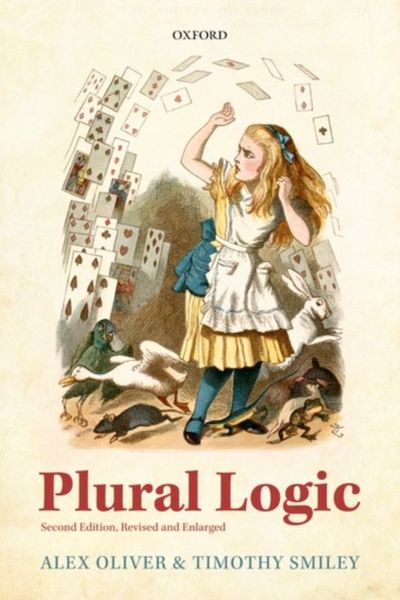
Produktbild: Plural Logic 2/e

Plural Logic 2/e Second Edition, Revised and Enlarged

0

Fr. 61.90

inkl. gesetzl. MwSt., Versandkostenfrei


Beschreibung

Produktdetails

Einband

Taschenbuch

Erscheinungsdatum

27.12.2016

Verlag

Oxford University Press

Seitenzahl

352

Maße (L/B/H)

23.3/15.6/2.5 cm

Gewicht

606 g

Auflage

2. überarbeitete Auflage

Sprache

Englisch

ISBN

978-0-19-874438-2

Beschreibung

Produktdetails

Einband

Taschenbuch

Erscheinungsdatum

27.12.2016

Verlag

Oxford University Press

Seitenzahl

352

Maße (L/B/H)

23.3/15.6/2.5 cm

Gewicht

606 g

Auflage

2. überarbeitete Auflage

Sprache

Englisch

ISBN

978-0-19-874438-2

Kundinnen und Kunden meinen

0 Bewertungen

Informationen zu Bewertungen

Zur Abgabe einer Bewertung ist eine Anmeldung im Konto notwendig. Die Authentizität der Bewertungen wird von uns nicht überprüft. Wir behalten uns vor, Bewertungstexte, die unseren Richtlinien widersprechen, entsprechend zu kürzen oder zu löschen.

Die Bewertungen sind nach Format, Anzahl Sterne und Datum sortiert.

Verfassen Sie die erste Bewertung zu diesem Artikel

Helfen Sie anderen Kund*innen durch Ihre Meinung

Kundinnen und Kunden meinen

0 Bewertungen filtern

Die Leseprobe wird geladen.
  • Produktbild: Plural Logic 2/e
    • 1: The project1.1 Plural phenomena1.2 Plurals in mathematics and logic

    • 2: 1.3 Strategies for a logic of plurals1.4 Manoeuvres of a consertative logician: a case study1.5 Plan of the bookHistory2.1 Distributive and collective predication2.2 Mill2.3 Frege2.4 Lesniewski2.5 Russell2.6 Russell to Boolos

    • 3: Changing the subject3.1 Changing the subject to sets3.2 Uniformity3.3 Against the naive version of changing the subject3.4 Changing the subject and the predicate3.5 The pain of paradox3.6 Changing the subject is simply not on3.7 Changing the subject in practiceAppendix. Events to the rescue?

    • 4: Predicative analyses4.1 Russell's theory of plural descriptions4.2 Other predicative analyses4.3 The equivocity objection4.4 Boolos's 'reciprocal illumination'4.5 Boolos's second-order representation of plurals4.6 Boolos and equivocity4.7 Rumfitt's purified Boolosian schemeAppendix. Dummett and Frege on plurals

    • 5: Terms--singular and plural5.1 Terms5.2 Varieties of singular term5.3 Varieties of plural term5.4 The Russellian idea of singular term5.5 Nested terms5.6 Empty terms5.7 Predication

    • 6: The indeterminacy of plural denotation6.1 Two accounts of denotation6.2 Plural descriptions: some elementary facts6.3 Which account is correct?6.4 Dissenting voices I6.5 Free relatives and why -- questions6.6 Dissenting voices II6.7 Indeterminacy

    • 7: Some basic ideas of plural logic7.1 Variables and quantification7.2 Inclusion and identity7.3 Zilch7.4 Distributive predicates7.5 Collective predicatesAppendix 1. Ex nihilo nihil fitAppendix 2. Das Nichts selbst nichtet

    • 8: Plural descriptions8.1 A theory of descriptions8.2 Formalizing the theory, definability, and ineliminability8.3 Exercises for the reader8.4 SuperpluralsAppendix. Sharvy's theory of descriptions

    • 9: Multivalued functions9.1 Varieties of function9.2 Mathematicians and logicians9.3 Functions and relations9.4 The ambiguity objection9.5 Proposals for eliminating them

    • 10: Lists10.1 Lists as terms10.2 Term-forming 'and'10.3 Lists as strings10.4 Places and positions10.5 Terms vs strings in the literatureAnalyses assessedAppendix.In defence of multigrade predicates

    • 11: Singular logic11.1 Topic neutrality11.2 Syntax11.3 Axioms11.4 Metatheorems11.5 SemanticsAppendix. Soundness and completeness proofs

    • 12: Mid-plural logic12.1 Ideas12.2 Syntax12.3 Axioms12.4 Metatheorems12.5 Semantics12.6 Relation of mid-plural logic to singular logic12.7 The algebra of pluralsAppendix. Soundness and completeness proofs

    • 13: Full plural logic13.1 Syntax13.2 Semantics13.3 Expressive power13.4 Partial axiomatization13.5 Comprehension13.6 Choice

    • 1415: Cantorian set theory14.1 Plurals and sets14.2 Cantor's collections14.3 The empty set14.4 Singletons14.5 Ur-elements14.6 A superstructure, not a foundation14.7 Iterative Cantorian set theory14.8 Developing the theoryAppendix. Development of the theoryHigher-level plural logic15.1 Pseudo-singular terms15.2 Higher-level plural logic: some basic ideas15.3 Description15.4 Levels15.5 Partial axiomatization15.6 Does set theory rest on a mistake?

    • Postscript: unfinished business1 Second-order plural logic2 Partial functions3 Other topics

    • Principal symbols

    • Glossary

    • References

    • Index