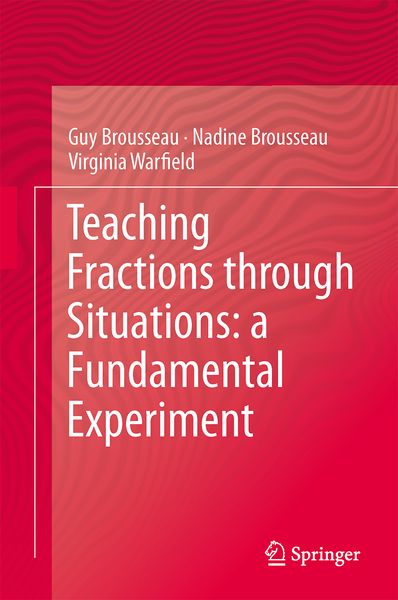
Teaching Fractions through Situations: A Fundamental Experiment
-
- Hardcover
- Taschenbuch ausgewählt
- eBook
-
Sprache:Englisch
Fr. 73.90
inkl. gesetzl. MwSt.,
Beschreibung
Produktdetails
Einband
Taschenbuch
Erscheinungsdatum
08.02.2015
Verlag
Springer NetherlandSeitenzahl
218
Maße (L/B/H)
23.5/15.5/1.3 cm
Gewicht
359 g
Auflage
2014
Sprache
Englisch
ISBN
978-94-017-8420-7
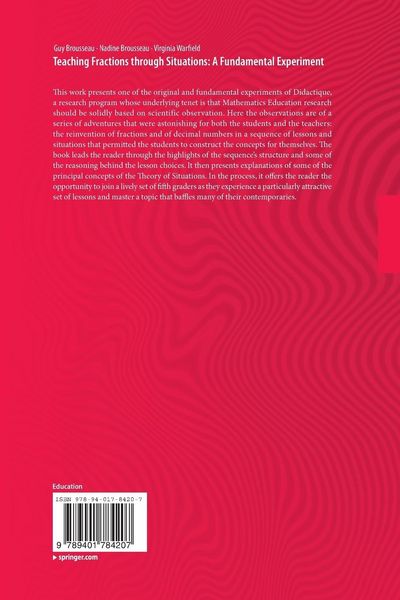
This work presents one of the original and fundamental experiments of Didactique, a research program whose underlying tenet is that Mathematics Education research should be solidly based on scientific observation. Here the observations are of a series of adventures that were astonishing for both the students and the teachers: the reinvention of fractions and of decimal numbers in a sequence of lessons and situations that permitted the students to construct the concepts for themselves. The book leads the reader through the highlights of the sequence's structure and some of the reasoning behind the lesson choices. It then presents explanations of some of the principal concepts of the Theory of Situations. In the process, it offers the reader the opportunity to join a lively set of fifth graders as they experience a particularly attractive set of lessons and master a topic that baffles many of their contemporaries.
Noch keine Bewertungen vorhanden
Verfassen Sie die erste Bewertung zu diesem Artikel
Helfen Sie anderen Kundinnen und Kunden durch Ihre Meinung.