The Vienna Circle Studies in the Origins, Development, and Influence of Logical Empiricism
-
- Hardcover ausgewählt
- Taschenbuch
- eBook
-
Sprache:Englisch
-
Verlag:Springer
- Springer Wien Fr. 220.00
- Springer Fr. 192.00 ausgewählt
Fr. 192.00
inkl. gesetzl. MwSt.,
Beschreibung
Produktdetails
Einband
Gebundene Ausgabe
Erscheinungsdatum
21.05.2015
Abbildungen
XXXI, 125 illus., schwarz-weiss Illustrationen
Verlag
SpringerSeitenzahl
681
Maße (L/B/H)
24.1/16/4.4 cm
Gewicht
1226 g
Auflage
2015
Sprache
Englisch
ISBN
978-3-319-16560-8
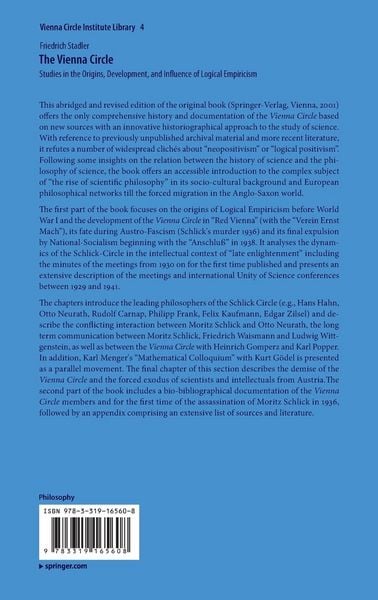
This abridged and revised edition of the original book (Springer-Wien-New York: 2001) offers the only comprehensive history and documentation of the Vienna Circle based on new sources with an innovative historiographical approach to the study of science. With reference to previously unpublished archival material and more recent literature, it refutes a number of widespread clichés about "neo-positivism" or "logical positivism". Following some insights on the relation between the history of science and the philosophy of science, the book offers an accessible introduction to the complex subject of "the rise of scientific philosophy” in its socio-cultural background and European philosophical networks till the forced migration in the Anglo-Saxon world.
The first part of the book focuses on the origins of Logical Empiricism before World War I and the development of the Vienna Circle in "Red Vienna" (with the "Verein Ernst Mach"), its fate during Austro-Fascism (Schlick's murder 1936) and its final expulsion by National-Socialism beginning with the "Anschluss" in 1938. It analyses the dynamics of the Schlick-Circle in the intellectual context of "late enlightenment" including the minutes of the meetings from 1930 on for the first time published and presents an extensive description of the meetings and international Unity of Science conferences between 1929 and 1941.
The chapters introduce the leading philosophers of the Schlick Circle (e.g., Hans Hahn, Otto Neurath, Rudolf Carnap, Philipp Frank, Felix Kaufmann, Edgar Zilsel) and describe the conflicting interaction between Moritz Schlick and Otto Neurath, the long term communication between Moritz Schlick, Friedrich Waismann and Ludwig Wittgenstein, as well as between the Vienna Circle with Heinrich Gomperz and Karl Popper. In addition, Karl Menger's "Mathematical Colloquium" with Kurt Gödel is presented as a parallel movement. The final chapter of this section describes the demise of the Vienna Circle andthe forced exodus of scientists and intellectuals from Austria. The second part of the book includes a bio-bibliographical documentation of the Vienna Circle members and for the first time of the assassination of Moritz Schlick in 1936, followed by an appendix comprising an extensive list of sources and literature.
Noch keine Bewertungen vorhanden
Verfassen Sie die erste Bewertung zu diesem Artikel
Helfen Sie anderen Kundinnen und Kunden durch Ihre Meinung.