Gutscheinbedingungen

*Gültig bis 05.07.2026 auf (fast) alles. Ausgeschlossen sind Smartboxen, Zeitschriften, Tickets, Lebensmittel, Gaming-Elektroartikel, Tinte/Toner, Gutscheine, Geschenkkarten, Blumen und Abos | Einlösbar in allen Buchhandlungen von Orell Füssli, Barth Bücher, Buchladen Rapunzel, Papeterie Köhler, Schuler Orell Füssli, Stauffacher und ZAP unter Vorweisung des Gutscheins, auf www.orellfüssli.ch durch Eingabe des Gutscheincodes. Beim Service „eBooks verschenken“ und bei eBook-Käufen via eReader nicht einlösbar | Mindesteinkaufswert: Fr. 30.- | Nicht mit anderen Rabatten kumulierbar.

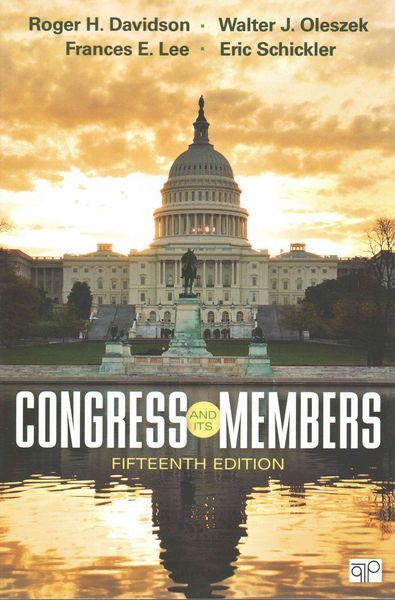
Produktbild: Davidson, R: Congress and Its Members

Davidson, R: Congress and Its Members

Fr. 118.00

inkl. gesetzl. MwSt., Versandkostenfrei


Beschreibung

Produktdetails

Einband

Taschenbuch

Erscheinungsdatum

27.10.2015

Verlag

Sage Publications

Seitenzahl

616

Maße (L/B/H)

15.5/22.9/2.8 cm

Gewicht

746 g

Auflage

15 Revised edition

Sprache

Englisch

ISBN

978-1-4833-8888-5

Beschreibung

Produktdetails

Einband

Taschenbuch

Erscheinungsdatum

27.10.2015

Verlag

Sage Publications

Seitenzahl

616

Maße (L/B/H)

15.5/22.9/2.8 cm

Gewicht

746 g

Auflage

15 Revised edition

Sprache

Englisch

ISBN

978-1-4833-8888-5

Noch keine Bewertungen vorhanden

Verfassen Sie die erste Bewertung zu diesem Artikel

Helfen Sie anderen Kundinnen und Kunden durch Ihre Meinung.

Kundinnen und Kunden meinen

Bewertungen (0)

  • Produktbild: Davidson, R: Congress and Its Members
  • Part I: In Search of the Two Congresses
    Chapter 1: The Two Congresses
    The Dual Nature of Congress
    The Two Congresses in Comparative Context
    Divergent Views of Congress
    Chapter 2: Evolution of the Modern Congress
    Antecedents of Congress
    Congress in the Constitution
    Institutional Evolution
    Evolution of the Legislator's Job
    Conclusion
    Part II: A Congress of Ambassadors
    Chapter 3: Going for It: Recruitment and Candidacy
    Formal Rules of the Game
    Districting in the House
    Becoming a Candidate
    Nominating Politics
    Conclusion
    Chapter 4: Making It: The Electoral Game
    Campaign Strategies
    Campaign Resources
    Campaign Techniques
    The Parallel Campaigns
    Who Votes?
    How Voters Decide
    Election Outcomes
    Conclusion
    Chapter 5: Being There: Hill Styles and Home Styles
    Hill Styles
    Looking Homeward
    Office of the Member Inc.
    Members and the Media
    Conclusion
    Part III: A Deliberative Assembly of One Nation
    Chapter 6: Leaders and Parties in Congress
    The Speaker of the House
    Leaders of the Senate
    Selection of Leaders
    Leadership Activities
    Party Caucuses, Committees, and Informal Groups
    Party Continuity and Change
    Conclusion
    Chapter 7: Committees: Workshops of Congress
    The Purposes of Committees
    Evolution of the Committee System
    Types of Committees
    The Assignment Process
    Committee Leadership
    Policy Making in Committee
    Committee Staff
    Committee Reform and Change
    Conclusion
    Chapter 8: Congressional Rules and Procedures
    Introduction of Bills
    Referral of Bills
    Scheduling in the House
    House Floor Procedures
    Scheduling in the Senate
    Senate Floor Procedures
    Resolving House-Senate Differences
    Conclusion
    Chapter 9: Decision Making in Congress
    The Power to Choose
    Types of Decisions
    Determinants of Voting
    Legislative Bargaining
    Conclusion
    Part IV: Policy Making and Change in the Two Congresses
    Chapter 10: Congress and the President
    The President as Legislator
    The Veto Power
    Sources of Legislative-Executive Cooperation
    Sources of Legislative-Executive Conflict
    The Balance of Power
    Conclusion
    Chapter 11: Congress and the Bureaucracy
    Congress Organizes the Executive Branch
    Congressional Control of the Bureaucracy
    Conclusion
    Chapter 12: Congress and the Courts
    The Federal Courts
    The Court as Referee and Umpire
    Advice and Consent for Judicial Nominees
    Conclusion
    Chapter 13: Congress and Organized Interests
    American Pluralism
    Pressure Group Methods
    Groups and the Electoral Connection
    Groups, Lobbying, and Legislative Politics
    Regulation of Lobbying
    Conclusion
    Chapter 14: Congress, Budgets, and Domestic Policy Making
    Stages of Policy Making
    Types of Domestic Policies
    Characteristics of Congressional Policy Making
    Congressional Budgeting
    The 1974 Budget Act
    Conclusion
    Chapter 15: Congress and National Security Policies
    Constitutional Powers
    Who Speaks for Congress?
    Types of Foreign and National Security Policies
    Structural Policies
    Strategic Policies
    Crisis Policies: The War Powers
    Conclusion
    Part V: Conclusion
    Chapter 16: The Two Congresses and the American People
    Congress-as-Politicians
    Congress-as-Institution
    Twenty-First-Century Challenges