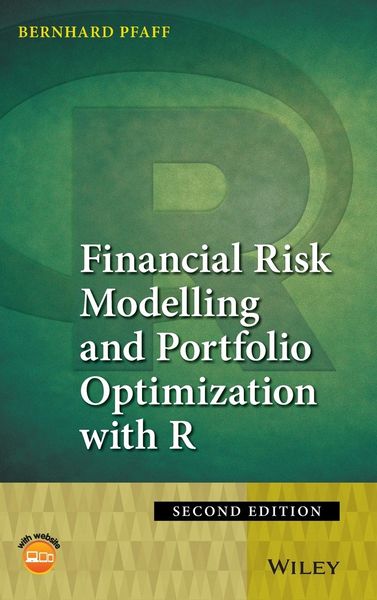
Produktbild: Financial Risk Modelling and Portfolio Optimization with R

Financial Risk Modelling and Portfolio Optimization with R 2nd Edition

Fr. 123.00

inkl. gesetzl. MwSt., Versandkostenfrei


Beschreibung

Produktdetails

Einband

Gebundene Ausgabe

Erscheinungsdatum

03.10.2016

Verlag

John Wiley & Sons

Seitenzahl

446

Maße (L/B/H)

23.5/15.7/2.9 cm

Gewicht

766 g

Auflage

2. Auflage

Sprache

Englisch

ISBN

978-1-119-11966-1

Beschreibung

Produktdetails

Einband

Gebundene Ausgabe

Erscheinungsdatum

03.10.2016

Verlag

John Wiley & Sons

Seitenzahl

446

Maße (L/B/H)

23.5/15.7/2.9 cm

Gewicht

766 g

Auflage

2. Auflage

Sprache

Englisch

ISBN

978-1-119-11966-1

Herstelleradresse

Libri GmbH
Europaallee 1
36244 Bad Hersfeld
DE

Email: Libri GmbH

Noch keine Bewertungen vorhanden

Verfassen Sie die erste Bewertung zu diesem Artikel

Helfen Sie anderen Kundinnen und Kunden durch Ihre Meinung.

Kundinnen und Kunden meinen

Bewertungen (0)

Die Leseprobe wird geladen.
  • Produktbild: Financial Risk Modelling and Portfolio Optimization with R
  • Preface to the Second Edition xi

    Preface xiii

    Abbreviations xv

    About the Companion Website xix

    PART I MOTIVATION 1

    1 Introduction 3

    Reference 5

    2 A brief course in R 6

    2.1 Origin and development 6

    2.2 Getting help 7

    2.3 Working with R 10

    2.4 Classes, methods, and functions 12

    2.5 The accompanying package FRAPO 22

    References 28

    3 Financial market data 29

    3.1 Stylized facts of financial market returns 29

    3.1.1 Stylized facts for univariate series 29

    3.1.2 Stylized facts for multivariate series 32

    3.2 Implications for risk models 35

    References 36

    4 Measuring risks 37

    4.1 Introduction 37

    4.2 Synopsis of risk measures 37

    4.3 Portfolio risk concepts 42

    References 44

    5 Modern portfolio theory 46

    5.1 Introduction 46

    5.2 Markowitz portfolios 47

    5.3 Empirical mean-variance portfolios 50

    References 52

    PART II RISK MODELLING 55

    6 Suitable distributions for returns 57

    6.1 Preliminaries 57

    6.2 The generalized hyperbolic distribution 57

    6.3 The generalized lambda distribution 60

    6.4 Synopsis of R packages for GHD 66

    6.4.1 The package fBasics 66

    6.4.2 The package GeneralizedHyperbolic 67

    6.4.3 The package ghyp 69

    6.4.4 The package QRM 70

    6.4.5 The package SkewHyperbolic 70

    6.4.6 The package VarianceGamma 71

    6.5 Synopsis of R packages for GLD 71

    6.5.1 The package Davies 71

    6.5.2 The package fBasics 72

    6.5.3 The package gld 73

    6.5.4 The package lmomco 73

    6.6 Applications of the GHD to risk modelling 74

    6.6.1 Fitting stock returns to the GHD 74

    6.6.2 Risk assessment with the GHD 77

    6.6.3 Stylized facts revisited 80

    6.7 Applications of the GLD to risk modelling and data analysis 82

    6.7.1 VaR for a single stock 82

    6.7.2 Shape triangle for FTSE 100 constituents 84

    References 86

    7 Extreme value theory 89

    7.1 Preliminaries 89

    7.2 Extreme value methods and models 90

    7.2.1 The block maxima approach 90

    7.2.2 The rth largest order models 91

    7.2.3 The peaks-over-threshold approach 92

    7.3 Synopsis of R packages 94

    7.3.1 The package evd 94

    7.3.2 The package evdbayes 95

    7.3.3 The package evir 96

    7.3.4 The packages extRemes and in2extRemes 98

    7.3.5 The package fExtremes 99

    7.3.6 The package ismev 101

    7.3.7 The package QRM 101

    7.3.8 The packages Renext and RenextGUI 102

    7.4 Empirical applications of EVT 103

    7.4.1 Section outline 103

    7.4.2 Block maxima model for Siemens 103

    7.4.3 r-block maxima for BMW 107

    7.4.4 POT method for Boeing 110

    References 115

    8 Modelling volatility 116

    8.1 Preliminaries 116

    8.2 The class of ARCH models 116

    8.3 Synopsis of R packages 120

    8.3.1 The package bayesGARCH 120

    8.3.2 The package ccgarch 121

    8.3.3 The package fGarch 122

    8.3.4 The package GEVStableGarch 122

    8.3.5 The package gogarch 123

    8.3.6 The package lgarch 123

    8.3.7 The packages rugarch and rmgarch 125

    8.3.8 The package tseries 127

    8.4 Empirical application of volatility models 128

    References 130

    9 Modelling dependence 133

    9.1 Overview 133

    9.2 Correlation, dependence, and distributions 133

    9.3 Copulae 136

    9.3.1 Motivation 136

    9.3.2 Correlations and dependence revisited 137

    9.3.3 Classification of copulae 139

    9.4 Synopsis of R packages 142

    9.4.1 The package BLCOP 142

    9.4.2 The package copula 144

    9.4.3 The package fCopulae 146

    9.4.4 The package gumbel 147

    9.4.5 The package QRM 148

    9.5 Empirical applications of copulae 148

    9.5.1 GARCH-copula model 148

    9.5.2 Mixed copula approaches 155

    References 157

    PART III PORTFOLIO OPTIMIZATION APPROACHES 161

    10 Robust portfolio optimization 163

    10.1 Overview 163

    10.2 Robust statistics 164

    10.2.1 Motivation 164

    10.2.2 Selected robust estimators 165

    10.3 Robust optimization 168

    10.3.1 Motivation 168

    10.3.2 Uncertainty sets and problem formulation 168

    10.4 Synopsis of R packages 174

    10.4.1 The package covRobust 174

    10.4.2 The package fPortfolio 174

    10.4.3 The package MASS 175

    10.4.4 The package robustbase 176

    10.4.5 The package robust 176

    10.4.6 The package rrcov 178

    10.4.7 Packages for solving SOCPs 179

    10.5 Empirical applications 180

    10.5.1 Portfolio simulation: robust versus classical statistics 180

    10.5.2 Portfolio back test: robust versus classical statistics 186

    10.5.3 Portfolio back-test: robust optimization 190

    References 195

    11 Diversification reconsidered 198

    11.1 Introduction 198

    11.2 Most-diversified portfolio 199

    11.3 Risk contribution constrained portfolios 201

    11.4 Optimal tail-dependent portfolios 204

    11.5 Synopsis of R packages 207

    11.5.1 The package cccp 207

    11.5.2 The packages DEoptim, DEoptimR, and RcppDE 207

    11.5.3 The package FRAPO 210

    11.5.4 The package PortfolioAnalytics 211

    11.6 Empirical applications 212

    11.6.1 Comparison of approaches 212

    11.6.2 Optimal tail-dependent portfolio against benchmark 216

    11.6.3 Limiting contributions to expected shortfall 221

    References 226

    12 Risk-optimal portfolios 228

    12.1 Overview 228

    12.2 Mean-VaR portfolios 229

    12.3 Optimal CVaR portfolios 234

    12.4 Optimal draw-down portfolios 238

    12.5 Synopsis of R packages 241

    12.5.1 The package fPortfolio 241

    12.5.2 The package FRAPO 243

    12.5.3 Packages for linear programming 245

    12.5.4 The package PerformanceAnalytics 249

    12.6 Empirical applications 251

    12.6.1 Minimum-CVaR versus minimum-variance portfolios 251

    12.6.2 Draw-down constrained portfolios 254

    12.6.3 Back-test comparison for stock portfolio 260

    12.6.4 Risk surface plots 265

    References 272

    13 Tactical asset allocation 274

    13.1 Overview 274

    13.2 Survey of selected time series models 275

    13.2.1 Univariate time series models 275

    13.2.2 Multivariate time series models 281

    13.3 The Black-Litterman approach 289

    13.4 Copula opinion and entropy pooling 292

    13.4.1 Introduction 292

    13.4.2 The COP model 292

    13.4.3 The EP model 293

    13.5 Synopsis of R packages 295

    13.5.1 The package BLCOP 295

    13.5.2 The package dse 297

    13.5.3 The package fArma 300

    13.5.4 The package forecast 301

    13.5.5 The package MSBVAR 302

    13.5.6 The package PortfolioAnalytics 304

    13.5.7 The packages urca and vars 304

    13.6 Empirical applications 307

    13.6.1 Black-Litterman portfolio optimization 307

    13.6.2 Copula opinion pooling 313

    13.6.3 Entropy pooling 318

    13.6.4 Protection strategies 324

    References 334

    14 Probabilistic utility 339

    14.1 Overview 339

    14.2 The concept of probabilistic utility 340

    14.3 Markov chain Monte Carlo 342

    14.3.1 Introduction 342

    14.3.2 Monte Carlo approaches 343

    14.3.3 Markov chains 347

    14.3.4 Metropolis-Hastings algorithm 349

    14.4 Synopsis of R packages 354

    14.4.1 Packages for conducting MCMC 354

    14.4.2 Packages for analyzing MCMC 358

    14.5 Empirical application 362

    14.5.1 Exemplary utility function 362

    14.5.2 Probabilistic versus maximized expected utility 366

    14.5.3 Simulation of asset allocations 369

    References 375

    Appendix A Package overview 378

    A.1 Packages in alphabetical order 378

    A.2 Packages ordered by topic 382

    References 386

    Appendix B Time series data 391

    B.1 Date/time classes 391

    B.2 The ts class in the base package stats 395

    B.3 Irregularly spaced time series 395

    B.4 The package timeSeries 397

    B.5 The package zoo 399

    B.6 The packages tframe and xts 401

    References 404

    Appendix C Back-testing and reporting of portfolio strategies 406

    C.1 R packages for back-testing 406

    C.2 R facilities for reporting 407

    C.3 Interfacing with databases 407

    References 408

    Appendix D Technicalities 411

    Reference 411

    Index 413