• Produktbild: Prudential Public Leadership
  • Produktbild: Prudential Public Leadership

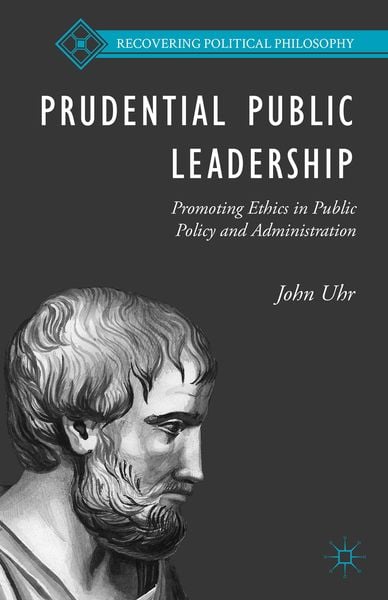
Prudential Public Leadership Promoting Ethics in Public Policy and Administration

Fr. 73.90

inkl. gesetzl. MwSt., Versandkostenfrei


Beschreibung

Produktdetails

Einband

Gebundene Ausgabe

Erscheinungsdatum

09.07.2015

Verlag

Palgrave Macmillan US

Seitenzahl

202

Maße (L/B/H)

21.6/14/1.4 cm

Gewicht

404 g

Auflage

2015

Sprache

Englisch

ISBN

978-1-137-50648-1

Beschreibung

Rezension

“John Uhr has written a rich and challenging work of political philosophy for public leaders, in order to demonstrate the relevance of political philosophy to practitioners in democratic societies. Specifically, he aims to retrieve Aristotle, to restore Aristotle’s rightful place among theorists of the ethics of leadership.” (Kenneth Winston, Political Theory, Vol. 14 (1), March, 2016)

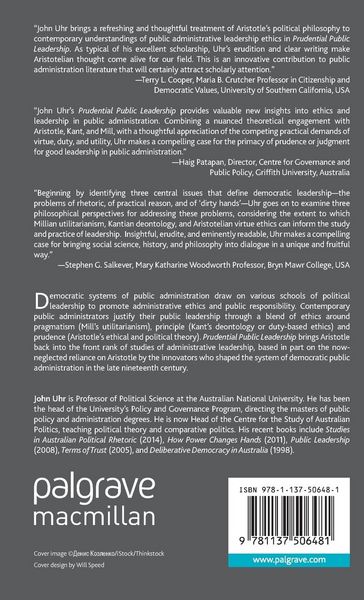
"John Uhr brings a refreshing and thoughtful treatment of Aristotle's political philosophy to contemporary understandings of public administrative leadership ethics in Prudential Public Leadership. As typical of his excellent scholarship, Uhr's erudition and clear writing make Aristotelian thought come alive for our field. This is an innovative contribution to public administration literature that will certainly attract scholarly attention." - Terry L. Cooper, Maria B. Crutcher Professor in Citizenship and Democratic Values, University of Southern California, USA


"John Uhr's Prudential Public Leadership provides valuable new insights into ethics and leadership in public administration. Combining a nuanced theoretical engagement with Aristotle, Kant and Mill, with a thoughtful appreciation of the competing practical demands of virtue, duty and utility, Uhr makes a compelling case for the primacy of prudence or judgment for good leadership in public administration." - Haig Patapan, Director, Centre for Governance and Public Policy, Griffith University, Australia


"Beginning by identifying three central issues that define democratic leadership the problems of rhetoric, of practical reason, and of 'dirty hands' Uhr goes on to examine three philosophical perspectives for addressing these problems, considering the extent to which Millian utilitarianism, Kantian deontology, and Aristotelian virtue ethics can inform the study and practice of leadership. Insightful, erudite, and eminently readable, Uhr makes a compelling case for bringing social science, history, and philosophy into dialogue in a unique and fruitful way." - Stephen G. Salkever, Mary Katharine Woodworth Professor, Bryn Mawr College, USA


"Uhr reinvigorates the study of public ethics with a rich and nuanced understanding of the historical foundations of three three major schools. He illustrates with great textual dexterity and historical awareness how the sources of so much modern public ethics Aristotle, Kant, Mill provide a far more nuanced and realistic approach to how to connect ethics and political action than their followers." - J. Patrick Dobel, John & Marguerite Corbally University Chair of Public Service, University of Washington

Produktdetails

Einband

Gebundene Ausgabe

Erscheinungsdatum

09.07.2015

Verlag

Palgrave Macmillan US

Seitenzahl

202

Maße (L/B/H)

21.6/14/1.4 cm

Gewicht

404 g

Auflage

2015

Sprache

Englisch

ISBN

978-1-137-50648-1

Herstelleradresse

Libri GmbH
Europaallee 1
36244 Bad Hersfeld
DE

Email: gpsr@libri.de

Kundinnen und Kunden meinen

0 Bewertungen

Informationen zu Bewertungen

Zur Abgabe einer Bewertung ist eine Anmeldung im Konto notwendig. Die Authentizität der Bewertungen wird von uns nicht überprüft. Wir behalten uns vor, Bewertungstexte, die unseren Richtlinien widersprechen, entsprechend zu kürzen oder zu löschen.

Die Bewertungen sind nach Format, Anzahl Sterne und Datum sortiert.

Verfassen Sie die erste Bewertung zu diesem Artikel

Helfen Sie anderen Kund*innen durch Ihre Meinung

Kundinnen und Kunden meinen

0 Bewertungen filtern

  • Produktbild: Prudential Public Leadership
  • Produktbild: Prudential Public Leadership
  • 1. Preview: Political Theory and Public Administration 2. Leadership Rhetoric: Defining the Terms 3. Prudential Leadership: The Power of Practical Reason 4. Leadership Dilemmas: Debating Dirty Hands 5. Pragmatism: Mill and the Ethics of Impact 6. Principle: Kant and the Ethics of Intent 7. Prudence: Aristotle and the Ethics of Virtue 8. Leadership Accountability: Democracy and Deliberation 9. Review: Ethics and Leadership in Public Administration