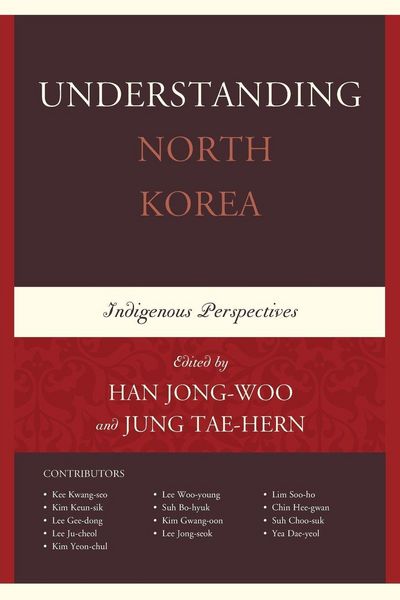
Understanding North Korea Indigenous Perspectives
-
- Hardcover
- Taschenbuch ausgewählt
- eBook
-
Sprache:Englisch
Fr. 98.90
inkl. gesetzl. MwSt.,
Beschreibung
Produktdetails
Einband
Taschenbuch
Erscheinungsdatum
25.08.2015
Abbildungen
13 BW Illustrations, 15 BW Photos, 23 Tables
Herausgeber
Han Jongwoo + weitereVerlag
Ingram Publishers ServicesSeitenzahl
428
Maße (L/B/H)
22.9/15.2/2.5 cm
Gewicht
658 g
Sprache
Englisch
ISBN
978-1-4985-2109-3
Why does North Korea want to possess nuclear capabilities? In order to find the answer to this question, we must have an accurate understanding of the history and structure of the North Korean regime. So far, we have only formed conjectures and predictions regarding North Korea based on our own perspectives; we now need to deal with and consider North Korea "as is" to reach viable solutions to the issues North Korea presents. This volume contains analyses of the most salient, critical issues pertinent to understanding the North Korean regime, penned by representative Korean scholars of North Korea. As such, the book examines the historical formation of North Korea, the identities of those power elite, and the relative stability (or instability, as the case may be) of the new regime under Kim Jong-un. Also an important aspect to consider is the possibility of socio-economic change in North Korea. Though North Korea has remained relatively static vis-à-vis its political and military systems, it is in the process of becoming rapidly marketized, having continued various attempts to modify its economic policy. In the social realm, said economic shift has elicited the polarization of the disparate classes and the expansion of individualism. Such social transformations, obscured by the easily visible political reality of North Korea, can provide solid grounds for determining the future of the North Korea regime. Moreover, it is imperative that we accurately understand the motivation behind North Korea's intention to develop nuclear weapons-namely, the expansion of deterrence. We must recognize the reasons for the North Korean hostility toward the United States from the very beginning of the DPRK formation and the North Korean fixation on nuclear weapons development. Further, we need to understand the nature of relations between China and North Korea-relations on which the international community has focused since North Korea began its nuclear testing-as well as the history and structure of relations between North and South Korea. Only when we accurately understand North Korea can we reach solutions to the North Korean nuclear issue. The studies in this volume by Korean scholars will reveal the veiled background of the visible phenomena and thereby help the readers to correctly understand the North Korean behaviors hitherto misunderstood (or even those that were impossible to understand).
Noch keine Bewertungen vorhanden
Verfassen Sie die erste Bewertung zu diesem Artikel
Helfen Sie anderen Kundinnen und Kunden durch Ihre Meinung.