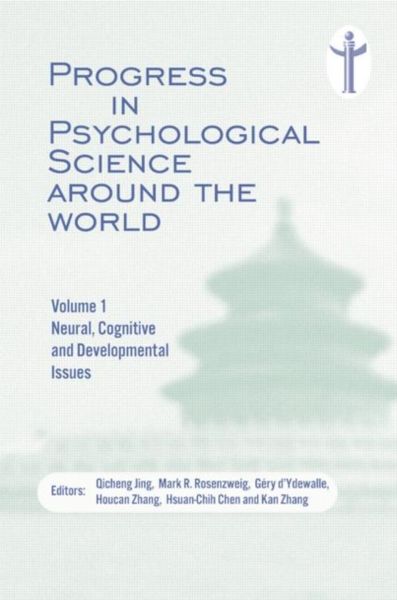
Produktbild: Progress in Psychological Science Around the World

Progress in Psychological Science Around the World Proceedings of the 28th International Congress of Psychology

Fr. 98.90

inkl. gesetzl. MwSt., Versandkostenfrei


Beschreibung

Produktdetails

Einband

Taschenbuch

Erscheinungsdatum

25.06.2015

Herausgeber

Jing Qicheng + weitere

Verlag

Taylor & Francis

Seitenzahl

584

Maße (L/B)

23.4/15.6 cm

Gewicht

1080 g

Sprache

Englisch

ISBN

978-1-138-88331-4

Beschreibung

Produktdetails

Einband

Taschenbuch

Erscheinungsdatum

25.06.2015

Herausgeber

Verlag

Taylor & Francis

Seitenzahl

584

Maße (L/B)

23.4/15.6 cm

Gewicht

1080 g

Sprache

Englisch

ISBN

978-1-138-88331-4

Kundinnen und Kunden meinen

0 Bewertungen

Informationen zu Bewertungen

Zur Abgabe einer Bewertung ist eine Anmeldung im Konto notwendig. Die Authentizität der Bewertungen wird von uns nicht überprüft. Wir behalten uns vor, Bewertungstexte, die unseren Richtlinien widersprechen, entsprechend zu kürzen oder zu löschen.

Die Bewertungen sind nach Format, Anzahl Sterne und Datum sortiert.

Verfassen Sie die erste Bewertung zu diesem Artikel

Helfen Sie anderen Kund*innen durch Ihre Meinung

Kundinnen und Kunden meinen

0 Bewertungen filtern

Die Leseprobe wird geladen.
  • Produktbild: Progress in Psychological Science Around the World
  • Nobel Laureate Address. D. Kahneman, A perspective on judgment and choice: Mapping bounded rationality. Presidential Address. M. Denis, Psychological science in its multidisciplinary environment. Section 1. Learning, Memory, and Motivation. C.R. Gallistel, The nature of learning and the functional architecture of the brain. M. Domjan, Ecological and functional perspectives on Pavlovian conditioning. M. Jitsumori, Categorization and concept formation in pigeons: A perspective on comparative cognition. L. Nilsson, C.M. de Frias, The effect of genetics and vascular health on memory functioning: The Betula study. H.J. Markowitsch, Memory and memory disorders: Neuroimaging correlates of organic brain damage and psychic disturbances. P.M. Gollwitzer, Successful goal pursuit. Section 2. Cognitive Neuroscience. L. Nyberg, Imaging cognition: Recent developments and a tentative hierarchical cognitive model. M.C. Corballis, The divided brain. S.M. Kosslyn, G. Ganis,W.L. Thompson, Mental imagery and the human brain. G.W. Humphreys, Objects, actions and affordance: The cognitive neuroscience of action selection. T. Shallice, The fractionation of executive functions. T. Bachmann, A single metatheoretical framework for a number of conscious-vision phenomena. Section 3. Attention, Emotion, and Language. Anne Treisman, How the deployment of attention determines what we see. C. Bundesen, T. Habekost, Models of attention. A. Öhman, Automatic processes in emotion: Capture of attention and emotion activation. K. C. Liang, Neural circuitry involved in avoidance learning and memory: The amygdala and beyond. W.H.R. Miltner, T. Straube, T. Weiss, Neural foundations of threat processing in phobic subjects. P. De Boeck, D. Smits, A double-structure structural equation model for the study of emotions and their components. H. Chen, Language processing: Implications from the study of Chinese. J. Rönnberg, Cognitive and neuroscience perspectives on speech and sign processing: Evidence from persons with deafness, hearing impairment, and normal hearing. A. Cleeremans, Conscious and unconscious cognition: A graded, dynamic perspective. Section 4. Life-Span Developmental Psychology. P. Lemaire, Cognitive aging: Some recent developments. D.C. Park, E.D. Leshikar, An overview of the cognitive neuroscience of aging. L. Backmann, L. Nyberg, L. Farde, Dopamine and cognitive aging: A strong relationship. A. Streri, Touch in infancy: The development of haptic abilities in very young infants. F.C. Keil, How children grasp the causal structure of the world. H.M. Wellman, Theory of mind: A core human cognition. R.K. Silbereisen, Social change and transitions to adulthood.