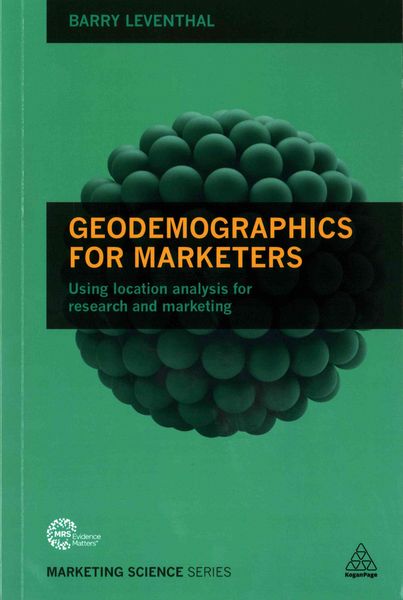
Produktbild: Geodemographics for Marketers

Geodemographics for Marketers Using Location Analysis for Research and Marketing

Fr. 59.90

inkl. gesetzl. MwSt., Versandkostenfrei


Beschreibung

Produktdetails

Einband

Taschenbuch

Erscheinungsdatum

26.01.2016

Verlag

Kogan Page

Seitenzahl

232

Maße (L/B/H)

23.4/15.6/1.3 cm

Gewicht

360 g

Sprache

Englisch

ISBN

978-0-7494-7382-2

Beschreibung

Rezension

"In this era of excitement over "big" data it is important for marketers to be able to understand the data sources available to them. Without working knowledge they can neither challenge the experts nor write an accessible, decent brief. This excellent and eminently understandable book positions Geodemographics as a partner to other "big" data streams and market segmentation techniques. It clearly and helpfully provides marketers with the information they need on this key science, and should be required reading." Jane Frost CBE, Chief Executive Officer, Market Research Society

Produktdetails

Einband

Taschenbuch

Erscheinungsdatum

26.01.2016

Verlag

Kogan Page

Seitenzahl

232

Maße (L/B/H)

23.4/15.6/1.3 cm

Gewicht

360 g

Sprache

Englisch

ISBN

978-0-7494-7382-2

Herstelleradresse

Libri GmbH
Europaallee 1
36244 Bad Hersfeld
DE

Email: gpsr@libri.de

Noch keine Bewertungen vorhanden

Verfassen Sie die erste Bewertung zu diesem Artikel

Helfen Sie anderen Kundinnen und Kunden durch Ihre Meinung.

Kundinnen und Kunden meinen

Bewertungen (0)

Die Leseprobe wird geladen.
  • Produktbild: Geodemographics for Marketers
  • Contributors' biographies
    Foreword
    Preface and acknowledgements
    List of abbreviations

    Introduction

    01 An overview of geodemographics
    Introduction
    Definitions and principles
    How neighbourhood classifications work
    Key strengths and weaknesses of geodemographics
    Origins of modern geodemographics
    Other methods of market segmentation
    Can geodemographics actually predict purchasing behaviour?
    Conclusion
    Notes

    02 Big data and geodemographics
    Introduction
    The trend towards big data
    Why geodemographics is relevant in an age of big data
    How big data and geodemographics can work together
    Conclusion

    03 Key data sources
    Introduction
    Sources required for building geodemographic discriminators
    Sources that geodemographic discriminators are linked to
    Conclusion

    04 Geodemographic classification systems
    Introduction
    What is a neighbourhood classification?
    How neighbourhood classifications are built
    Current neighbourhood classifications in the UK
    Market-specific classifications
    How classifications are updated
    Choosing a classification
    Conclusion

    05 Other types of geodemographic discriminators
    Introduction
    Census raw variables
    Derived indicators
    Fuzzy classifications
    Sub-postcode discriminators
    Conclusion
    Notes

    06 The mechanics of using geodemographics
    Introduction
    Tools and techniques
    Accessing geodemographic information
    Visual presentation of results
    Potential pitfalls and how to avoid them
    Conclusion

    07 Applications in various industry sectors
    Introduction
    General applications
    Marketing applications
    Retail applications
    Financial services applications
    Media applications
    Market research applications
    Public-sector applications
    Applications in academia
    Conclusion
    Note

    08 Choosing a geodemographic classification
    Introduction
    Steps in the selection process
    Issues in comparing geodemographic products
    Measuring discrimination
    Comparing geodemographic classifications
    Conclusion

    09 The international perspective
    Introduction
    Prerequisites for geodemographics to operate in a country
    Differences between national censuses
    Differences in small-area output geographies between countries
    International classification systems
    Obtaining international data
    Country case study-the United States
    Conclusion
    Notes

    10 Creating your own information products
    Introduction
    Why build a customized solution?
    Building a bespoke discriminator
    Small-area estimation
    Conclusion

    11 Looking to the future
    Introduction
    Likelihood of change in user demand
    Census developments
    Open data developments
    Administrative data developments
    Big data developments
    Conclusion

    Appendix A: Useful information sources
    Appendix B: The structure of a UK postcode
    References
    Index