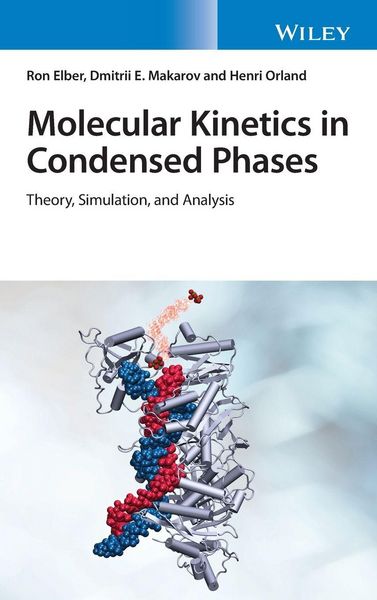
Molecular Kinetics in Condensed Phases Theory, Simulation, and Analysis
Fr. 143.00
inkl. gesetzl. MwSt.,
Beschreibung
Produktdetails
Einband
Gebundene Ausgabe
Erscheinungsdatum
18.02.2020
Verlag
John Wiley & SonsSeitenzahl
288
Maße (L/B/H)
23.3/15.6/2.2 cm
Gewicht
567 g
Auflage
1. Auflage
Sprache
Englisch
ISBN
978-1-119-17677-0
A guide to the theoretical and computational toolkits for the modern study of molecular kinetics in condensed phases
Molecular Kinetics in Condensed Phases: Theory, Simulation and Analysis puts the focus on the theory, algorithms, simulations methods and analysis of molecular kinetics in condensed phases. The authors - noted experts on the topic - offer a detailed and thorough description of modern theories and simulation methods to model molecular events. They highlight the rigorous stochastic modelling of molecular processes and the use of mathematical models to reproduce experimental observations, such as rate coefficients, mean first passage times and transition path times.
The book's exploration of simulations examines atomically detailed modelling of molecules in action and the connections of these simulations to theory and experiment. The authors also explore the applications that range from simple intuitive examples of one- and two-dimensional systems to complex solvated macromolecules. This important book:
* Offers an introduction to the topic that combines theory, simulation and analysis
* Presents a guide written by authors that are well-known and highly regarded leaders in their fields
* Contains detailed examples and explanation of how to conduct computer simulations of kinetics. A detailed study of a two-dimensional system and of a solvated peptide are discussed.
* Discusses modern developments in the field and explains their connection to the more traditional concepts in chemical dynamics
Written for students and academic researchers in the fields of chemical kinetics, chemistry, computational statistical mechanics, biophysics and computational biology, Molecular Kinetics in Condensed Phases is the authoritative guide to the theoretical and computational toolkits for the study of molecular kinetics in condensed phases.
Molecular Kinetics in Condensed Phases: Theory, Simulation and Analysis puts the focus on the theory, algorithms, simulations methods and analysis of molecular kinetics in condensed phases. The authors - noted experts on the topic - offer a detailed and thorough description of modern theories and simulation methods to model molecular events. They highlight the rigorous stochastic modelling of molecular processes and the use of mathematical models to reproduce experimental observations, such as rate coefficients, mean first passage times and transition path times.
The book's exploration of simulations examines atomically detailed modelling of molecules in action and the connections of these simulations to theory and experiment. The authors also explore the applications that range from simple intuitive examples of one- and two-dimensional systems to complex solvated macromolecules. This important book:
* Offers an introduction to the topic that combines theory, simulation and analysis
* Presents a guide written by authors that are well-known and highly regarded leaders in their fields
* Contains detailed examples and explanation of how to conduct computer simulations of kinetics. A detailed study of a two-dimensional system and of a solvated peptide are discussed.
* Discusses modern developments in the field and explains their connection to the more traditional concepts in chemical dynamics
Written for students and academic researchers in the fields of chemical kinetics, chemistry, computational statistical mechanics, biophysics and computational biology, Molecular Kinetics in Condensed Phases is the authoritative guide to the theoretical and computational toolkits for the study of molecular kinetics in condensed phases.
Kundinnen und Kunden meinen
Verfassen Sie die erste Bewertung zu diesem Artikel
Helfen Sie anderen Kund*innen durch Ihre Meinung