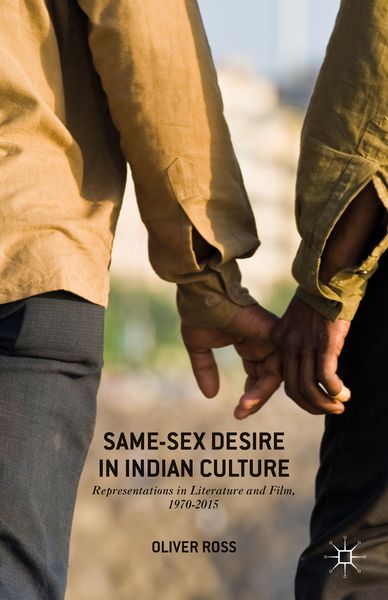
Produktbild: Same-Sex Desire in Indian Culture

Same-Sex Desire in Indian Culture Representations in Literature and Film, 1970-2015

Fr. 73.90

inkl. gesetzl. MwSt., Versandkostenfrei


Beschreibung

Produktdetails

Einband

Gebundene Ausgabe

Erscheinungsdatum

05.01.2016

Verlag

Palgrave Macmillan US

Seitenzahl

205

Maße (L/B/H)

22.2/14.5/1.7 cm

Gewicht

416 g

Auflage

1st edition 2016

Sprache

Englisch

ISBN

978-1-137-57075-8

Beschreibung

Rezension

"Oliver Ross brings fresh insight to the debates and texts he examines and undertakes some excellent exegeses of much-analyzed, as well as under-analysed texts. He bravely takes on the current received wisdom that gay identity is 'irremediably Eurocentric'; as he points out, practitioners of queer theory who propound this view exempt queer theory itself from Eurocentricity in a largely unexamined way." - Ruth Vanita, Professor of Liberal Studies, University of Montana, USA and co-editor of Same-Sex Love in India: Readings from Literature and History

Reviewer: Ruth Vanita, Professor of English, University of Montana, USA

Report on 'Same-Sex Desire and Syncretism: Same-Sex Desire in Indian Literature and Film
Outline
This book situates itself as an intervention in the debate around whether identity terms like 'gay' are inappropriate or even neo-colonial imports from the West into India, and whether indigenous terms should be discovered or coined in their place. Ross proposes the model of what he calls syncretism, arguing that Indian activists and writers eclectically use English-language terms like 'gay' along with newly coined terms like 'kothi' and that thereby the English-language terms themselves morph and indicate identities that are distinct in some ways from their Western counterparts.
Ross then proceeds to examine a number of texts and films about same-sex desire, with a view to uncovering syncretic representations of same-sex desire in them. He employs strategies of close reading as well as historical and biographical criticism in his exegeses, raising questions regarding the intersection of various identities based on religion, caste and sexuality, and enquiring whether or not the representation of same-sex desire is imbricated with anxiety about the author's own identity or the reception of the work.
Strengths
Ross examines English-language texts on which many young scholars round the world have written and continue to write, and he thus covers well-trodden ground, such as Fire and the writings of Vikram Seth, Raj Rao and Kamala Das,. However, he does bring fresh insight to the debates and texts he examines. This is primarily because he is more skilled at close reading than most queer theorists. The book contains some good analyses of much-analysed texts such as Fire as well as of recent and less-analysed texts such as Neel Mukherjee's A Life Apart. Thus, Ross manages to balance appreciation for the intervention accomplished by Fire with a judicious assessment of its simplistic portrayal of Hindu thought, texts and practices. Likewise, he performs a good close reading I have seen of the Feroze-Maan relationship in Vikram Seth's A Suitable Boy (though somewhat marred by inaccurate comments on Lucknow's culture and the ghazal) and a thoughtful exegesis of The Sandal Trees.
Ross's main innovation is his challenge to the current received wisdom among queer theorists that gay identity is 'irremediably Eurocentric' (8); as he points out with understated irony, practitioners of queer theory who propound this view exempt queer theory itself from Eurocentricity in a largely unexamined way (p. 8). He also challenges the assertions of non-academic commentators like Jeremy Seabrook and Shivananda Khan that the deployment of terms like 'gay' by Indians is neo-colonial and retrograde. His model of syncretism is sensible and well articulated.
The book is clearly organized. Ross writes with an awareness of multiple contexts and hybridities. I list factual errors and over-readings in the Appendix.
Ross is capable of elegant writing; unfortunately, he muddies it with jargon of this kind: 'There emerges a diachronic approach to irruptive moments in Indian history and their syncretic overlapping with contemporary homosexual subjectivity and existence, but ambivalence predominates' (164).
Weaknesses
It is very important that the title of this book be changed. It performs the same hubristic move as Rushdie's infamous anthol

Produktdetails

Einband

Gebundene Ausgabe

Erscheinungsdatum

05.01.2016

Verlag

Palgrave Macmillan US

Seitenzahl

205

Maße (L/B/H)

22.2/14.5/1.7 cm

Gewicht

416 g

Auflage

1st edition 2016

Sprache

Englisch

ISBN

978-1-137-57075-8

Herstelleradresse

Palgrave Macmillan
Tiergartenstr. 17
69121 Heidelberg
DE

Email: ProductSafety@springernature.com

Kundinnen und Kunden meinen

0 Bewertungen

Informationen zu Bewertungen

Zur Abgabe einer Bewertung ist eine Anmeldung im Konto notwendig. Die Authentizität der Bewertungen wird von uns nicht überprüft. Wir behalten uns vor, Bewertungstexte, die unseren Richtlinien widersprechen, entsprechend zu kürzen oder zu löschen.

Die Bewertungen sind nach Format, Anzahl Sterne und Datum sortiert.

Verfassen Sie die erste Bewertung zu diesem Artikel

Helfen Sie anderen Kund*innen durch Ihre Meinung

Kundinnen und Kunden meinen

0 Bewertungen filtern

  • Produktbild: Same-Sex Desire in Indian Culture
  • Introduction

    1. Contradictions or Syncretism? The Politics of Female-Female Desire in Deepa Mehta's Fire and Ligy J. Pullappally's Sancharram (The Journey)

    2. "Am I Lesbian?" The Contexts of Female-Female Desire in the Work of Kamala Das

    3. "The Bliss I Could Portray": Elliptical and Declamatory Male-Male Desire in the Work of Vikram Seth

    4. Communal Tensions: Homosexuality in Raj Rao's The Boyfriend and Neel Mukherjee's A Life Apart

    5. Transitional Mediations: Homosexuality in My Brother Nikhil, 68 Pages, and Quest/Thaang

    Conclusion