Gutscheinbedingungen

*Gültig bis 21.06.2026 auf (fast) alles. Ausgeschlossen sind Smartboxen, Zeitschriften, Tickets, Lebensmittel, Gaming-Elektroartikel, Tinte/Toner, Gutscheine, Geschenkkarten, Blumen und Abos | Einlösbar in allen Buchhandlungen von Orell Füssli, Barth Bücher, Buchladen Rapunzel, Schuler Orell Füssli, Stauffacher und ZAP unter Vorweisung des Gutscheins, auf www.orellfüssli.ch durch Eingabe des Gutscheincodes. Beim Service „eBooks verschenken“ und bei eBook-Käufen via eReader nicht einlösbar | Mindesteinkaufswert: Fr. 30.- | Nicht mit anderen Rabatten kumulierbar.

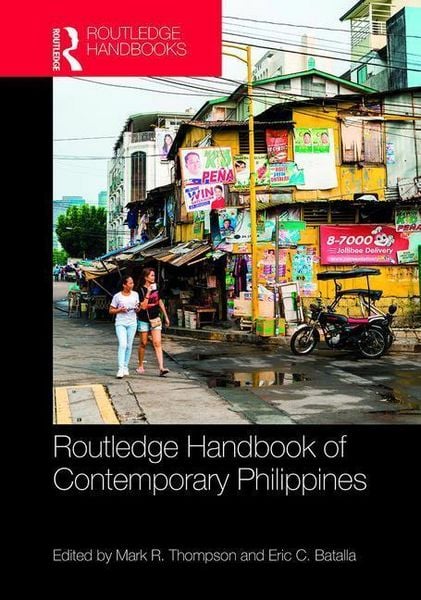
Produktbild: Routledge Handbook of the Contemporary Philippines

Routledge Handbook of the Contemporary Philippines

Fr. 373.00

inkl. gesetzl. MwSt., Versandkostenfrei


Beschreibung

Produktdetails

Einband

Gebundene Ausgabe

Erscheinungsdatum

05.03.2018

Abbildungen

9 Line drawings, black and white 53 Tables, black and white 9 Illustrations, black and white

Herausgeber

Mark Thompson + weitere

Verlag

Taylor & Francis

Seitenzahl

492

Maße (L/B/H)

25.2/18/3.5 cm

Gewicht

1050 g

Sprache

Englisch

ISBN

978-1-138-89234-7

Beschreibung

Rezension

"The book allows readers to enjoy a compilation of chapters written by scholars who have shaped the discourse of Philippine politics, economics, and civil society. Those who come from the complementary fields of history, economics, and sociology should consider this handbook as a good resource. The book provides useful material for understanding the persistence of political, social, and economic problems in the country. For those engaged in Southeast Asian studies, this volume is beneficial when thinking about the suitability of comparing cases in the region. The authors are scholars who have a deep knowledge in the study of the Philippines and have done comparative work as well. Covering domestic politics, foreign relations, economics and social policy, cultures, and movements the book delivers on its promise to look in to the contemporary challenges of the Philippines and its "troubled transition to democracy." There is no doubt that the handbook serves as an excellent volume for Political Science students and academics." Cleo Calimbahin, Philippine Political Science Journal 40 (2019)

"The Handbook proves itself a useful guide in chartering the situation of contemporary Philippine society, from the post-edsa period to the present. [...] The Handbook likewise provides an essential interdisciplinary guide for students, scholars and policymakers alike into the most central themes that have impact on Philippine society. [... ] The book forwards a comprehensive overview of contemporary Philippines' domestic politics, foreign policy, economic and livelihood concerns, the cultural factors shaping its traditions in the modern period, and the social movements which changed the course of the country's history." Maria Veronica M. Manalo, Philippine Political Science Journal 40 (2019)

Produktdetails

Einband

Gebundene Ausgabe

Erscheinungsdatum

05.03.2018

Abbildungen

9 Line drawings, black and white 53 Tables, black and white 9 Illustrations, black and white

Herausgeber

Verlag

Taylor & Francis

Seitenzahl

492

Maße (L/B/H)

25.2/18/3.5 cm

Gewicht

1050 g

Sprache

Englisch

ISBN

978-1-138-89234-7

Kundinnen und Kunden meinen

0 Bewertungen

Informationen zu Bewertungen

Zur Abgabe einer Bewertung ist eine Anmeldung im Konto notwendig. Die Authentizität der Bewertungen wird von uns nicht überprüft. Wir behalten uns vor, Bewertungstexte, die unseren Richtlinien widersprechen, entsprechend zu kürzen oder zu löschen.

Die Bewertungen sind nach Format, Anzahl Sterne und Datum sortiert.

Verfassen Sie die erste Bewertung zu diesem Artikel

Helfen Sie anderen Kund*innen durch Ihre Meinung

Kundinnen und Kunden meinen

0 Bewertungen filtern

Die Leseprobe wird geladen.
  • Produktbild: Routledge Handbook of the Contemporary Philippines
  • Introduction Part I: Domestic Politics 1. Clientelism Revisited, Masataka Kimura 2. Patrons, Bosses, Dynasties, and Reformers in Local Politics, John T. Sidel 3. The Party Political System, Allen Hicken 4. Combating Corruption, Jon S. T. Quah 5. The Civil Service: Weaknesses and Constructive Informal Practices, Rupert Hodder 6. House of Clans: Political Dynasties in the Legislature, Julio C. Teehankee 7. Pork Transmogrified: The Unending Story of Particularistic Spending, Ronald D. Holmes 8. Congress: Separate but not Equal, Diana J. Mendoza and Mark R. Thompson 9. The Presidency: a Relational Approach, Mark R. Thompson 10. The Judiciary under Threat, Eric Vincent C. Batalla, Michelle Sta. Romana, and Karen Rodrigo 11. Civil-Military Relations: Norming and Departures, Rosalie Arcala Hall

    Part II: Foreign Relations 12. Foreign Relations between the Philippines and the United States, Howard Loewen 13. From Antagonistic to Close Neighbor: Twenty-first Century Philippine-China Relations, Renato Cruz de Castro 14. Towards Strategic Partnership: Philippines-Japan Relations after Seventy Years, Dennis D. Trinidad 15. Diaspora Diplomacy, Joaquin Jay Gonzalez III

    Part III: Economics and social policy 16. Bypassing Industrial Development, Eric Vincent C. Batalla 17. Capital Flight, Edsel L. Beja Jr. 18. The Changing Configuration of Capitalism, Antoinette R. Raquiza 19. Economic Nationalism and its Legacy, Yusuke Takagi 20. Technocracy and Class Politics in Policy-Making, Teresa S. Encarnacion Tadem 21. The Allure of Pantawid Pamilya: The Conditional Cash Transfer Program, Ma. Victoria R. Raquiza 22. Informality and Legality in Women’s Livelihoods in Baguio City, B. Lynne Milgram 23. Persistent Poverty and Elite-dominated Policymaking, David G. Timberman 24. From Pamilya to Grasya: Microfinance, Asuncion Sebastian

    Part IV: Cultures and Movements 25. A Syncretic Culture, Paul A. Rodell 26. Gender, Nation and Filipino Catholicism past and present, Coeli Barry 27. Between Rights Protection and Development Aggression: Indigenous Peoples, Oona Paredes 28. The Resilience of the Peasantry, Eduardo C. Tadem 29. The Middle Class in Society and Politics, Temario C. Rivera 30. NGOs in the post-Marcos Era, Gerard Clarke 31. Crossovers Double-Crossed: NGOs, Semi-Clientelism, and Political Reform, Ben Reid 32. The Left: Struggling to Make a Comeback, Nathan Quimpo 33. Trade Unions: "Free" but Weak, Carmel Veloso Abao 34. The Women’s Movement: Policy Issues, Influence and Constraints, Diana Mendoza 35. Bangsamoro Secessionism, Rizal G. Buendia 36. Moro Insurgency and Third Party Mediation, Bruce E. Barnes 37. The Problem with the National(ist) Method, Patricio N. Abinales