Gutscheinbedingungen

*Gültig bis 05.07.2026 auf (fast) alles. Ausgeschlossen sind Smartboxen, Zeitschriften, Tickets, Lebensmittel, Gaming-Elektroartikel, Tinte/Toner, Gutscheine, Geschenkkarten, Blumen und Abos | Einlösbar in allen Buchhandlungen von Orell Füssli, Barth Bücher, Buchladen Rapunzel, Papeterie Köhler, Schuler Orell Füssli, Stauffacher und ZAP unter Vorweisung des Gutscheins, auf www.orellfüssli.ch durch Eingabe des Gutscheincodes. Beim Service „eBooks verschenken“ und bei eBook-Käufen via eReader nicht einlösbar | Mindesteinkaufswert: Fr. 30.- | Nicht mit anderen Rabatten kumulierbar.

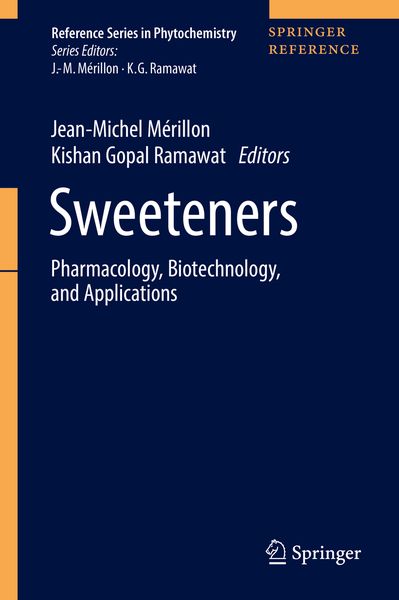
Produktbild: Sweeteners

Sweeteners Pharmacology, Biotechnology, and Applications

Fr. 420.00

inkl. gesetzl. MwSt., Versandkostenfrei


Beschreibung

Produktdetails

Einband

Gebundene Ausgabe

Erscheinungsdatum

30.01.2018

Abbildungen

XVII, 108 illus., 74 illus. in color., farbige Illustrationen, schwarz-weiss Illustrationen

Herausgeber

Jean-Michel Mérillon + weitere

Verlag

Springer

Seitenzahl

657

Maße (L/B/H)

24.1/16/4 cm

Gewicht

1234 g

Auflage

1st ed. 2018

Sprache

Englisch

ISBN

978-3-319-27026-5

Beschreibung

Portrait

Professeur Dr. Jean-Michel Merillon is the « Directeur de l’EA 3675 (Groupe d’Etude des Substances Vegetales à Activité Biologique + Polyphenols Biotech) », at the Faculte de Pharmacie, Universite de Bordeaux, Institut des Sciences de la Vigne et du Vin, in Villenave d’Ornon, France. He received his M.Pharma. (1979) and Ph.D. (1984) from the University of Tours in France. He joined the University of Tours as assistant professor in 1981, became associate professor in 1987. In 1993 he moved to the faculty of Pharmacy, University of Bordeaux, France, accepting a position as full professor. He is currently leading the “study group on biologically active plant substances” at the Institute of Vine and Wine Sciences, which comprises 25 scientists and research students. The group has been working on phenolic compounds from vine and wine for many years, mainly complex stilbenes and their involvement in health. Prof. Mérillon has supervised the doctoral theses of 19 students. He is involvedin developing teaching on plant biology, natural bioactive compounds and biotechnology.  Prof. Mérillon has published more than 145 research papers in internationally recognized journals, resulting in an H index of 35 (documents published between 1996 and 2015). He has co-edited books and reference works on secondary metabolites and biotechnology. Throughout his career, Prof. Mérillon has traveled widely as a senior professor. Scientists from several countries have been and are working in his laboratory, and his research is supported by funding from the Aquitaine Regional Government, the Ministry of Higher Education and Research, and various private companies. In 2004, he founded the technology transfer unit “Polyphenols Biotech”, providing support for R&D programs for SMEs and major groups from the cosmetic, pharmaceutical, agricultural and health-nutrition sectors. Prof. Dr. Kishan G. Ramawat is Former Professor & Head of the Botany Department, M.L. Sukhadia University, Udaipur, India, and can look back on longstanding research experience. He received his Ph.D. in Plant Biotechnology in 1978 from the University of Jodhpur, India and afterwards joined the university as a faculty member. In 1991 he moved to the M.L.Sukhadia University in Udaipur as Associate Professor and became Professor in 2001. He served as the Head of the Department of Botany (2001-2004, 2010-2012), was in charge of the Department of Biotechnology (2003-2004), was a member of the task force on medicinal and aromatic plants of the Department of Biotechnology, Government of India, New Delhi (2002-2005) and coordinated UGC-DRS and DST-FIST programmes (2002-2012). Prof. Ramawat had done his postdoctoral studies at the University of Tours, France from 1983-85, and later returned to Tours as visiting professor (1991). He also visited the University of Bordeaux 2, France several times as visiting professor (1995, 1999, 2003, 2006, 2010), and in 2005 Poland in an academic exchange programme (2005). Through these visits in France, Prof. Ramawat and Prof. Mérillon established a strong connection, which has resulted in productive collaborations and several book and reference work publications. Prof. Ramawat has published more than 170 well cited peer reviewed papers and articles, and edited several books and reference works on topics such as the biotechnology of medicinal plants, secondary metabolites, bioactive molecules, herbal drugs, and many other topics. His research was funded by several funding agencies. In his research group, Prof. Ramawat has supervised doctoral thesis of 25 students. He is an active member of several academic bodies, associations and editorial boards of journals.

Produktdetails

Einband

Gebundene Ausgabe

Erscheinungsdatum

30.01.2018

Abbildungen

XVII, 108 illus., 74 illus. in color., farbige Illustrationen, schwarz-weiss Illustrationen

Herausgeber

Verlag

Springer

Seitenzahl

657

Maße (L/B/H)

24.1/16/4 cm

Gewicht

1234 g

Auflage

1st ed. 2018

Sprache

Englisch

ISBN

978-3-319-27026-5

Herstelleradresse

Springer-Verlag KG
Sachsenplatz 4-6
1201 Wien
AT

Email: GPSR Kontakt

Noch keine Bewertungen vorhanden

Verfassen Sie die erste Bewertung zu diesem Artikel

Helfen Sie anderen Kundinnen und Kunden durch Ihre Meinung.

Kundinnen und Kunden meinen

Bewertungen (0)

  • Produktbild: Sweeteners
  • Part I Sweeteners – introduction and general aspects: Artificial sweeteners.- Non-Caloric Sweeteners, Sweetness Modulators, and Sweetener Enhancers.- Characterization of artificial sweeteners using raman spectroscopy.- HPLC-MS/MS analysis of nine artificial sweeteners.- Non-Nutritive sweeteners and their role in the gastrointestinal tract.- Biotechnological production of natural zero-calorie sweeteners.- Sweeteners/sweet proteins from plants.- Sweeteners: regulatory aspects.- Part II Stevioside: Production and physicochemical assessment of new stevia amino acid sweeteners from the natural stevioside.- Analysing major steviol glycosides from Stevia rebaudiana leaves.- Effect of a natural sweetener (steviol glycoside) on cardiovascular risk factors.- Stevia rebaudiana antioxidant activities and cellular properties.- Somatic Embryogenesis of Stevia rebaudiana.- Stevia rebaudiana: optimal culture conditions.- Part III Sucralose: Sucralose and the metabolic response.- Sucralose – An ecotoxicological challenger?.- Analytical methodologies for the detection of sucralose.- Is sucralose too good to be true?.- Potential use of isomaltulose to healthier candies.- Part IV Mogrosides: Biosynthesis of mogrosides.- Bioactivities of mogrosides.- Biotransformation of mogrosides.- Phytochemical and pharmacological aspects of mogrosides.- Methods of isolation, purification of mogrosides from Siraitia grosvenorii.- Part V Glycyrrhizin: Biological and pharmacological activities of Glycyrrhizin.- Production of glycyrrhizae radix.- Production of glycyrrhetic acid 3-O-mono-β-d-glucuronide by whole-cell biocatalysis.- Part VI Brazzein: Brazzein: A Natural Sweetener.- Designing brazzein by mutations.- Brazzein from the Yeast, Pichia pastoris.-Brazzein from Lactobacillus.-Part V Aspartame: Aspartame and pharmacological effects.- Neurobehavioral Effects of Aspartame Consumption.- Aspartame and oxidative stress.-Part VII Thaumatin: The sweet-tasting protein thaumatin: Physical and chemical properties.- Plant thaumatin-like proteins.- Transgenic plants as supersweet protein thaumatin II producers.- Part VIII Mabinlin, Monatin, and Monellin: Recombinant expressions of sweet plant protein mabinlin II.- R,R-Monatin, a Naturally Occurring High-Potency Sweetener.- Monellin.- Monellin from transgenes.- Improving flavour and quality of fruits by monellin expression.