Gutscheinbedingungen

*Gültig bis 20.07.2026 auf alle Bücher. Ausgeschlossen sind Zeitschriften, Prozentbücher und Abos | Einlösbar in allen Buchhandlungen von Orell Füssli, Barth Bücher, Buchladen Rapunzel, Papeterie Köhler, Schuler Orell Füssli, Stauffacher und ZAP unter Vorweisung des Gutscheins, auf www.orellfüssli.ch durch Eingabe des Gutscheincodes. Beim Service „eBooks verschenken“ und bei eBook-Käufen via eReader nicht einlösbar | Mindesteinkaufswert: Fr. 30.- | Nicht mit anderen Rabatten kumulierbar.

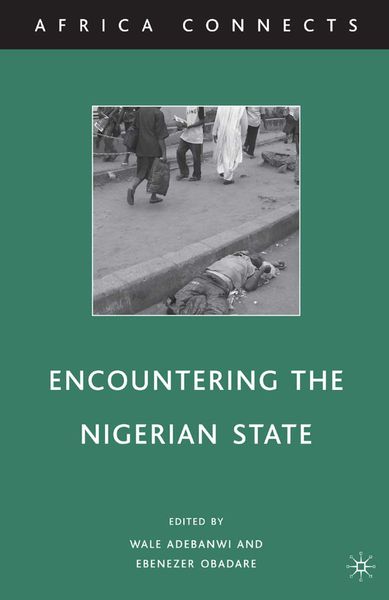
  • Produktbild: Encountering the Nigerian State
  • Produktbild: Encountering the Nigerian State

Encountering the Nigerian State

Aus der Reihe Africa Connects

Fr. 73.90

inkl. gesetzl. MwSt., Versandkostenfrei


Beschreibung

Produktdetails

Einband

Taschenbuch

Erscheinungsdatum

18.08.2010

Herausgeber

W. Adebanwi + weitere

Verlag

Palgrave Macmillan US

Seitenzahl

269

Maße (L/B/H)

21.6/14/1.6 cm

Gewicht

361 g

Auflage

1st ed. 2010

Sprache

Englisch

ISBN

978-1-349-38403-7

Beschreibung

Rezension

"Those looking for standard versions of nascent democratization, the weak or failing state, familiar models of state-society relations, or the liberating and liberalizing effects of civil society should look away! Imaginative, erudite, and thought-provoking, this is the sort of sustained engagement with the space between state and citizens that the study of Nigeria has been crying out for." - David Pratten, Director, African Studies Centre, Oxford University


"How do those who inhabit the often conflicted, turbulent, and chaotic worlds of postcolonial Africa apprehend those, inside and outside of the state, who exercise power to the point of excess or violence? Why has the Nigerian state in particular, occupying such a crucial space in the lives of all Nigerians, seemingly lost its restorative and redemptive powers for the Nigerian masses and middle classes? In their magisterial collection of essays, Adebanwi and Obadare offer some provocative, exciting and often counter-intuitive answers to these and other questions. Here is a book to savor, one which takes the notion of Nigerian lifeworlds very seriously whether in the slumworld of Maroko or on city streets with student protestors. At a moment (once again) when the future of Nigeria seems in question, here is a pathbreaking and foundational collection of essays by a posse of first rate intellectuals and scholars who have much to say about what that future might hold. A tour de force." - Michael Watts, Class of 63 Professor, University of California, Berkeley

Produktdetails

Einband

Taschenbuch

Erscheinungsdatum

18.08.2010

Herausgeber

Verlag

Palgrave Macmillan US

Seitenzahl

269

Maße (L/B/H)

21.6/14/1.6 cm

Gewicht

361 g

Auflage

1st ed. 2010

Sprache

Englisch

ISBN

978-1-349-38403-7

Herstelleradresse

Palgrave Macmillan
Tiergartenstr. 17
69121 Heidelberg
DE

Email: ProductSafety@springernature.com

Noch keine Bewertungen vorhanden

Verfassen Sie die erste Bewertung zu diesem Artikel

Helfen Sie anderen Kundinnen und Kunden durch Ihre Meinung.

Kundinnen und Kunden meinen

Bewertungen (0)

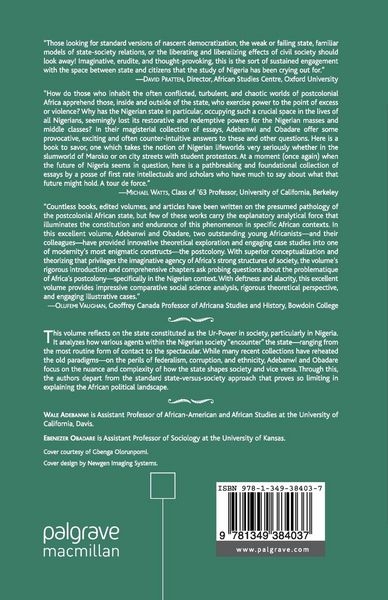
  • Produktbild: Encountering the Nigerian State
  • Produktbild: Encountering the Nigerian State
  • Excess and Abjection in the Study of the African State; E.Obadare & W.Adebanwi Deconstructing 'Oluwole': Political Economy at the Margins of the State; O.Ismail The Spatial Economy of Abjection: The Evacuation of Maroko Slum in Nigeria; S.Folarin 'Rotten English': Excremental Politics and Literary Witnessing; S.L.Lincoln The Perils of Protest: State Repression and Student Mobilization in Nigeria; B.Akintola Vocalizing Rage: Deconstructing the Language of Anti-State Forces; A.Olusola Olaniyan The Subaltern Encounters the State: OPC-State Relations 1999-2003; O.Olarinmoye The State as Undertaker: Power and Insurgent Media in Nigeria; A.Olukotun From Corporatist Power to Abjection: Labour and State Control in Nigeria; E.Remi Aiyede When the State Kills: Political Assassinations in Abacha's Nigeria; I.Olawale Albert The Sharia Challenge: Revisiting the Travails of the Secular State; R.Suberu Koma: A Glimpse of Life at the Edges of the State; M.Kabir Isa References