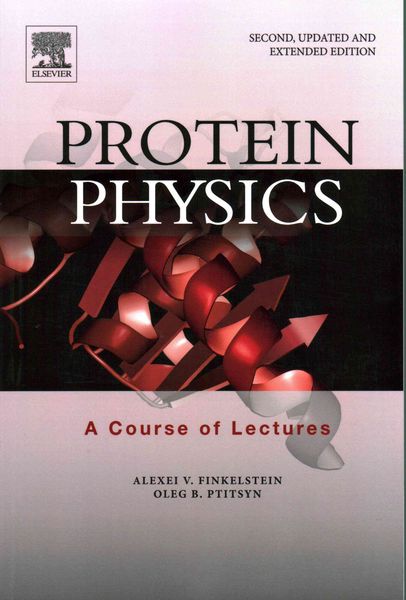
Finkelstein, A: Protein Physics A Course of Lectures
-
- Hardcover
- Taschenbuch ausgewählt
- eBook
-
Sprache:Englisch
Fr. 149.00
inkl. gesetzl. MwSt.,
Beschreibung
Produktdetails
Einband
Taschenbuch
Erscheinungsdatum
27.06.2016
Abbildungen
colour illustrations
Verlag
Elsevier Science & TechnologySeitenzahl
528
Maße (L/B/H)
22.8/15.4/3.2 cm
Gewicht
1080 g
Auflage
2. Auflage
Sprache
Englisch
ISBN
978-0-12-809676-5
Protein Physics: A Course of Lectures covers the most general problems of protein structure, folding and function. It describes key experimental facts and introduces concepts and theories, dealing with fibrous, membrane, and water-soluble globular proteins, in both their native and denatured states.
The book systematically summarizes and presents the results of several decades of worldwide fundamental research on protein physics, structure, and folding, describing many physical models that help readers make estimates and predictions of physical processes that occur in proteins.
New to this revised edition is the inclusion of novel information on amyloid aggregation, natively disordered proteins, protein folding in vivo, protein motors, misfolding, chameleon proteins, advances in protein engineering & design, and advances in the modeling of protein folding.
Further, the book provides problems with solutions, many new and updated references, and physical and mathematical appendices. In addition, new figures (including stereo drawings, with a special appendix showing how to use them) are added, making this an ideal resource for graduate and advanced undergraduate students and researchers in academia in the fields of biophysics, physics, biochemistry, biologists, biotechnology, and chemistry.
Noch keine Bewertungen vorhanden
Verfassen Sie die erste Bewertung zu diesem Artikel
Helfen Sie anderen Kundinnen und Kunden durch Ihre Meinung.