Gutscheinbedingungen

*Gültig bis 21.06.2026 auf (fast) alles. Ausgeschlossen sind Smartboxen, Zeitschriften, Tickets, Lebensmittel, Gaming-Elektroartikel, Tinte/Toner, Gutscheine, Geschenkkarten, Blumen und Abos | Einlösbar in allen Buchhandlungen von Orell Füssli, Barth Bücher, Buchladen Rapunzel, Schuler Orell Füssli, Stauffacher und ZAP unter Vorweisung des Gutscheins, auf www.orellfüssli.ch durch Eingabe des Gutscheincodes. Beim Service „eBooks verschenken“ und bei eBook-Käufen via eReader nicht einlösbar | Mindesteinkaufswert: Fr. 30.- | Nicht mit anderen Rabatten kumulierbar.

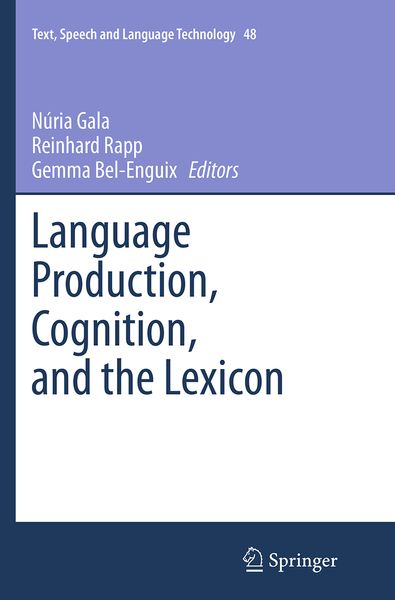
  • Produktbild: Language Production, Cognition, and the Lexicon
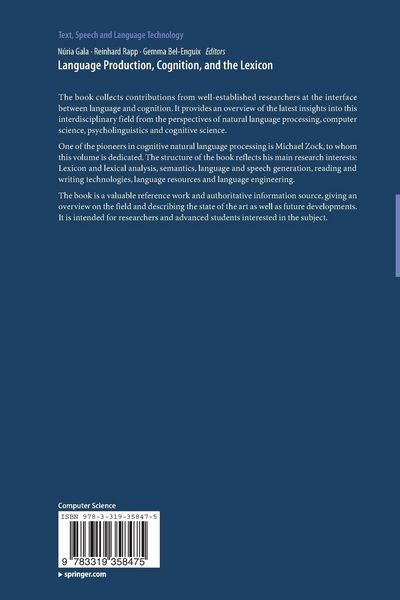
  • Produktbild: Language Production, Cognition, and the Lexicon
Band 48

Language Production, Cognition, and the Lexicon

Fr. 138.00

inkl. gesetzl. MwSt., Versandkostenfrei


Beschreibung

Produktdetails

Einband

Taschenbuch

Erscheinungsdatum

22.09.2016

Abbildungen

XI, 140 illus., schwarz-weiss Illustrationen

Herausgeber

Núria Gala + weitere

Verlag

Springer

Seitenzahl

586

Maße (L/B/H)

23.5/15.5/3.3 cm

Gewicht

896 g

Auflage

Softcover reprint of the original 1st edition 2015

Sprache

Englisch

ISBN

978-3-319-35847-5

Beschreibung

Portrait

Núria Gala. PhD in computational linguistics at Paris Sud University. She worked as a research engineer at Xerox Research Center in Grenoble before being appointed as an Assistant Professor at Aix Marseille University (2004). She currently works with the natural language processing team at LIF (Computer Science Laboratory). Her main research interests on natural language processing focus on the lexicon, building lexical resources and automatic simplification.

Reinhard Rapp, PhD, Marie Curie Fellow at Aix-Marseille University. He previously worked at various institutions in Germany, Switzerland, Australia, Spain, Canada, and England. His research interests are in computational linguistics and cognitive science. His about 140 publications (among them 20 books and proceedings) deal with topics such as machine translation, dictionary extraction from parallel and comparable corpora, statistical language learning, text mining, word sense disambiguation, and thesaurus construction. He has been involved in 15 (mostly international) projects, regularly serves as a reviewer for journals and scientific meetings, and co-organized 14 international conferences, symposia and workshops.

Gemma Bel Enguix. PhD in linguistics at the Rovira i Virgili University (Tarragona). She has been a postdoctoral fellow at Georgetown (Washington, DC) and Milano-Bicocca, and has held a Ramon y Cajal research position in Tarragona. Currently, she is working as a Marie Curie Researcher at LIF at Aix-Marseille Université.

Produktdetails

Einband

Taschenbuch

Erscheinungsdatum

22.09.2016

Abbildungen

XI, 140 illus., schwarz-weiss Illustrationen

Herausgeber

Verlag

Springer

Seitenzahl

586

Maße (L/B/H)

23.5/15.5/3.3 cm

Gewicht

896 g

Auflage

Softcover reprint of the original 1st edition 2015

Sprache

Englisch

ISBN

978-3-319-35847-5

Herstelleradresse

Springer-Verlag GmbH
Tiergartenstr. 17
69121 Heidelberg
DE

Email: ProductSafety@springernature.com

Kundinnen und Kunden meinen

0 Bewertungen

Informationen zu Bewertungen

Zur Abgabe einer Bewertung ist eine Anmeldung im Konto notwendig. Die Authentizität der Bewertungen wird von uns nicht überprüft. Wir behalten uns vor, Bewertungstexte, die unseren Richtlinien widersprechen, entsprechend zu kürzen oder zu löschen.

Die Bewertungen sind nach Format, Anzahl Sterne und Datum sortiert.

Verfassen Sie die erste Bewertung zu diesem Artikel

Helfen Sie anderen Kund*innen durch Ihre Meinung

Kundinnen und Kunden meinen

0 Bewertungen filtern

  • Produktbild: Language Production, Cognition, and the Lexicon
  • Produktbild: Language Production, Cognition, and the Lexicon
  • Preface. - Michael Zock: A Life of Interdisciplinary Research and International Engagement. Mark T. Maybury.- Part I.Michael Zock and Cognitive Natural Language Processing.- Towards a Cognitive Natural Language Processing Perspective. Bernadette Sharp.- Cognitive Systems as Explanatory Artificial Intelligence. Sergei Nirenburg.- Part II. Lexicon and Lexical Analysis.- Lexical Contextualism: the Abélard Syndrome. Alain Polguère.- Predicative Lexical Units in Terminology. Marie Claude L'Homme.- TOTAKI: a Help for Lexical Access on the tip-of-the-tongue Problem. Mathieu Lafourcade and Alain Joubert.- Typing Relations in Distributional Thesauri. Olivier Ferret.- Multilingual Conceptual Access to Lexicon based on Shared Orthography: An ontology-driven study of Chinese and Japanese. Chu-Ren Huang, Ya-Min Chou.- Proportional Analogy in Written Language Data. Yves Lepage.- Multilingual Projections. Pushpak Bhattacharyya.- Part III.Semantics.- Personal Semantics. Gregory Grefenstette.- Accessing Words in a Speaker’s Lexicon: Comparisons of Relatedness Measures through a Word Sense Disambiguation Task. Didier Schwab, Jérôme Goulian, Gilles Sérasset & Andon Tchechmedjiev.- Can Metaphors be Interpreted Cross-linguistically and Cross-culturally? Yorick Wilks.- Recursion and Ambiguity: a Linguistic and Computational Perspective. Rodolfo Delmonte.- Part IV.Language and Speech Analysis and Generation.- Consonants as Skeleton of Language. Statistical Evidences through Text Production. Kumiko Tanaka-Ishii.- How Natural are Artificial Languages? Rebecca Smaha & Christiane Fellbaum.- Handling Defaults and their Exceptions in Controlled Natural Language. Rolf Schwitter.- Ontology in Coq for a Guided Message Composition. Line Jakubiec-Jamet.- Bridging Gaps between Planning and Open-domain SpokenDialogues. Kristiina Jokinen.- JSREAL: A Text Realizer for Web Programming. Nicolas Daoust and Guy Lapalme.- Part V.Reading and Writing Technologies.- Simple or not, Simple… A Readability Question? Sanja Stajner, Ruslan Mitkov, Gloria Corpas Pastor.- An Approach to Improve a Language Quality of Requirements. Juyeon Kang, Patrick Saint-Dizier.- Learning from Errors. Systematic Analysis of Complex Writing Errors for Improving Writing Technology. Cerstin Mahlow.- Part VI.Language Resources and Language Engineering.- Language Matrices and the Language Resource Impact Factor. Joseph Mariani, Gil Francopoulo.- The Fips Multilingual Parser. Eric Wehrli,  Luka Nerima.- The Lexical Ontology for Romanian. Dan Tufis and Verginica Barbu-Mititelu.- Quo Vadis: A Corpus of Entities and Relations. Dan Cristea, Daniela Gîfu, Mihaela Colhon, Paul Diac, Anca Bibiri, C ă t ă lina Mărănduc, Liviu-Andreai Scutelnicu.- AusTalk and the HCS vLab: an Australian Corpus and Human Communication Science Collaboration Down Under. Dominique Estival.- Knowledge Services Innovation: When Language Engineering Marries Knowledge Engineering. Asanee Kawtrakul.