• Produktbild: Emotional Prosody Processing for Non-Native English Speakers
  • Produktbild: Emotional Prosody Processing for Non-Native English Speakers
Band 3

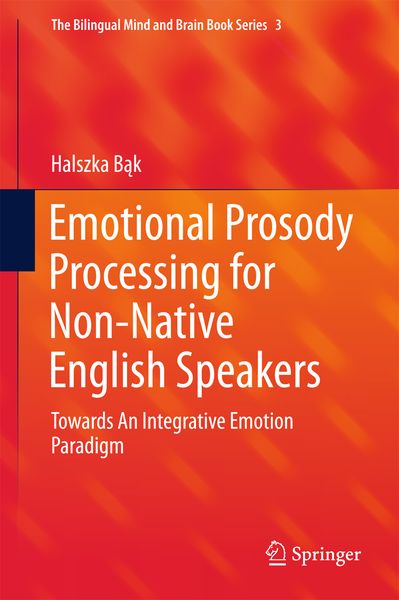
Emotional Prosody Processing for Non-Native English Speakers Towards An Integrative Emotion Paradigm

Fr. 73.90

inkl. gesetzl. MwSt., Versandkostenfrei


Beschreibung

Produktdetails

Einband

Gebundene Ausgabe

Erscheinungsdatum

09.09.2016

Abbildungen

XIX, 9 illus., schwarz-weiss Illustrationen

Verlag

Springer

Seitenzahl

197

Maße (L/B/H)

24.1/16/1.8 cm

Gewicht

500 g

Auflage

1st edition 2016

Sprache

Englisch

ISBN

978-3-319-44041-5

Beschreibung

Produktdetails

Einband

Gebundene Ausgabe

Erscheinungsdatum

09.09.2016

Abbildungen

XIX, 9 illus., schwarz-weiss Illustrationen

Verlag

Springer

Seitenzahl

197

Maße (L/B/H)

24.1/16/1.8 cm

Gewicht

500 g

Auflage

1st edition 2016

Sprache

Englisch

ISBN

978-3-319-44041-5

Herstelleradresse

Springer-Verlag KG
Sachsenplatz 4-6
1201 Wien
AT

Email: GPSR Kontakt

Noch keine Bewertungen vorhanden

Verfassen Sie die erste Bewertung zu diesem Artikel

Helfen Sie anderen Kundinnen und Kunden durch Ihre Meinung.

Kundinnen und Kunden meinen

Bewertungen (0)

  • Produktbild: Emotional Prosody Processing for Non-Native English Speakers
  • Produktbild: Emotional Prosody Processing for Non-Native English Speakers
  • Chapter 1 Emotional relativity – argument from nurture              1.1  Introduction       1.2 The relativity of emotions in anthropology           1.1.1 The dawn of relativity – Franz Boas and salvage anthropology          1.1.2 The principle of linguistic relativity and the dual system of language – Edward Sapir               1.1.3 Relativity through habituation and the seeds of confusion – Benjamin Lee Whorf   1.1.4 From linguistic relativity principle to the Sapir-Whorf Hypothesis     1.1.5 Relativity of emotions in syntactic structures            1.1.6 Emotional relativity in semantics    1.1.7 Non-verbal and pragmatic emotional relativity        1.3 Conclusions - emotional relativity      Chapter 2 Emotion universals – argument from nature  2.1 Universalism in the psychological research on emotions         2.1.1 The great pioneer – Charles Darwin’s Expression of emotions in man and animal    2.1.2 The forefathers of psychology: Wilhelm Wundt and William James                2.1.3 Between the dawn and rebirth – from the forefathers to Paul Ekman          2.1.4 The universalist – Paul Ekman          2.1.5 Resistance and revisionism – the Post-Ekmanians  2.1.6 Conclusions – emotional universalism          2.2 Between specificity and universalism – conclusion    Chapter 3 Linguistics – the great absentee          3.1 Introduction                3.2 From Saussure to Chomsky – The Great Abstraction 3.3 Semiotics      3.4 Semantics    3.5 Pragmatics   3.6 Conclusions Chapter 4 A different look at emotion processing models            4.1 A different approach to modelling and visualization  4.2 The classic models of emotion processing      4.3 Transition stage – Discrete emotions vs. Early dimensional models of emotion processing          4.4 Current approaches – From skeptical resistance to deep complexity 4.5 Conclusions – The Cartesian see-saw               Chapter 5 The state of emotional prosody research – A meta-analysis   5.1 Introduction                5.2 Consensus on the nature of emotional prosody processing   5.3 Literature review selection criteria    5.3.1 On the development and validity of stimuli for emotional prosody research             5.3.2 On the populations involved in emotional prosody research             5.4 The state of emotional research - evaluation               5.5 Investigating emotional prosody in non-native English speakers – study design           5.5.1 Creating stimuli      5.5.2 Stimuli exploration               5.5.3 Population sampling – Non-native English speakers              5.6 Conclusion   Chapter 6 The development of stimuli for emotional prosody research With contributions from Prof Dr. Jeanette Altarriba, State University of New York, Albany, USA               6.1. Introduction              6.2 Stimuli creation stage              6.2.1 Speakers providing emotional speech samples        6.2.2 Materials – elicitation and acting    6.2.3 Recording procedure           6.2.4 Results – the recorded material and emotion elicitation evaluation                6.3. Stimuli exploration study     6.3.1 The judges               6.3.2 The evaluation procedures               6.3.3 Determining “accuracy” across evaluation procedures         6.3.4 The results of the exploration study             6.4 Conclusions Chapter 7 Emotional prosody processing in non-native English speakers              7.1 Introduction                7.2 Participants7.3 Materials      7.4 Experimental Procedure        7.5 Data processing and determining accuracy    7.6 Results7.6.1 The Valence and Arousal Evaluation Task (ValAr) Results    7.6.2 The Categorization Task (Cat.) Results         7.6.3 The Free (naming) Task Results – Statistical Analysis Results              7.6.4 The Free (naming) Task – Qualitative Results Analysis          7.6.5 Task Difficulty Effects Analysis         7.6.6 The Post-probe questionnaire results          Chapter 8 Emotional prosody processing for non-native English speakers            8.1 Introduction                8.2 On reductionism       8.3 On negativity bias     8.4 On language                8.5 On method  8.6 Conclusions Appendix 1         Appendix 2