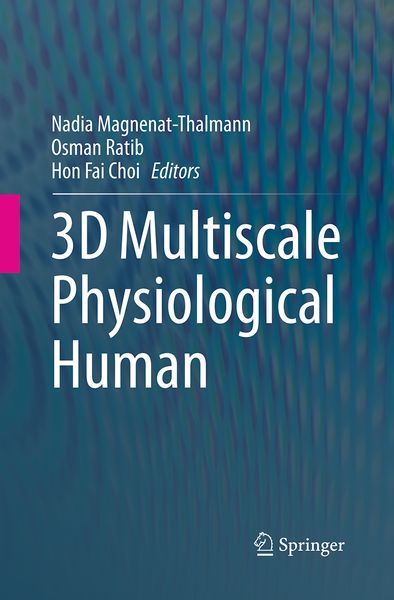
3D Multiscale Physiological Human
-
- Hardcover
- Taschenbuch ausgewählt
- eBook
-
Sprache:Englisch
Fr. 138.00
inkl. gesetzl. MwSt.,
Beschreibung
Produktdetails
Einband
Taschenbuch
Erscheinungsdatum
27.08.2016
Abbildungen
XII, 110 illus., 99 illus. in color., farbige Illustrationen, schwarz-weiss Illustrationen
Herausgeber
Nadia Magnenat-Thalmann + weitereVerlag
Springer LondonSeitenzahl
316
Maße (L/B/H)
23.5/15.5/1.7 cm
Gewicht
559 g
Auflage
Softcover reprint of the original 1st ed. 2014
Sprache
Englisch
ISBN
978-1-4471-7250-5
3D Multiscale Physiological Human aims to promote scientific exchange by bringing together overviews and examples of recent scientific and technological advancements across a wide range of research disciplines. As a result, the variety in methodologies and knowledge paradigms are contrasted, revealing potential gaps and opportunities for integration. Chapters have been contributed by selected authors in the relevant domains of tissue engineering, medical image acquisition and processing, visualization, modeling, computer aided diagnosis and knowledge management. The multi-scale and multi-disciplinary research aspects of articulations in humans are highlighted, with a particular emphasis on medical diagnosis and treatment of musculoskeletal diseases and related disorders.
The need for multi-scale modalities and multi-disciplinary research is an emerging paradigm in the search for a better biological and medical understanding of the human musculoskeletal system. This is particularly motivated by the increasing socio-economic burden of disability and musculoskeletal diseases, especially in the increasing population of elderly people. Human movement is generated through a complex web of interactions between embedded physiological systems on different spatiotemporal scales, ranging from the molecular to the organ level. Much research is dedicated to the understanding of each of these systems, using methods and modalities tailored for each scale. Nevertheless, combining knowledge from different perspectives opens new venues of scientific thinking and stimulates innovation. Integration of this mosaic of multifaceted data across multiple scales and modalities requires further exploration of methods in simulations and visualization to obtain a comprehensive synthesis. However, this integrative approach cannot be achieved without a broad appreciation for the multiple research disciplines involved.
Kundinnen und Kunden meinen
Verfassen Sie die erste Bewertung zu diesem Artikel
Helfen Sie anderen Kund*innen durch Ihre Meinung