Produktbild: Innate Tolerance in the CNS

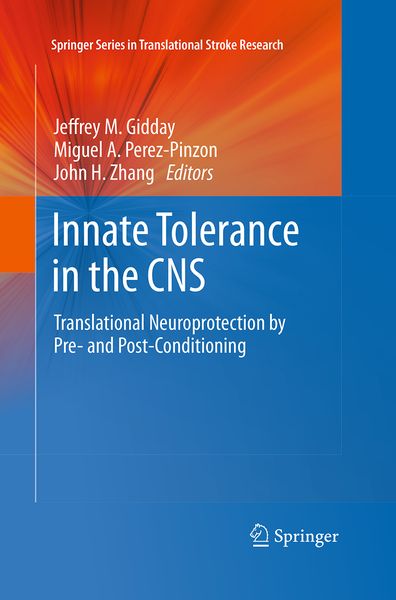
Innate Tolerance in the CNS Translational Neuroprotection by Pre- and Post-Conditioning

Fr. 242.00

inkl. gesetzl. MwSt., Versandkostenfrei


Beschreibung

Produktdetails

Einband

Taschenbuch

Erscheinungsdatum

23.08.2016

Herausgeber

Jeffrey M. Gidday + weitere

Verlag

Springer Us

Seitenzahl

699

Maße (L/B/H)

23.5/15.5/3.8 cm

Gewicht

1074 g

Auflage

Softcover reprint of the original 1st ed. 2013

Sprache

Englisch

ISBN

978-1-4939-4177-3

Beschreibung

Portrait

Jeffrey M. Gidday PhD, Associate Professor of Neurosurgery at Washington University School of Medicine, has been working in the field of CNS preconditioning for 18 years, and has numerous publications on preconditioning-induced protection in the setting of several different cerebral and retinal pathologies. 

Miguel A. Perez-Pinzon PhD is Professor of Neurology/Neuroscience, Vice-Chair for Basic Science of Neurology at the University of Miami Miller School of Medicine. He began studies of ischemic preconditioning in 1995 and for many years prior to that worked in the field of anoxia tolerance, publishing close to 50 peer-reviewed articles and many book chapters on these topics.

John H. Zhang MD PhD is Professor of Neurosurgery, Anesthesiology, and Physiology, and Vice-Chair of the Basic Science Department at the Loma Linda University School of Medicine. His research interests include stroke and medical gases, and he has published papers related to pre-, post- and remote-conditioning in subarachnoid hemorrhage, focal cerebral ischemia, and neonatal brain injury.

Produktdetails

Einband

Taschenbuch

Erscheinungsdatum

23.08.2016

Herausgeber

Verlag

Springer Us

Seitenzahl

699

Maße (L/B/H)

23.5/15.5/3.8 cm

Gewicht

1074 g

Auflage

Softcover reprint of the original 1st ed. 2013

Sprache

Englisch

ISBN

978-1-4939-4177-3

Herstelleradresse

Libri GmbH
Europaallee 1
36244 Bad Hersfeld
DE

Email: GPSR Kontakt

Kundinnen und Kunden meinen

0 Bewertungen

Informationen zu Bewertungen

Zur Abgabe einer Bewertung ist eine Anmeldung im Konto notwendig. Die Authentizität der Bewertungen wird von uns nicht überprüft. Wir behalten uns vor, Bewertungstexte, die unseren Richtlinien widersprechen, entsprechend zu kürzen oder zu löschen.

Die Bewertungen sind nach Format, Anzahl Sterne und Datum sortiert.

Verfassen Sie die erste Bewertung zu diesem Artikel

Helfen Sie anderen Kund*innen durch Ihre Meinung

Kundinnen und Kunden meinen

0 Bewertungen filtern

  • Produktbild: Innate Tolerance in the CNS
  • Preface.- Section I.   Comparative Physiology and Historical Background.- 1. Tolerance, Historical Review.- 2. Anoxia resistance in lower and higher vertebrates.- 3. Hibernation:  A Natural Model of Tolerance to Cerebral Ischemia/Reperfusion.- 4. Preconditioning in the Heart.- Section II.   Conditioning Methods.- 5. Neuroprotection and Physical Preconditioning:  Exercise, Hypothermia, and Hyperthermia.- 6. A New Future in Brain Preconditioning Based on Nutraceuticals:  Focus on α-Linolenic Omega-3 Fatty Acids for Stroke Protection.- 7. Medical Gases for Conditioning:  Volatile Anesthetics, Hyperbaric Oxygen, and Hydrogen Sulfide.- 8. Hypoxic Preconditioning in the CNS.- 9. Pharmacologic Preconditioning.- 10. Surgical Methods to Induce Brain Preconditioning.- Section III. Conditioning Models for Cerebral Ischemia.- 11. Tolerance Against Global Cerebral Ischemia:  Experimental Strategies, Mechanisms, and Clinical Applications.- 12. Preconditioning and Neuroprotection in the Immature Brain.- 13. Conditioning Studies in Focal Cerebral Ischemia:  Model Selection, Physiological Monitoring, and Other Methodological Issues.- 14. Preconditioning for Subarachnoid Hemorrhage.- 15. Preconditioning for Intracerebral Hemorrhage.- 16. The Protective Effects of Ischemic Postconditioning in Experimental Stroke.- Section IV. Mechanisms of Preconditioning.- 17. Synaptic Signaling in Ischemic Tolerance.- 18.- The Genomics of Preconditioning and Ischemic Tolerance.- 19. How do Subcellular Organelles Participate in Preconditioning-Conferred Neuroprotection?.- 20. Ischemic Preconditioning–Mediated Signaling Pathways Lead to Tolerance Against Cerebral Ischemia.- 21. Preconditioning the Neurovascular Unit:  Tolerance in the Brain’s Non-Neuronal Cells.- Section V.   Other Neurological Disorders.- 22. Preconditioning for Surgical Brain Injury.- 23. Intrinsic Neuroprotection in Traumatic Brain Injury.- 24. Preconditioning for Epilepsy.- 25. Ischemic Pre- andPost-Conditioning in the Retina.- Section VI. Clinical Applications.- 26. Clinical Cerebral Ischemic Preconditioning.- 27. Preconditioning Strategy:  Coronary Bypass, Subarachnoid Hemorrhage, Temporary Proximal Vessel Occlusion in Carotid Revascularization, and Intracranial Aneurysm Surgery.- 28. HBO preconditioning for TBI and Stroke Patients.- 29. Electroacupuncture Preconditioning for Stroke Patients.- 30. Clinical Trials of Ischemic Conditioning.- Epilogue.- Index.