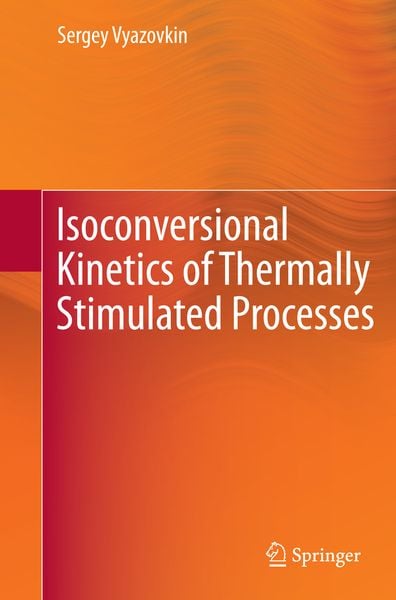
• Produktbild: Isoconversional Kinetics of Thermally Stimulated Processes
  • Produktbild: Isoconversional Kinetics of Thermally Stimulated Processes

Isoconversional Kinetics of Thermally Stimulated Processes

Fr. 127.00

inkl. gesetzl. MwSt., Versandkostenfrei


Beschreibung

Produktdetails

Einband

Taschenbuch

Erscheinungsdatum

06.10.2016

Abbildungen

XIII, 165 illus., 6 illus. in color., schwarz-weiss Illustrationen, farbige Illustrationen

Verlag

Springer

Seitenzahl

239

Maße (L/B/H)

23.5/15.5/1.5 cm

Gewicht

394 g

Auflage

Softcover reprint of the original 1st edition 2015

Sprache

Englisch

ISBN

978-3-319-37943-2

Beschreibung

Produktdetails

Einband

Taschenbuch

Erscheinungsdatum

06.10.2016

Abbildungen

XIII, 165 illus., 6 illus. in color., schwarz-weiss Illustrationen, farbige Illustrationen

Verlag

Springer

Seitenzahl

239

Maße (L/B/H)

23.5/15.5/1.5 cm

Gewicht

394 g

Auflage

Softcover reprint of the original 1st edition 2015

Sprache

Englisch

ISBN

978-3-319-37943-2

Herstelleradresse

Springer-Verlag GmbH
Tiergartenstr. 17
69121 Heidelberg
DE

Email: ProductSafety@springernature.com

Kundinnen und Kunden meinen

0 Bewertungen

Informationen zu Bewertungen

Zur Abgabe einer Bewertung ist eine Anmeldung im Konto notwendig. Die Authentizität der Bewertungen wird von uns nicht überprüft. Wir behalten uns vor, Bewertungstexte, die unseren Richtlinien widersprechen, entsprechend zu kürzen oder zu löschen.

Die Bewertungen sind nach Format, Anzahl Sterne und Datum sortiert.

Verfassen Sie die erste Bewertung zu diesem Artikel

Helfen Sie anderen Kund*innen durch Ihre Meinung

Kundinnen und Kunden meinen

0 Bewertungen filtern

  • Produktbild: Isoconversional Kinetics of Thermally Stimulated Processes
  • Produktbild: Isoconversional Kinetics of Thermally Stimulated Processes
  • 1. Some basics en route to isoconversional methodology
    1.1. From condensed phase kinetics to isoconversional principle
    1.2. Understanding variable activation energy
    1.3. Obtaining computation worthy data
    2. Isoconversional methodology
    2.1. Evolution of isoconversional methods
    2.1.1. Early methods
    2.1.2. Modern methods
    2.2. Estimating reaction models and preexponential factors
    2.2.1. Prelude
    2.2.2. The use of the compensation effect
    2.2.3. The use of the y() or z() master plots
    2.3. Kinetic predictions
    2.3.1. Why predictions?
    2.3.2. Model-based vs. model-free
    2.3.3. Understanding precision and accuracy of predictions
    3. Physical Processes
    3.1. Phases and transitions between them
    3.2. Vaporization and Sublimation
    3.2.1. Background
    3.2.2. Isoconversional treatment
    3.3. Glass transition
    3.3.1. Background
    3.3.2. Isoconversional treatment
    3.4. Glass aging
    3.4.1. Background
    3.4.2. Isoconversional treatment
    3.4.3. Activation energies of -relaxation from DSC
    3.5. Nucleation
    3.6. Crystallization of polymers
    3.6.1. Background
    3.6.2. Isoconversional treatment
    3.7. Melting of polymers
    3.7.1. Background
    3.7.2. Isoconversional treatment
    3.8. Solid-solid transitions
    3.8.1. Background
    3.8.2. Isoconversional treatment
    3.9. Mixing and demixing
    3.9.1. Background
    3.9.2. Isoconversional treatment
    3.10. Gelation and gel melting
    3.10.1. Background
    3.10.2. Isoconversional treatment of gelation
    3.10.3. Isoconversional treatment of gel melting
    3.11. Helix-Coil Transition
    3.11.1. Background
    3.11.2. Isoconversional treatment of protein denaturation
    4. Chemical processes
    4.1. Introduction
    4.2. Polymerization and Crosslinking
    4.2.1. Background to polymerization
    4.2.2. Isoconversional treatment of polymerization
    4.2.3. Background to crosslinking
    4.2.4. Isoconversional treatment of crosslinking
    4.3. Thermal and Thermo-oxidative degradation of polymers
    4.3.1. Background
    4.3.2. Isoconversional treatment
    4.4. Thermal decomposition of solids
    4.4.1. Background
    4.4.2. Isoconversional treatment
    5. Epilogue