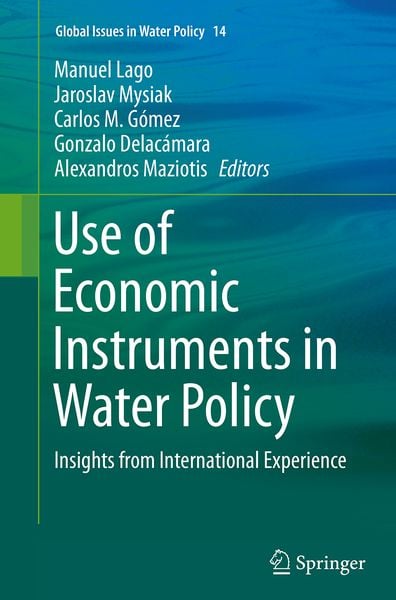
Use of Economic Instruments in Water Policy Insights from International Experience
-
- Hardcover
- Taschenbuch ausgewählt
- eBook
-
Sprache:Englisch
Fr. 138.00
inkl. gesetzl. MwSt.,
Beschreibung
Produktdetails
Einband
Taschenbuch
Erscheinungsdatum
29.10.2016
Abbildungen
XIV, 46 illus., 42 illus. in color., farbige Illustrationen, schwarz-weiss Illustrationen
Herausgeber
Manuel Lago + weitereVerlag
SpringerSeitenzahl
423
Maße (L/B/H)
23.5/15.5/2.3 cm
Gewicht
743 g
Auflage
Softcover reprint of the original 1st edition 2015
Sprache
Englisch
ISBN
978-3-319-36353-0
This book assesses both the effectiveness and efficiency of implemented Economic Policy Instruments (EPIs) in order to achieve water policy goals and identifies the preconditions under which they outperform alternative (e.g. regulatory) policy instruments and/or can complement them as part of complex policy mixes. The development of a consolidated assessment framework helps clarify (and where possible, quantify) the effectiveness of each EPI on the basis of different criteria. Outcome-oriented criteria describe how the EPIs perform. They include intended and unintended economic and environmental outcomes and the distribution of benefits and costs among the affected parties. These steps consider the application of cost effectiveness and cost benefits analysis, e.g. to assess ex-post performance of the EPI. Process criteria describe the institutional conditions (legislative, political, cultural, etc.) affecting the formation and operation of the EPI studied (particularly relevant for assessing the possible impacts of using economic instruments), the transaction costs involved in implementing and enforcing the instruments and the process of implementation.
Case studies from Cyprus, Denmark, France, Germany, Hungary, Italy, the Netherlands, Spain and the United Kingdom, as well as from Australia, Chile, Israel and the USA are presented in this book. A wide variety of EPIs are also covered, including water-pricing schemes (tariffs, environmental taxes, environmental charges or fees, subsidies on products and practices), trading schemes (tradable permits for abstraction and pollution) and cooperation mechanisms.Kundinnen und Kunden meinen
Verfassen Sie die erste Bewertung zu diesem Artikel
Helfen Sie anderen Kund*innen durch Ihre Meinung