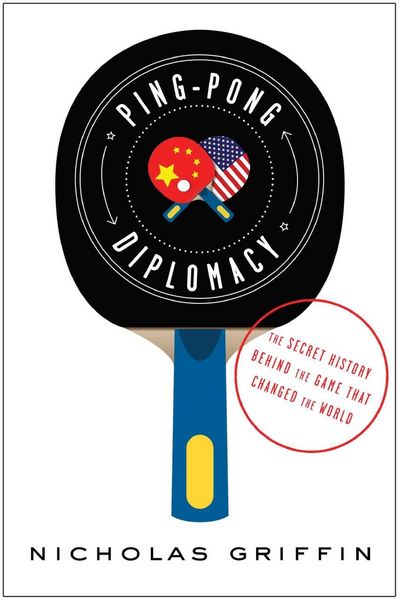
Ping-Pong Diplomacy The Secret History Behind the Game That Changed the World
-
- Hardcover
- Taschenbuch
- eBook ausgewählt
-
Form:Einzelkauf Download
-
Sprache:Englisch
Fr. 13.55
inkl. gesetzl. MwSt.Beschreibung
Produktdetails
Format
ePUB
Kopierschutz
Ja
Family Sharing
Ja
Text-to-Speech
Ja
Erscheinungsdatum
07.01.2014
Verlag
Simon + Schuster LLCSeitenzahl
352 (Printausgabe)
Dateigröße
18352 KB
Sprache
Englisch
EAN
9781451642810
Combining the insight of Franklin Foer's How Soccer Explains the World and the intrigue of Ben Affleck's Argo, Ping Pong Diplomacy traces the story of how an aristocratic British spy used the game of table tennis to propel a Communist strategy that changed the shape of the world.
THE SPRING OF 1971 heralded the greatest geopolitical realignment in a generation. After twenty-two years of antagonism, China and the United States suddenly moved toward a détenteachieved not by politicians but by Ping-Pong players. The Western press delighted in the absurdity of the moment and branded it Ping-Pong Diplomacy. But for the Chinese, Ping-Pong was always political, a strategic cog in Mao Zedong's foreign policy. Nicholas Griffin proves that the organized game, from its first breath, was tied to Communism thanks to its founder, Ivor Montagu, son of a wealthy English baron and spy for the Soviet Union.
Ping-Pong Diplomacy traces a crucial intersection of sports and society. Griffin tells the strange and tragic story of how the game was manipulated at the highest levels; how the Chinese government helped cover up the death of 36 million peasants by holding the World Table Tennis Championships during the Great Famine; how championship players were driven to their deaths during the Cultural Revolution; and, finally, how the survivors were reconvened in 1971 and ordered to reach out to their American counterparts. Through a cast of eccentric characters, from spies to hippies and Ping-Pong-obsessed generals to atom-bomb survivors, Griffin explores how a neglected sport was used to help realign the balance of worldwide power.
THE SPRING OF 1971 heralded the greatest geopolitical realignment in a generation. After twenty-two years of antagonism, China and the United States suddenly moved toward a détenteachieved not by politicians but by Ping-Pong players. The Western press delighted in the absurdity of the moment and branded it Ping-Pong Diplomacy. But for the Chinese, Ping-Pong was always political, a strategic cog in Mao Zedong's foreign policy. Nicholas Griffin proves that the organized game, from its first breath, was tied to Communism thanks to its founder, Ivor Montagu, son of a wealthy English baron and spy for the Soviet Union.
Ping-Pong Diplomacy traces a crucial intersection of sports and society. Griffin tells the strange and tragic story of how the game was manipulated at the highest levels; how the Chinese government helped cover up the death of 36 million peasants by holding the World Table Tennis Championships during the Great Famine; how championship players were driven to their deaths during the Cultural Revolution; and, finally, how the survivors were reconvened in 1971 and ordered to reach out to their American counterparts. Through a cast of eccentric characters, from spies to hippies and Ping-Pong-obsessed generals to atom-bomb survivors, Griffin explores how a neglected sport was used to help realign the balance of worldwide power.
Kundinnen und Kunden meinen
Verfassen Sie die erste Bewertung zu diesem Artikel
Helfen Sie anderen Kund*innen durch Ihre Meinung