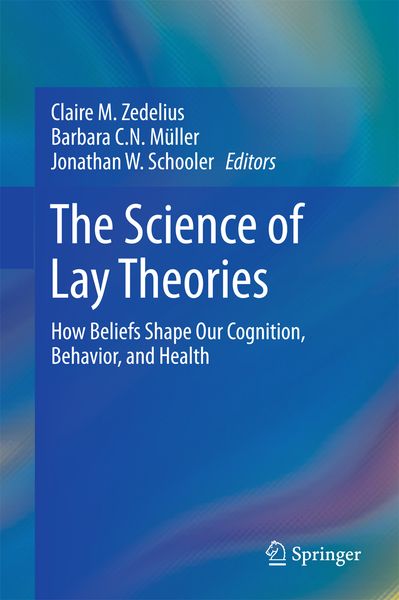
Produktbild: The Science of Lay Theories

The Science of Lay Theories How Beliefs Shape Our Cognition, Behavior, and Health

Fr. 192.00

inkl. gesetzl. MwSt., Versandkostenfrei


Beschreibung

Produktdetails

Einband

Gebundene Ausgabe

Erscheinungsdatum

24.07.2017

Abbildungen

XII, 2 illus., schwarz-weiss Illustrationen

Herausgeber

Claire M. Zedelius + weitere

Verlag

Springer

Seitenzahl

382

Maße (L/B/H)

24.1/16/2.7 cm

Gewicht

758 g

Auflage

1st edition 2017

Sprache

Englisch

ISBN

978-3-319-57305-2

Beschreibung

Portrait

Dr. Claire Zedelius is working as a postdoctoral researcher in Jonathan Schooler’s META (Memory, Emotion, Thought, Awareness) lab. One of her research lines examines the effects of mind wandering or daydreaming on different aspects of creativity. Another line of her research focuses on the roles of meta-awareness and meta-cognitive beliefs in mind wandering. Claire did her dissertation research at the social psychology department at Utrecht University (the Netherlands), where she worked with Henk Aarts studying conscious and unconscious processes in human reward pursuit.


Dr. Barbara Müller is an Assistant Professor at the Communication Science department of the Behavioural Science Institute at Radboud University in Nijmegen, The Netherlands. In her work, she investigates the developmental and neurocognitive mechanisms of human/robot interactions, and how these interactions can be improved. Her second line of research focuses on social influence in health communication. She is particularly interested in how people can convince themselves to adopt a healthy lifestyle, instead of being convinced by someone else. Barbara did her dissertation research at Radboud University, where she worked with Rick van Baaren and Ap Dijksterhuis on action co-representation of non-biological actions.


Dr. Jonathan Schooler is a Professor in the Department of Psychological and Brain Sciences at the University of California Santa Barbara.  He oversees the META lab and is the Director of UCSB’s Center for Mindfulness and Human Potential. Jonathan pursues research on consciousness, memory, the relationship between language and thought, problem-solving, and decision-making. He is particularly interested in exploring phenomena that intersect between the empirical and the philosophical such as how fluctuations in people’s awareness of their experience mediate mind-wandering and how people’s theories about the mind influence how they behave.  

Produktdetails

Einband

Gebundene Ausgabe

Erscheinungsdatum

24.07.2017

Abbildungen

XII, 2 illus., schwarz-weiss Illustrationen

Herausgeber

Verlag

Springer

Seitenzahl

382

Maße (L/B/H)

24.1/16/2.7 cm

Gewicht

758 g

Auflage

1st edition 2017

Sprache

Englisch

ISBN

978-3-319-57305-2

Herstelleradresse

Springer-Verlag KG
Sachsenplatz 4-6
1201 Wien
AT

Email: GPSR Kontakt

Noch keine Bewertungen vorhanden

Verfassen Sie die erste Bewertung zu diesem Artikel

Helfen Sie anderen Kundinnen und Kunden durch Ihre Meinung.

Kundinnen und Kunden meinen

Bewertungen (0)

  • Produktbild: The Science of Lay Theories
  • Preface: Lay theories beyond intelligence, a bigger picture perspective by Carol Dweck

    Table of Contents Part I: The origins and nature of lay theoriesChapter 1. The Origins of Lay Theories: The Case of Essentialist Beliefsby Nick Haslam Chapter 2. The Motivated Fluidity of Lay Theories of Changeby Anne E. Wilson and Jaslyn A. English Part II: Explorations in lay theories about human psychological attributes or phenomenaChapter 3. Lay Theories of Self-Control                by Veronika Job and Gregory M. Walton Chapter 4. What are People’s Lay Theories about Mind Wandering and How do Those Beliefs Affect Them?                by Claire M. Zedelius and Jonathan W. Schooler Chapter 5. Lay Theories of Creativity                by Simone Ritter, and Eric Rietzschel Chapter 6. Mindsets about Malleability and Intergroup Relations                by Aneeta Rattan, and Oriane Georgeac Chapter 7. Effects of Lay Beliefs on the Justice Motive                by Michèlle Bal, and Kees van den BosPart III: Insights into  lay theories about the metaphysical or supernatural Chapter 8. Antecedents, Manifestations, and Consequences of Belief in Mind-Body Dualism                by Matthias Forstmann, and Pascal Burgmer Chapter 9. Lay Theories of the Mind/Brain Relationship and the Allure of Neuroscience                 by Diego Fernandez-Duque Chapter 10. Causes and Consequences of the Belief in Free Will                by Davide  Rigoni, Axel Cleeremans, and Marcel Brass Chapter 11. Religion and its Cultural Evolutionary By-Products                by Kristin Laurin Chapter 12. From the Impossible to the Improbable: A Probabilistic Account of Magical Beliefs and Practices Across Development and Cultures                 by Martin Fortier and Sunae KimPart IV: Investigation of lay theories about mental and physical healthChapter 13. Mindsets of Body-Weight                by Jeni L. Burnette, Crystal L. Hoyt, and Kasey Orvidas Chapter 14. Lay Theories and Metaphors of Health and Illness                 by David J. Hauser, Randolph M. Nesse, and Norbert Schwarz Chapter 15. How Lay Theories Influence our Mental Health                 by Adrian Furnham