
Band 10
Multiple Representations in Physics Education
Aus der Reihe
Models and Modeling in Science Education
-
- Hardcover ausgewählt
- Taschenbuch
- eBook
-
Sprache:Englisch
Fr. 191.00
inkl. gesetzl. MwSt.,
Beschreibung
Produktdetails
Einband
Gebundene Ausgabe
Erscheinungsdatum
03.08.2017
Abbildungen
XI, 322 p. 94 illus.
Herausgeber
David F. Treagust + weitereVerlag
SpringerSeitenzahl
322
Maße (L/B/H)
24.1/16/2.4 cm
Gewicht
670 g
Auflage
1st ed. 2017
Sprache
Englisch
ISBN
978-3-319-58912-1
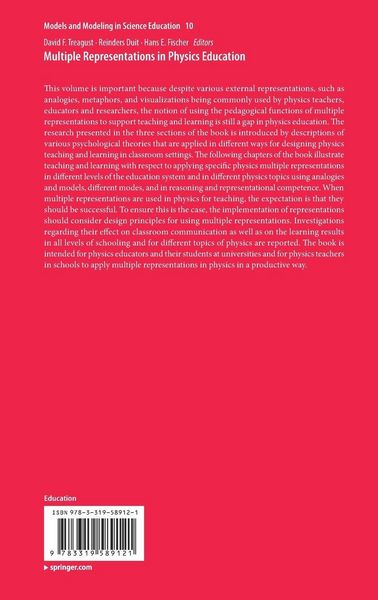
This volume is important because despite various external representations, such as analogies, metaphors, and visualizations being commonly used by physics teachers, educators and researchers, the notion of using the pedagogical functions of multiple representations to support teaching and learning is still a gap in physics education. The research presented in the three sections of the book is introduced by descriptions of various psychological theories that are applied in different ways for designing physics teaching and learning in classroom settings. The following chapters of the book illustrate teaching and learning with respect to applying specific physics multiple representations in different levels of the education system and in different physics topics using analogies and models, different modes, and in reasoning and representational competence. When multiple representations are used in physics for teaching, the expectation is that they should be successful. To ensure this is the case, the implementation of representations should consider design principles for using multiple representations. Investigations regarding their effect on classroom communication as well as on the learning results in all levels of schooling and for different topics of physics are reported. The book is intended for physics educators and their students at universities and for physics teachers in schools to apply multiple representations in physics in a productive way.
Noch keine Bewertungen vorhanden
Verfassen Sie die erste Bewertung zu diesem Artikel
Helfen Sie anderen Kundinnen und Kunden durch Ihre Meinung.