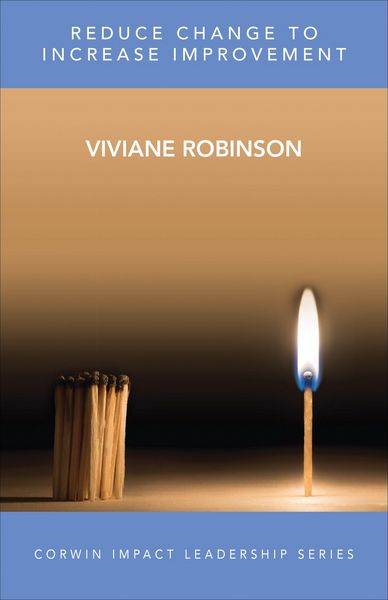
Reduce Change to Increase Improvement
-
- Englisch ausgewählt
Fr. 51.90
inkl. gesetzl. MwSt.,
Beschreibung
Produktdetails
Einband
Taschenbuch
Erscheinungsdatum
21.12.2017
Verlag
Sage PublicationsSeitenzahl
148
Maße (L/B/H)
21.7/14.1/1.4 cm
Gewicht
221 g
Sprache
Englisch
ISBN
978-1-5063-2537-8
Too much change, not enough improvement
Planned changes often fail because those designing them underestimate the complexity of implementation.
Reduce Change to Increase Improvement provides a practical structure for helping system and school leaders increase improvement while reducing ineffective change and innovation. By drilling down to the beliefs and values that inform the actual practice of change leaders, Robinson identifies the mindset, processes, and actual behaviors that contribute to successful reform efforts and, importantly, provide school leaders with concrete tools that enable them to be more effective.
The structures described in the book are illustrated by numerous examples, cases, and conversation extracts and center on four phases of engagement:
- Agreeing about the problem to be solved
- Revealing the beliefs that sustain the current practices
- Evaluating the relative merit of the existing practices and proposed theory
- Implementing and monitoring the new theory of action
Finally, a serious, evidence-proven book about educational change that takes a different tact beginning with the impact on the learner. Reduce Change to Increase Improvement is a treasure-trove of concrete information for educational leaders. Robinson, always cautious about change for change sake , brilliantly delineates each step of the way for leaders using authentically-documented conversations and practical discussion-starters that guide us through this collective inquiry approach towards student improvement. All leaders need this concise, clearly-stated text to guide their intentional improvement practices.
Dr. Lyn Sharratt, International Consultant and Author
OISE, University of Toronto, Ontario, Canada
Noch keine Bewertungen vorhanden
Verfassen Sie die erste Bewertung zu diesem Artikel
Helfen Sie anderen Kundinnen und Kunden durch Ihre Meinung.