• Produktbild: Theories of Mathematical Learning
  • Produktbild: Theories of Mathematical Learning

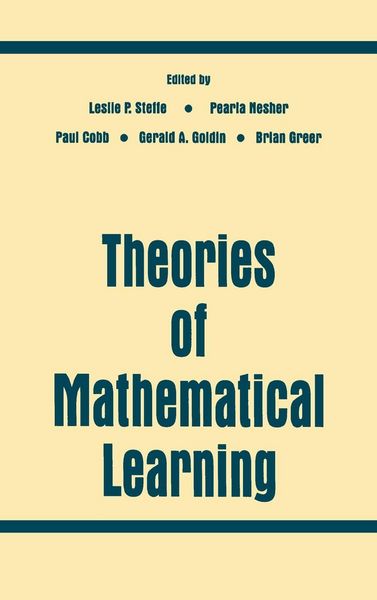
Theories of Mathematical Learning

Fr. 253.00

inkl. gesetzl. MwSt., Versandkostenfrei


Beschreibung

Produktdetails

Einband

Gebundene Ausgabe

Erscheinungsdatum

01.09.1996

Herausgeber

Steffe Leslie P. + weitere

Verlag

Taylor and Francis

Seitenzahl

538

Maße (L/B/H)

23.5/15.7/3.3 cm

Gewicht

1170 g

Sprache

Englisch

ISBN

978-0-8058-1661-7

Beschreibung

Portrait

Leslie P. Steffe, Pearla Nesher, Paul Cobb, Bharath Sriraman, Brian Greer

Produktdetails

Einband

Gebundene Ausgabe

Erscheinungsdatum

01.09.1996

Herausgeber

Verlag

Taylor and Francis

Seitenzahl

538

Maße (L/B/H)

23.5/15.7/3.3 cm

Gewicht

1170 g

Sprache

Englisch

ISBN

978-0-8058-1661-7

Herstelleradresse

Libri GmbH
Europaallee 1
36244 Bad Hersfeld
DE

Email: gpsr@libri.de

Kundinnen und Kunden meinen

0 Bewertungen

Informationen zu Bewertungen

Zur Abgabe einer Bewertung ist eine Anmeldung im Konto notwendig. Die Authentizität der Bewertungen wird von uns nicht überprüft. Wir behalten uns vor, Bewertungstexte, die unseren Richtlinien widersprechen, entsprechend zu kürzen oder zu löschen.

Die Bewertungen sind nach Format, Anzahl Sterne und Datum sortiert.

Verfassen Sie die erste Bewertung zu diesem Artikel

Helfen Sie anderen Kund*innen durch Ihre Meinung

Kundinnen und Kunden meinen

0 Bewertungen filtern

Die Leseprobe wird geladen.
  • Produktbild: Theories of Mathematical Learning
  • Produktbild: Theories of Mathematical Learning
  • Contents: Preface. Part I: P. Cobb, Sociological and Anthropological Perspectives on Mathematics Learning. P. Cobb, B. Jaworski, N. Presmeg, Emergent and Sociocultural Views of Mathematical Activity. J. Voigt, Negotiation of Mathematical Meaning in Classroom Processes: Social Interaction and Learning Mathematics. G.B. Saxe, T. Bermudez, Emergent Mathematical Environments in Children's Games. J. Richards, Negotiating the Negotiation of Meaning: Comments on Voigt (1992) and Saxe and Bermudez (1992). A.D. Schliemann, D.W. Carraher, Negotiationg Mathematical Meanings In and Out of School. E. Yackel, Social Interaction and Individual Cognition. B. van Oers, Learning Mathematics as a Meaningful Activity. E.A. Forman, Learning Mathematics as Participation in Classroom Practice: Implications of Sociocultural Theory for Educational Reform. K. Crawford, Cultural Processes and Learning: Expectations, Actions, and Outcomes. J.W. Stigler, C. Fernandez, M. Yoshida, Traditions of School Mathematics in Japanese and American Elementary Classrooms. Part II: B. Greer, Cognitive Science Theories and Their Contributions to the Learning of Mathematics. B. Greer, Theories of Mathematics Education: The Role of Cognitive Analyses. G. Hatano, A Conception of Knowledge Acquisition and Its Implications for Mathematics Education. G. Vergnaud, The Theory of Conceptual Fields. D.W. Carraher, Learning About Fractions. P.W. Thompson, Imagery and the Development of Mathematical Reasoning. R.B. Davis, Cognition, Mathematics, and Education. Part III: G.A. Goldin, The Contribution of Constructivism to the Learning of Mathematics. G.A. Goldin, Theory of Mathematics Education: The Contributions of Constructivism. E. von Glasersfeld, Aspects of Radical Constructivism and Its Educational Recommendations. F. Marton, D. Neuman, Phenomenography and Children's Experience of Division. P. Ernest, Varieties of Constructivism: A Framework for Comparison. N. Herscovics, The Construction of Conceptual Schemes in Mathematics. G. Booker, Constructing Mathematical Conventions Formed by the Abstraction and Generalization of Earlier Ideas: The Development of Initial Fraction Ideas. G.A. Goldin, J.J. Kaput, A Joint Perspective on the Idea of Representation in Learning and Doing Mathematics. C.A. Maher, A.M. Martino, Young Children Invent Methods of Proof: The Gang of Four. C. Janvier, Constructivism and Its Consequences for Training Teachers. Part IV: Perspectives on the Nature of Mathematical Learning. W. Dörfler, Is the Metaphor of Mental Object Appropriate for a Theory of Learning Mathematics? L.P. Steffe, H.G. Wiegel, On the Nature of a Model of Mathematical Learning.