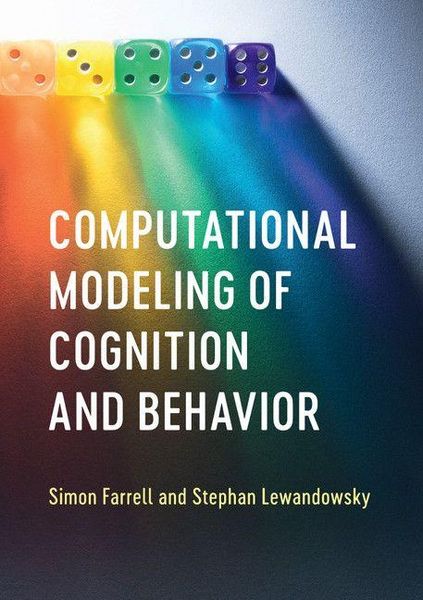
Computational Modeling of Cognition and Behavior
-
- Hardcover
- Taschenbuch ausgewählt
- eBook
-
Sprache:Englisch
Fr. 49.90
inkl. gesetzl. MwSt.,
Beschreibung
Produktdetails
Einband
Taschenbuch
Erscheinungsdatum
06.03.2019
Verlag
Cambridge University PressSeitenzahl
482
Maße (L/B/H)
24.4/17/2.7 cm
Gewicht
970 g
Sprache
Englisch
ISBN
978-1-107-52561-0
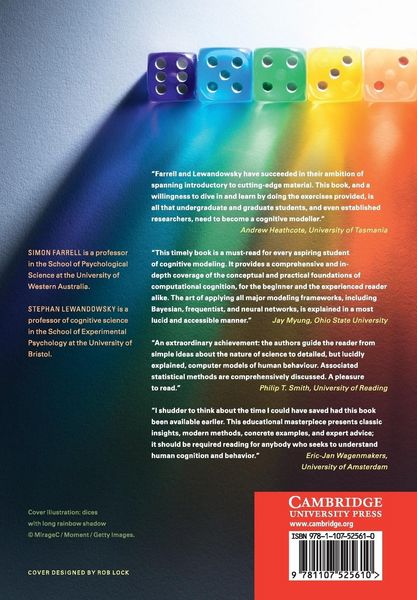
Computational modeling is now ubiquitous in psychology, and researchers who are not modelers may find it increasingly difficult to follow the theoretical developments in their field. This book presents an integrated framework for the development and application of models in psychology and related disciplines. Researchers and students are given the knowledge and tools to interpret models published in their area, as well as to develop, fit, and test their own models. Both the development of models and key features of any model are covered, as are the applications of models in a variety of domains across the behavioural sciences. A number of chapters are devoted to fitting models using maximum likelihood and Bayesian estimation, including fitting hierarchical and mixture models. Model comparison is described as a core philosophy of scientific inference, and the use of models to understand theories and advance scientific discourse is explained.
Noch keine Bewertungen vorhanden
Verfassen Sie die erste Bewertung zu diesem Artikel
Helfen Sie anderen Kundinnen und Kunden durch Ihre Meinung.