• Produktbild: Child and Adolescent Resilience Within Medical Contexts
  • Produktbild: Child and Adolescent Resilience Within Medical Contexts

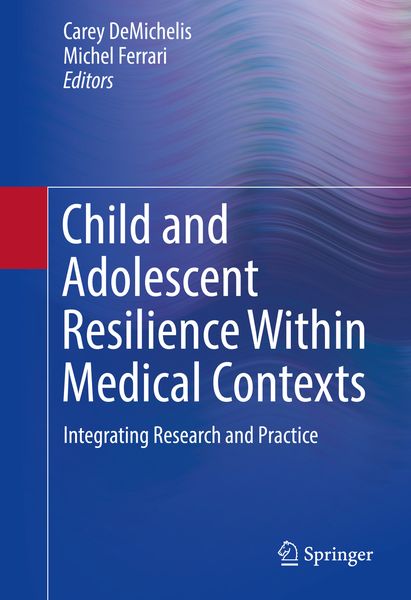
Child and Adolescent Resilience Within Medical Contexts Integrating Research and Practice

Fr. 113.00

inkl. gesetzl. MwSt., Versandkostenfrei


Beschreibung

Produktdetails

Einband

Taschenbuch

Erscheinungsdatum

14.09.2017

Abbildungen

XI, 14 illus., 10 illus. in color., schwarz-weiss Illustrationen, farbige Illustrationen

Herausgeber

Carey DeMichelis + weitere

Verlag

Springer

Seitenzahl

345

Maße (L/B/H)

23.5/15.5/2 cm

Gewicht

546 g

Auflage

1st ed. 2016

Sprache

Englisch

ISBN

978-3-319-68374-4

Beschreibung

Portrait

Carey DeMichelis is a doctoral candidate in the Department of Applied Psychology and Human Development at the University of Toronto. Her research focuses on the way adolescent patients make medical decisions- particularly in cases where the family’s cultural or religious beliefs conflict with medical recommendations. Located at the intersection of biomedical ethics, developmental psychology, and medical anthropology, Carey’s research explores the way adolescent autonomy intersects with medical authority, cultural identity and legal president in these complex cases. Carey is a student in the Collaborative Program at the Joint Centre for Bioethics. She is a graduate associate at the Centre for Ethics and at the Centre for Critical Qualitative Health Research at the University of Toronto. Carey earned her M.A. in 2011 from the University of Chicago where she studied comparative human development.

Michel Ferrari, Ph.D., teaches developmental and educational psychology in the Department of Applied Psychology and Human Development at the Ontario Institute for Studies in Education (OISE), part of the University of Toronto. From 2004 to 2005, he was a visiting scholar at Harvard and at the Max Planck Institute for the History of Science and in 2013 was a visiting scholar at the University of Potsdam. He is interested in personal identity and developing wisdom throughout the lifespan and has studied self-understanding of identity in people diagnosed with autism. Dr. Ferrari has coauthored and coedited books on wisdom, including, Teaching for Wisdom (with Georges Potworowski, Amsterdam: Springer, 2008), and The Science of Personal Wisdom (with Nic Weststrate, Springer, 2014).  Dr. Ferrari has also coedited books on child development and education, most recently, Developmental Relations Among Mind, Brain, and Education: Essays in Honor of Robbie Case (with Ljiljana Vuletic, Amsterdam: Springer, 2010), and a Handbook on Resilience in Children of War (with Chandi Fernando, Springer, 2013).  

Produktdetails

Einband

Taschenbuch

Erscheinungsdatum

14.09.2017

Abbildungen

XI, 14 illus., 10 illus. in color., schwarz-weiss Illustrationen, farbige Illustrationen

Herausgeber

Verlag

Springer

Seitenzahl

345

Maße (L/B/H)

23.5/15.5/2 cm

Gewicht

546 g

Auflage

1st ed. 2016

Sprache

Englisch

ISBN

978-3-319-68374-4

Herstelleradresse

Springer-Verlag GmbH
Tiergartenstr. 17
69121 Heidelberg
DE

Email: ProductSafety@springernature.com

Kundinnen und Kunden meinen

0 Bewertungen

Informationen zu Bewertungen

Zur Abgabe einer Bewertung ist eine Anmeldung im Konto notwendig. Die Authentizität der Bewertungen wird von uns nicht überprüft. Wir behalten uns vor, Bewertungstexte, die unseren Richtlinien widersprechen, entsprechend zu kürzen oder zu löschen.

Die Bewertungen sind nach Format, Anzahl Sterne und Datum sortiert.

Verfassen Sie die erste Bewertung zu diesem Artikel

Helfen Sie anderen Kund*innen durch Ihre Meinung

Kundinnen und Kunden meinen

0 Bewertungen filtern

  • Produktbild: Child and Adolescent Resilience Within Medical Contexts
  • Produktbild: Child and Adolescent Resilience Within Medical Contexts
  • Chapter 1. Relational Resilience: An Interdisciplinary Perspective.- Chapter 2. Psychosocial Factors that Influence Children with Immune Related Health Conditions.- Chapter 3. Resilience, Disparity, and Narrative Phenomenology: African American Families Raising Mentally Vulnerable Children.- Chapter 4. Promoting Resilience During the Transition to Adolescence in Chronically Ill Children and Their Families.- Chapter 5. Resilience in Pediatric Sickle Cell Disease and Cancer: Social Ecology Indicators of Health-Related Quality of Life.- Chapter 6. The Role of Parents in Promoting Children's Adjustment to Chronic Illness.- Chapter 7. Resilience in the Care of Children with Palliative Care Needs.- Chapter 8. Resilience and Pediatric Cancer Survivorship in Cultural Context.- Chapter 9. Promoting Resilience in Pediatric Health Care: The Role of the Child Life Specialist.- Chapter 10. Imaginal Coping: Resilience Through a Play of Tropes.- Chapter 11. Acceptance and Commitment Theory (ACT) to Foster Resilience in Pediatric Chronic Illness.- Chapter 12. Creating a Context for Resilience in Medical Settings: The Role of Collaborative Professionals and Informal Supports.- Chapter 13. Building Strengths and Resilience: Supporting Families and Disabled Children.- Chapter 14. The Concept of Resilience in Children's Health and Social Care Policy.- Chapter 15. Coping with Chronic Illness in Children and Their Families.- Chapter 16. Researching Resilience in a Medical Context: Understanding Social Ecologies Using Mixing Methods.- Chapter 17. A Global Perspective on Resilience and Creativity.- Chapter 18. Recommendations for Promoting Resilience of Children in Medical Contexts.