
• Produktbild: Mathematical Gauge Theory
  • Produktbild: Mathematical Gauge Theory

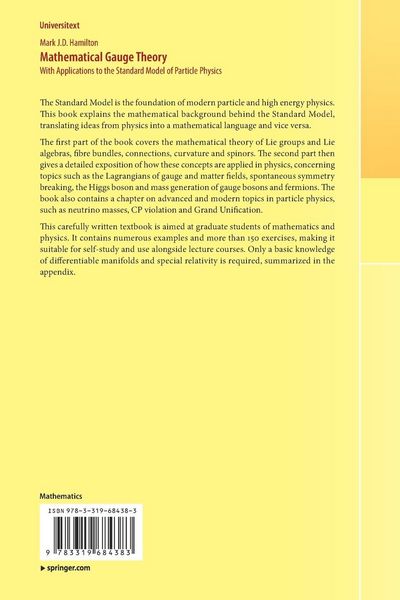
Mathematical Gauge Theory With Applications to the Standard Model of Particle Physics

Aus der Reihe Universitext

Fr. 127.00

inkl. gesetzl. MwSt., Versandkostenfrei


Beschreibung

Produktdetails

Einband

Taschenbuch

Erscheinungsdatum

10.01.2018

Abbildungen

XVIII, 40 illus., schwarz-weiss Illustrationen

Verlag

Springer

Seitenzahl

658

Maße (L/B/H)

23.5/15.5/3.7 cm

Gewicht

1007 g

Auflage

1st ed. 2017

Sprache

Englisch

ISBN

978-3-319-68438-3

Beschreibung

Rezension

“Assuming an introductory course on differential geometry and some basic knowledge of special relativity, both of which are summarized in the appendices, the book expounds the mathematical background behind the well-established standard model of modern particle and high energy physics… I believe that the book will be a standard textbook on the standard model for mathematics-oriented students.” (Hirokazu Nishimura, zbMATH 1390.81005)

Produktdetails

Einband

Taschenbuch

Erscheinungsdatum

10.01.2018

Abbildungen

XVIII, 40 illus., schwarz-weiss Illustrationen

Verlag

Springer

Seitenzahl

658

Maße (L/B/H)

23.5/15.5/3.7 cm

Gewicht

1007 g

Auflage

1st ed. 2017

Sprache

Englisch

ISBN

978-3-319-68438-3

Herstelleradresse

Springer-Verlag KG
Sachsenplatz 4-6
1201 Wien
AT

Email: ProductSafety@springernature.com

Kundinnen und Kunden meinen

0 Bewertungen

Informationen zu Bewertungen

Zur Abgabe einer Bewertung ist eine Anmeldung im Konto notwendig. Die Authentizität der Bewertungen wird von uns nicht überprüft. Wir behalten uns vor, Bewertungstexte, die unseren Richtlinien widersprechen, entsprechend zu kürzen oder zu löschen.

Die Bewertungen sind nach Format, Anzahl Sterne und Datum sortiert.

Verfassen Sie die erste Bewertung zu diesem Artikel

Helfen Sie anderen Kund*innen durch Ihre Meinung

Kundinnen und Kunden meinen

0 Bewertungen filtern

  • Produktbild: Mathematical Gauge Theory
  • Produktbild: Mathematical Gauge Theory
  • Part I Mathematical foundations 1 Lie groups and Lie algebras: Basic concepts 1.1 Topological groups and Lie groups 1.2 Linear groups and symmetry groups of vector spaces 1.3 Homomorphisms of Lie groups 1.4 Lie algebras 1.5 From Lie groups to Lie algebras 1.6 From Lie subalgebras to Lie subgroups 1.7 The exponential map 1.8 Cartan’s Theorem on closed subgroups 1.9 Exercises for Chapter 1 2 Lie groups and Lie algebras: Representations and structure theory 2.1 Representations 2.2 Invariant metrics on Lie groups 2.3 The Killing form 2.4 Semisimple and compact Lie algebras 2.5 Ad-invariant scalar products on compact Lie groups 2.6 Homotopy groups of Lie groups 2.7 Exercises for Chapter 2 3 Group actions 3.1 Transformation groups 3.2 Definition and first properties of group actions 3.3 Examples of group actions 3.4 Fundamental vector fields 3.5 The Maurer–Cartan form and the differential of a smooth group action 3.6 Left or right actions? 3.7 Quotient spaces 3.8 Homogeneous spaces 3.9 Stiefel and Grassmann manifolds 3.10 The exceptional Lie group G2 3.11 Godement’s Theorem on the manifold structure of quotient spaces 3.12 Exercises for Chapter 3 4 Fibre bundles 4.1 General fibre bundles 4.2 Principal fibre bundles 4.3 Formal bundle atlases 4.4 Frame bundles 4.5 Vector bundles 4.6 The clutching construction 4.7 Associated vector bundles 4.8 Exercises for Chapter 4 5 Connections and curvature 5.1 Distributions and connections 5.2 Connection 1-forms 5.3 Gauge transformations 5.4 Local connection 1-forms and gauge transformations 5.5 Curvature 5.6 Local curvature 2-forms 5.7 Generalized electric and magnetic fields on Minkowski spacetime of dimension 4 5.8 Parallel transport 5.9 The covariant derivative on associated vector bundles 5.10 Parallel transport and path-ordered exponentials 5.11 Holonomy and Wilson loops 5.12 The exterior covariant derivative 5.13 Forms with values in Ad(P) 5.14 A second and third version of the Bianchi identity 5.15 Exercises for Chapter 5 6 Spinors 6.1 The pseudo-orthogonal group O(s; t) of indefinite scalar products 6.2 Clifford algebras 6.3 The Clifford algebras for the standard symmetric bilinear forms 6.4 The spinor representation 6.5 The spin groups 6.6 Majorana spinors 6.7 Spin invariant scalar products 6.8 Explicit formulas for Minkowski spacetime of dimension 4 6.9 Spin structures and spinor bundles 6.10 The spin covariant derivative 6.11 Twisted spinor bundles 6.12 Twisted chiral spinors 6.13 Exercises for Chapter 6 Part II The Standard Model of elementary particle physics 7 The classical Lagrangians of gauge theories 7.1 Restrictions on the set of Lagrangians 7.2 The Hodge star and the codifferential 7.3 The Yang–Mills Lagrangian 7.4 Mathematical and physical conventions for gauge theories 7.5 The Klein–Gordon and Higgs Lagrangians 7.6 The Dirac Lagrangian 7.7 Yukawa couplings 7.8 Dirac and Majorana mass terms 7.9 Exercises for Chapter 7 8 The Higgs mechanism and the Standard Model 8.1 The Higgs field and symmetry breaking 8.2 Mass generation for gauge bosons 8.3 Massive gauge bosons in the SU(2)U(1)-theory of the electroweak interaction 8.4 The SU(3)-theory of the strong interaction (QCD) 8.5 The particle content of the Standard Model 8.6 Interactions between fermions and gauge bosons 8.7 Interactions between Higgs bosons and gauge bosons 8.8 Mass generation for fermions in the Standard Model 8.9 The complete Lagrangian of the Standard Model 8.10 Lepton and baryon numbers 8.11 Exercises for Chapter 8 9 Modern developments and topics beyond the Standard Model 9.1 Flavour and chiral symmetry 9.2 Massive neutrinos 9.3 C, P and CP violation 9.4 Vacuum polarization and running coupling constants 9.5 Grand Unified Theories 9.6 A short introduction to the Minimal Supersymmetric Standard Model (MSSM) 9.7 Exercises for Chapter 9 Part III Appendix A Background on differentiable manifolds A.1 Manifolds A.2 Tensors and forms B Background on special relativity and quantum field theory B.1 Basics of special relativity B.2 A short introduction to quantum field theory References Index