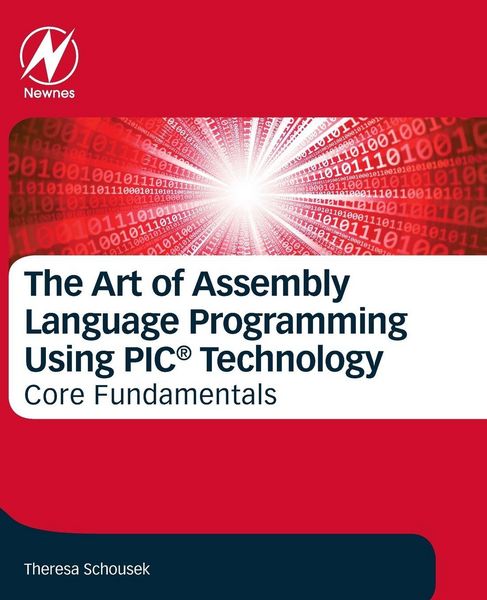
The Art of Assembly Language Programming Using PIC® Technology Core Fundamentals
-
- Taschenbuch ausgewählt
- eBook
-
Sprache:Englisch
Fr. 75.90
inkl. gesetzl. MwSt.,
Beschreibung
Produktdetails
Einband
Taschenbuch
Erscheinungsdatum
01.05.2019
Verlag
Elsevier Science & TechnologySeitenzahl
460
Maße (L/B/H)
23.5/19.1/2.4 cm
Gewicht
970 g
Sprache
Englisch
ISBN
978-0-12-812617-2
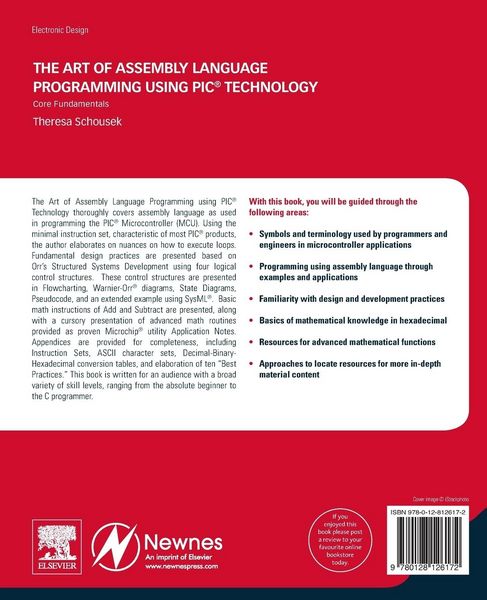
The Art of Assembly Language Programming using PIC® Technology thoroughly covers assembly language as used in programming the PIC® Microcontroller (MCU). Using the minimal instruction set, characteristic of most PIC® products, the author elaborates on the nuances of how to execute loops. Fundamental design practices are presented based on Orr's Structured Systems Development using four logical control structures. These control structures are presented in Flowcharting, Warnier-Orr® diagrams, State Diagrams, Pseudocode, and an extended example using SysML®. Basic math instructions of Add and Subtract are presented, along with a cursory presentation of advanced math routines provided as proven Microchip® utility Application Notes.
Appendices are provided for completeness, especially for the advanced reader, including several Instruction Sets, ASCII character sets, Decimal-Binary-Hexadecimal conversion tables, and elaboration of ten 'Best Practices.' Two datasheets (one complete datasheet on the 10F20x series and one partial datasheet on the 16F88x series) are also provided in the Appendices to serve as an important reference, enabling the new embedded programmer to develop familiarity with the format of datasheets and the skills needed to assess the product datasheet for proper selection of a microcontroller family for any specific project.
The Art of Assembly Language Programming Using PIC® Technology is written for an audience with a broad variety of skill levels, ranging from the absolute beginner completely new to embedded control to the embedded C programmer new to assembly language.
With this book, you will be guided through the following areas:
- Symbols and terminology used by programmers and engineers in microcontroller applications
- Programming using assembly language through examples
- Familiarity with design and development practices
- Basics of mathematical knowledge in hexadecimal
- Resources for advanced mathematical functions
Approaches to locate resources
Noch keine Bewertungen vorhanden
Verfassen Sie die erste Bewertung zu diesem Artikel
Helfen Sie anderen Kundinnen und Kunden durch Ihre Meinung.