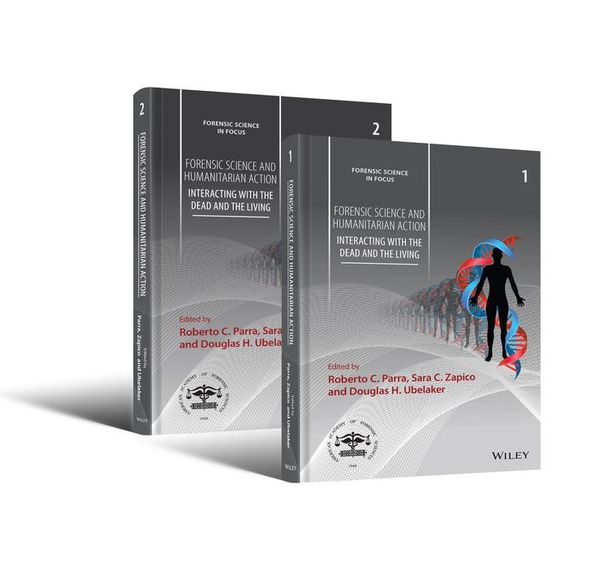
Produktbild: Forensic Science and Humanitarian Action, 2 Volume Set

Forensic Science and Humanitarian Action, 2 Volume Set Interacting with the Dead and the Living. 2 Volume Set

Fr. 303.00

inkl. gesetzl. MwSt., Versandkostenfrei


Beschreibung

Produktdetails

Einband

Gebundene Ausgabe

Erscheinungsdatum

16.03.2020

Herausgeber

Roberto C. Parra + weitere

Verlag

John Wiley & Sons Inc

Seitenzahl

896

Maße (L/B/H)

26.9/19.1/5.8 cm

Gewicht

2540 g

Auflage

1. Auflage

Sprache

Englisch

ISBN

978-1-119-48196-6

Beschreibung

Produktdetails

Einband

Gebundene Ausgabe

Erscheinungsdatum

16.03.2020

Herausgeber

Verlag

John Wiley & Sons Inc

Seitenzahl

896

Maße (L/B/H)

26.9/19.1/5.8 cm

Gewicht

2540 g

Auflage

1. Auflage

Sprache

Englisch

ISBN

978-1-119-48196-6

Herstelleradresse

Libri GmbH
Europaallee 1
36244 Bad Hersfeld
DE

Email: gpsr@libri.de

Noch keine Bewertungen vorhanden

Verfassen Sie die erste Bewertung zu diesem Artikel

Helfen Sie anderen Kundinnen und Kunden durch Ihre Meinung.

Kundinnen und Kunden meinen

Bewertungen (0)

Die Leseprobe wird geladen.
  • Produktbild: Forensic Science and Humanitarian Action, 2 Volume Set
  • Section I: History, theory, practice and legal foundation 

    1. Using forensic science to care for the dead and search for the missing: In conversation with Morris Tidball-Binz
    Morris Tidball-Binz, Email: mtidballbinz@icrc.org

    2. The protection of the missing and the dead under international law
    Ximena Londoño Romanowsky and Marisela Silva Chau*, Email: masilvachau@icrc.org

    3. Extraordinary deathwork: New developments in, and the social significance of, forensic humanitarian action
    Claire Moon, Email: c.moon@lse.ac.uk

    4. Between darts and bullets: A bioarchaeological view on the study of Human Rights and IHL violations
    Maria del Carmen Vega Dulanto, Email: vega.m@pucp.edu.pe

    5. Posthumous dignity and the importance in returning remains of the deceased
    Sian Cook, Email: s.cook2@uos.ac.uk

    6. Unidentified deceased persons: Social life, social death and humanitarian action
    Roberto C. Parra*, Email: ropachi@gmail.com, Pierre Perich, Élisabeth Anstett, and Jane E. Buikstra

    7. A forensic perspective on the new disappeared: Migration revisited
    Jose Pablo Baraybar*, Email: baraybarjp@gmail.com, Ines Caridi, and Jill Stockwell

    8. Iran: the impact of the beliefscape on the risk culture, resilience and disaster risk governance
    Michaela Ibrion, Email: mibrion5@gmail.com

    9. The search for the missing from a humanitarian approach as a Peruvian national policy
    Monica Barriga, Email: mbarriga@minjus.gob.pe

    10. Humanitarian forensic action in the Marawi crisis
    Sarah Ellinghan*, Email: sellingham@icrc.org and Derek Benedix

    Section II: Forensic basic information to trace missing persons

    11. Integration of information on missing persons and unidentified human remains: Best practices
    Diana Emilce Ramirez Páez, Email: psiyana@hotmail.com

    12. Forensic archaeology and humanitarian context: Localization, recovery and documentation of human remains
    Flavio Antonio Estrada Moreno*, Email: flavio_estrada@hotmail.com and Patricia Maita

    13. Applications of physiological bases of aging to forensic science: New advances
    Sara C. Zapico*, Email: saiczapico@gmail.com, Douglas H. Ubelaker, and Joe Adserias-Garriga

    14. Adult skeletal sex estimation and the global standardization
    Heather M. Garvin and Alexandra R. Klales*, Email: alexandra.klales@gmail.com

    15. Sexual dimorphism in juvenile skeletons and its real problem
    Flavio Antonio Estrada Moreno, Email: flavio_estrada@hotmail.com

    16. Dental Aging Methods and Population Variation
    Joe Adserias-Garriga*, Email: mjadserias@hotmail.com and Joel Ignacio Tejada Arana

    17. Age assessment in unaccompanied minors: A review
    Jose Luis Prieto, Email: jlprietocarrero@gmail.com

    18. Interdisciplinary approach and technological innovation for dealing with forensic humanitarian cases in complex scenarios
    Ginna P. Camacho C*, Email: gcamacho@equitas.org.co, Luz Adriana Pérez, and Diana Arango G.

    Section III: Stable isotopes forensics and search of missing persons

    19. The role of stable isotope analysis in forensic anthropology
    Douglas H. Ubelaker*, Email: UBELAKED@si.edu and Caroline Francescutti

    20. Basic principles of stable isotope analysis in humanitarian forensic science
    Lesley A. Chesson*, Email: Lesley.Chesson@pae.com, Gregory E. Berg, Clement P. Bataille, Eric J. Bartelink, and Michael P. Richards and Wolfram Meier-Augenstein,

    21. Andean isoscapes: Creating and testing oxygen isoscape models to aid in the identification of missing persons in Peru
    James Zimmer-Dauphinee, Beth K. Scaffidi, and Tiffiny A.Tung*, Email: t.tung@vanderbilt.edu

    22. Finding family, finding home: Applying predictive isotope model and other forensic tools on unidentified deceased in Peru
    Martha R. Palma*, Email: palmamalaga@gmail.com, Roberto C. Parra, Lucio A. Condori and Tiffiny A. Tung

    23. Utility of stable isotope ratios of tap water and human hair in determining region of origin in Central and Southern Mexico: Modeling relationships between ¿2H and ¿18O isotope inputs in modern Mexican hair
    Chelsey Juarez*, Email: chelsey.juarez@gmail.com, Robin Ramey, David T. Flaherty, and Belinda S. Akpa

    24. Multi-Isotope approaches for region of origin predictions of undocumented border crossers from the U.S./Mexico Border: Biocultural perspectives on diet and travel history
    Eric J. Bartelink*, Email: ebartelink@csuchico.edu, Lesley Chesson, Bret Tipple, Sarah Hall, and Robyn Kramer

    25. Spatial distribution of stable isotope values of human hair: Tools for region of origin and travel history assignment
    Luciano O. Valenzuela*, Email: lucianoovalenzuela@gmail.com, Lesley A. Chesson, Gabriel Bowen, Thure E. Cerling, and Jim R. Ehleringer

    26. Applicability of stable isotope analysis to the Colombian human identification crisis
    Daniel Castellanos Gutiérrez*, Email: dacaste@gmail.com, Elizabeth A. DiGangi, and Jonathan D. Bethard

    27. Application of stable isotopes and geostatistics to infer region of geographic origin for deceased undocumented Latin American migrants
    Robyn T. Kramer*, Email: rtkramer92@gmail.com, Eric J. Bartelink, Nick Herrmann, Clement Bataille, and Kate Spradley

    28. Tracking geographic patterns of contemporary human diet in Brazil using stable isotopes of nail keratin
    Gabriela Bielefeld Nardoto*, Email: gbnardoto@gmail.com, João Paulo Sena-Souza, Lesley A. Chesson, and Luiz Antonio Martinelli

    Section IV: DNA Analysis and Forensic Identification Process

    29. Phenotypic markers for forensic purposes
    Ana Freire-Aradas*, Email: ana.freire3@hotmail.com, Christopher Phillips, Victoria Lareu Huidobro, and Ángel Carracedo

    30. Genetic structure and kinship analysis from Peruvian Andean area: Limitations and recommendation for DNA identification on missing persons
    Gian Carlo Iannacone*, Email: ggiannacone@yahoo.com and Roberto C. Parra*, Email: ropachi@gmail.com

    31. Short tandem repeat markers applied to the identification of human remains
    William Goodwin*, Email: WHGoodwin@uclan.ac.uk, Hassain M.H. Alsafiah, and Ali A.H. Al-Janabi

    32. Genetics without non-genetic data in Colombian experience: Forensic difficulties for the correct identification
    Manuel Paredes, Email: manuel.paredes@medicinalegal.gov.co

    33. Is DNA always the answer?
    Caroline Bennett, Email: caroline.bennett@vuw.ac.nz

    Section V: Identifying deceased and finding missing persons

    34. Migrant deaths along the Texas/Mexico border: A collaborative approach to forensic identification of human remains
    Kate Spradley*, Email: mks@txstate.edu and Timothy Gocha

    35. The Argentine experience in forensic identification of human remains
    Mercedes Salado*, Email: msaladopuerto@gmail.com, Laura Catelli, Carola Romanini, Magdalena Romero, and Carlos Vullo

    36. The approach to unidentified dead migrants in Italy
    Cristina Cattaneo*, Email: cristina.cattaneo@unimi.it, Debora Mazzarelli, Lara Olivieri, Danilo De Angelis, Annalisa Cappella, Albarita Vitale, Giulia Caccia, Vittorio Piscitelli, and Agata Iadicicco

    37. Identification of human skeletal remains at the Federal Bureau of Investigation (FBI) laboratory
    Angi M. Christensen*, Email: angi.m.christensen@gmail.com, Ann D. Fasano, Richard B. Marx, John E.B. Stewart, Lisa G. Bailey, and Richard M. Thomas

    38. Forensic human identification: An Australian perspective
    Soren Blau, Email: soren.blau@vifm.org

    39. Forensic ¿dentification of human remains in Cyprus: The humanitarian work of the Committee on Missing Persons (CMP)
    Gülbanu K. Zorba*, Email: gulbanu.zorba@cmp-cyprus.org, Theodora Eleftheriou, ¿stenç Engin, Sophia Hartsioti, and Christiana Zenonos

    40. Forensic human identification during humanitarian crisis in Guatemala: Volcán de Fuego deadly eruption
    Daniel Jimenez, Email: daniel.jimenez.gaytan@gmail.com

    41. Peruvian forensic experience in the search for missing persons and the identification of human remains: History, limitations, and future challenges.
    Roberto C. Parra*, Email: ropachi@gmail.com, Martha R. Palma, Oswaldo Calcina, Joel Ignacio Tejada Arana, Lucio A. Condori and Jose Pablo Baraybar

    42. Forensic identification of human remains in Uruguay
    Alicia Lusiardo*, Email: nibya@yahoo.com, Ximena Salvo, Gustavo Casanova, Natalia Azziz, Rodrigo Bongiovanni, Matías López, and Sofía Rodríguez

    43. Forensic analysis of the unidentified dead in Costa Rica from 2000 to the present
    Georgina Pacheco-Revilla*, Email: gepare@gmail.com and Derek Congram

    44. Identifying the unknown and the undocumented: The Johannesburg (South Africa) experience
    Desiré Brits*, Email: Desire.Brits@wits.ac.za, Maryna Steyn, and Candice Hansmeyer

    45. The Colombian experience in forensic identifications process
    Jairo Vivas and Claudia Vega*, Email: clauvega_497@hotmail.com

    46. Chilean experience in forensic identification of human remains
    Marisol Intriago*, Email: marisol.intriago.mi@gmail.com, Viviana Uribe, and Claudia Garrido

    Section VI: Conclusions

    47. Humanitarian action: New approaches from forensic science
    Douglas H. Ubelaker, Sara C. Zapico, and Roberto C. Parra*, Email: ropachi@gmail.com