The Downsizing of Economics Professors How It Will Happen, and Why It Will Succeed
-
- Hardcover
- Taschenbuch
- eBook ausgewählt
-
Form:Einzelkauf Download
-
Sprache:Englisch
-
eBook Format:ePUB
- PDF Fr. 43.90
- ePUB Fr. 43.90 ausgewählt
Fr. 43.90
inkl. gesetzl. MwSt.Beschreibung
Produktdetails
Format
ePUB
Kopierschutz
Ja
Family Sharing
Nein
Text-to-Speech
Ja
Erscheinungsdatum
24.10.2017
Verlag
Bloomsbury eBooks USSeitenzahl
182 (Printausgabe)
Dateigröße
2661 KB
Auflage
1. Auflage
Sprache
Englisch
EAN
9781498562614
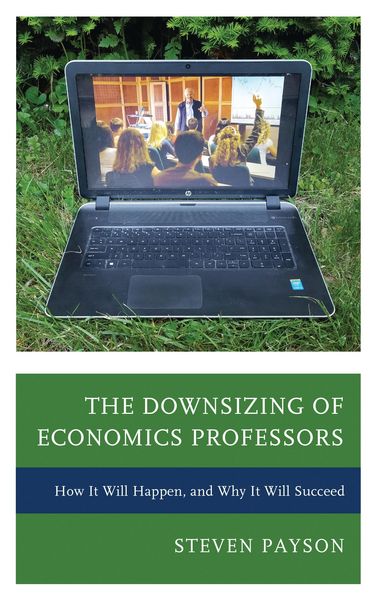
The number of economics professors now teaching at universities will decline substantially over the next couple of decades. This will happen for one main reason-the advent of distance learning, especially in the form of Massive Open Online Courses (MOOCs), which enable a single professor to lecture to tens of thousands of students. Other academic fields will undoubtedly encounter similar reductions in their numbers of professors. However, as this book argues at several levels, academic economics is the one profession that is most qualified to study and address the topic. In this sense it is the one profession that should best recognize the economic benefits of this transition, which this book describes, and take responsibility for leading the transition among all academic fields.
Unfortunately, the position espoused by several academic economists has been against this inevitable transition-a position that politically upholds their employment and the status of their institutions. They have asserted that MOOCs lower the quality of education and threaten the financial viability of traditional universities. Based on extensive evidence and analysis, however, this book argues that their position untenable. Their position is hypocritical as well, given the fact that economics professors, more than anyone else, have upheld the idea that jobs should be lost, and new ones should be gained, in response to technological changes that promote economic efficiency. There is also irony in the fact that the high tuitions required to maintain traditional classrooms effectively deny a college education to those who cannot afford it. Thus, unsound arguments that traditional lectures are needed to preserve the quality of education actually do not improve the quality of education but have the only real effect of denying education to many people who would otherwise be able to receive it.
To address this topic comprehensively, the book goes deep into fundamental questions about what economics professors really do with their time and energy, and what they should be doing in the best interests of their students and of society. These are areas that the profession has needed to address for a long time, but has failed to do so.
Unfortunately, the position espoused by several academic economists has been against this inevitable transition-a position that politically upholds their employment and the status of their institutions. They have asserted that MOOCs lower the quality of education and threaten the financial viability of traditional universities. Based on extensive evidence and analysis, however, this book argues that their position untenable. Their position is hypocritical as well, given the fact that economics professors, more than anyone else, have upheld the idea that jobs should be lost, and new ones should be gained, in response to technological changes that promote economic efficiency. There is also irony in the fact that the high tuitions required to maintain traditional classrooms effectively deny a college education to those who cannot afford it. Thus, unsound arguments that traditional lectures are needed to preserve the quality of education actually do not improve the quality of education but have the only real effect of denying education to many people who would otherwise be able to receive it.
To address this topic comprehensively, the book goes deep into fundamental questions about what economics professors really do with their time and energy, and what they should be doing in the best interests of their students and of society. These are areas that the profession has needed to address for a long time, but has failed to do so.
Kundinnen und Kunden meinen
Verfassen Sie die erste Bewertung zu diesem Artikel
Helfen Sie anderen Kund*innen durch Ihre Meinung