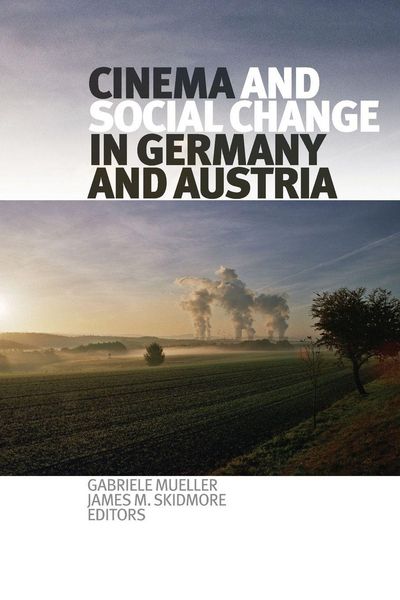
Produktbild: Cinema and Social Change in Germany and Austria

Cinema and Social Change in Germany and Austria

Fr. 62.90

inkl. gesetzl. MwSt., Versandkostenfrei


Beschreibung

Produktdetails

Einband

Taschenbuch

Erscheinungsdatum

20.01.2026

Abbildungen

5 Illustrations, colour - 1 Illustrations, black and white

Herausgeber

Gabriele Mueller + weitere

Verlag

Wilfrid Laurier University Press

Seitenzahl

314

Maße (L/B/H)

22.5/15/1.9 cm

Gewicht

452 g

Sprache

Englisch

ISBN

978-1-55458-560-1

Beschreibung

Rezension

"German-language cinema has always been more diverse than film historians admit. The contributions in this volume challenge us to recognize this heterogeneity in recent, post-millennial films from Germany and Austria. Close readings elaborate how filmmakers respond to the tensions that arise as the national and European social landscape changes, with implications for film aesthetics, funding, production, distribution, and reception. At the same time these crisply written chapters redefine the emerging cinema landscape within transnational market dynamics and capital flow. I recommend this volume to readers seeking to understand the multiplicity and hybridity of the post-1990s "consensus" cinema." - Marc Silberman, University of Wisconsin, editor of The German Wall: Fallout in Europe (2011)

"'Cinema by all means has to be dangerous!' (279) When Barbara Pichler quotes the title of Marcus Seibert's book of interviews with young Austrian filmmakers (2006), she also sums up the fifteen articles of this carefully edited volume, which presents a whole host of refreshing new perspectives on the most recent German-language film productions.... With its helpful abstracts, detailed notes, extensive reference lists, four-page filmography, and twelve-page index the book is an invaluable resource to anyone interested in German cinema in general and twenty-first century German cinema in particular. The articles present a forward-looking engagement with social issues that should serve as valuable reading in courses about contemporary Germany, Austria, and Europe, but also courses that want to explore European perspectives on globalization, or courses about the role of art in pursuit of social justice. They would provide a useful contrast, of course, in comparative courses with North American and other film productions. Indirectly the volume presents a strong case in favour of making all the films discussed available in region 1 format with English subtitles so that this exciting new German cinema can find the audience it deserves." - Sabine von Mering, Brandeis University.

"Cinema and Social Change focuses on two key areas in articulating a vision of contemporary German cinema as both a product and agent of globalization. Its fifteen contributions rethink the category of the national, along with issues of hybridity, identity, and cultural specificity, the age of transnationalism; they also investigate possibilities for experimental aesthetics, unconventional styles, utopian thinking, subversive critique in an era charaterized by the commercial drive of global capital. Spanning the volume"s consideration of both nation and aesthetics is its emphasis on the way contemporary cinema screens history, including the Nazi past, GDR history, and the legacy of both 1968 and domestic terrorism. The grouping of chapters into rubrics, including "Challenging Viewing Habits," "Reassessing and Consuming History," and "Questioning Collective Identities," helps to focus attention on thematic continuities across the volume"s contributions, as does the excellent introduction by Mueller and Skidmore.... [A] major strenghth of the volume is its attention to significant filmmakers who have been under-researched in English-language scholarship.... The engaging and accessible writing and the inclusion of ample colour images make the volume especially appealing; a paperback version would lend itself to course adoption." - Hester Baer, University of Oklahoma.

Portrait

Gabriele Mueller is an associate professor of German Studies and affiliated with the Canadian Centre for German and European Studies at York University, Toronto. Her research focuses mainly on German cultural studies and German film studies. She has published essays on various aspects of post-unification German film, in particular on cinematic contributions to cultural memory discourses.
James M. Skidmore teaches German literature, film, and cultural studies at the University of Waterloo. His research focuses mainly on the intersections of politics, history, and societal development in narrative literature and film. He is the author of The Trauma of Defeat: Ricarda Huch’s Historiography during the Weimar Republic (2005), as well as articles on German and Canadian literature and film.

Produktdetails

Einband

Taschenbuch

Erscheinungsdatum

20.01.2026

Abbildungen

5 Illustrations, colour - 1 Illustrations, black and white

Herausgeber

Verlag

Wilfrid Laurier University Press

Seitenzahl

314

Maße (L/B/H)

22.5/15/1.9 cm

Gewicht

452 g

Sprache

Englisch

ISBN

978-1-55458-560-1

Herstelleradresse

Libri GmbH
Europaallee 1
36244 Bad Hersfeld
DE

Email: gpsr@libri.de

Kundinnen und Kunden meinen

0 Bewertungen

Informationen zu Bewertungen

Zur Abgabe einer Bewertung ist eine Anmeldung im Konto notwendig. Die Authentizität der Bewertungen wird von uns nicht überprüft. Wir behalten uns vor, Bewertungstexte, die unseren Richtlinien widersprechen, entsprechend zu kürzen oder zu löschen.

Die Bewertungen sind nach Format, Anzahl Sterne und Datum sortiert.

Verfassen Sie die erste Bewertung zu diesem Artikel

Helfen Sie anderen Kund*innen durch Ihre Meinung

Kundinnen und Kunden meinen

0 Bewertungen filtern

  • Produktbild: Cinema and Social Change in Germany and Austria
    • List of Illustrations
    • Acknowledgements
    • 1. Gabriele Mueller & James M. Skidmore: Cinema of Dissent? Confronting Social, Economic, and Political Change in German-Language Cinema
    • Challenging Viewing Habits
    • 2. Marco Abel: The Counter-Cinema of the Berlin School
    • 3 Sophie Boyer: The Triumph of Hyperreality: A Baudrillardian Reading of Michael Haneke’s Cinematic Oeuvre
    • 4. Morgan Koerner: Subversions of the Medical Gaze: Disability and Media Parody in Christoph Schlingensief’s Freakstars 3000
    • Reassessing and Consuming History
    • 5. Roger Cook: Literary Discourse and Cinematic Narrative: Scripting Affect in Das Leben der Anderen
    • 6. Alasdair King: Heimat 3: Edgar Reitz’s Time Machine
    • 7. Joanne Leal: Troubled Parents, Angry Children: The Difficult Legacy of 1968 in Contemporary German-Language Film
    • 8. Mary-Elizabeth O’Brien: Creative Chaos as Political Strategy in Recent German-Language Cinema
    • 9. Florentine Strzelczyk: “Looking for an Old Man with a Black Moustache”: Hitler, Humour, Fake, and Forgery in Schtonk!
    • 10. Peter Gölz: Haha Hitler! Coming to Terms with Dani Levy
    • Questioning Collective Identities
    • 11. Myriam Léger: German Fascination for Jews in Oliver Hirschbiegel’s Ein ganz gewöhnlicher Jude
    • 12. Jakub Kazecki: Border, Bridge, or Barrier? Images of German–Polish Borderlands in German Cinema of the 2000s
    • 13. Michael Zimmermann: The Transnational Deutschkei in Yilmaz Arslan’s Brudermord
    • 14. Alice Kuzniar: Diasporic Queers: Reading for the Intersections of Alterities in Recent German Cinema
    • An Insider’s View
    • 15. Barbara Pichler: The Construction of Reality: Aspects of Austrian Cinema between Fiction and Documentary
    • Filmography
    • Notes on Contributors
    • Index