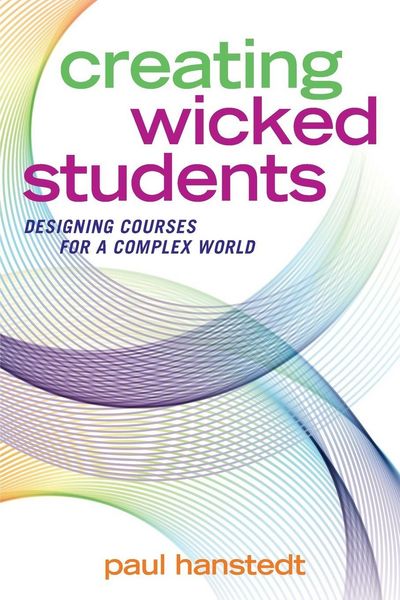
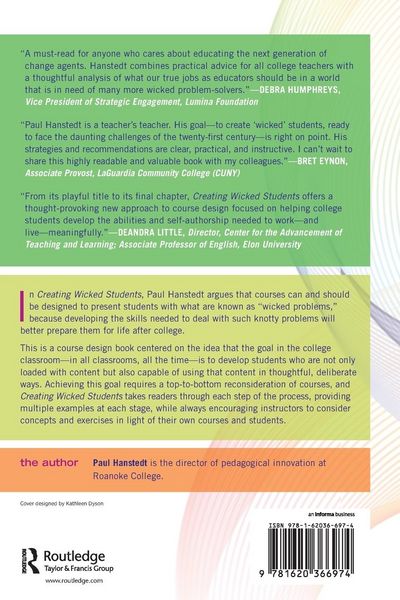
"This book could be useful as an introduction to course design for someone less familiar with the fundamentals, such as how to develop measurable learning outcomes, align course goals with institutional goals, nest content within higher-order goals, engage students' prior knowledge, or incorporate applied learning. The structure of the book allows for one to follow it step-by-step as a course design manual, and it also includes recursive 'intermissions' to encourage reflection along the way. In addition, his discussion of how to prompt critical thinking through multiple-choice exams offers helpful strategies for encouraging students to explain their thinking on ambiguous questions with follow-up questions that explain or justify their choice."
Reflective Teaching
"Creating Wicked Students is one of the best books I have read in the last decade. I am a mid-career teacher educator and scholar in an English department, and I wish I had read this book when I was a doctoral student. Nevertheless, this outstanding text has a lot to offer for all scholars trying to adapt to changing technologies and learner populations, providing innovative and practical strategies for course design.
The main argument of the book centers around the idea that we live in a changing, unpredictable world where the demands and expectations placed on graduates are constantly changing. According to Hanstedt, 'we need wicked graduates with wicked competencies', which he argues are developed when students are provided with opportunities to apply and use information instead of just receiving it. In a highly accessible and reader-friendly way, Hanstedt explains how this is done. He innovatively illustrates how to build such measurable, clear, and meaningful goals for learning outcomes.
In conclusion, [this] is a must-read for anyone teaching at the college level. The book provides incredibly useful information not only for current faculty but also for doctoral students who will soon assume faculty positions. Paul Hanstedt provides a compelling and thoughtful argument throughout the book that we, college instructors, need to reconsider the skills, goals, concepts, teaching methods, and assessment techniques in our classrooms so that our students, no matter what field they are in, are equipped with the skills, strategies, and knowledge necessary to face the daunting challenges of life after college."
Teachers College Record
"Paul Hanstedt is a teacher's teacher. He approaches the college classroom with a combination of excitement, experience, skill, and humor. His goal - to create 'wicked' students, ready to face the daunting challenges of the twenty-first century - is right on point. And his strategies and recommendations are clear, practical and instructive. I can't wait to share this highly readable and valuable book with my colleagues."
Bret Eynon, Associate Provost, LaGuardia Community College (CUNY), Co-Author, High Impact ePortfolio Practice: Catalyst for Student, Faculty and Institutional Learning
"A must-read for anyone who cares about educating the next generation of change agents. Hanstedt combines practical advice for all college teachers committed to learning outcomes that will help students thrive post-graduation with a thoughtful analysis of what our true jobs as educators should be in a world that is in flux, deeply inequitable, but also in need of many more wicked problem-solvers."
Debra Humphreys, Ph.D., Vice President of Strategic Engagement
Lumina Foundation
"Hanstedt's conversational tone conjures feelings of sitting with a colleague sharing ideas, brainstorming, and exchanging stories over coffee with lots of laughs. At first, I didn't want to participate in the "Designing Your Course" sections. But by the first "Intermission" I was so inspired I was engaging in all activities, ideas pouring out as if attending a great conference. Hanstedt uses his own wicked design within his book, resulting in an overwhelming sense of authority for the reader, indeed demonstrating the power of wickedness."
Kim Whiter, Director of Faculty Development
Jefferson College of Health Sciences
"Creating Wicked Students places faculty members in the role of engaged learners where the skillful Dr. Paul Hanstedt guides them to construct curricula, courses and assignments that will prepare students to participate in the world in active and constructive ways. Faculty readers become Dr. Hanstedt's 'wicked students,' equipped to transfer the skills practiced in this book to challenge their own students to do their best work."
Amy Sarch, Phd, Associate Vice President for Academic Affairs
Shenandoah University
"Hanstedt's Creating Wicked Students is, as they say in Boston, "wicked good"-a clear, clever, and creative step-by-step guide to creating courses that help shape students who are ready to engage with and make a positive impact on the world in which we live."
Michael Reder, Director, Joy Shechtman Mankoff Faculty Center for Teaching & Learning
Connecticut College
"From its playful title to its final chapter, Creating Wicked Students offers a thought-provoking new approach to course design focused on helping college students develop the abilities and self-authorship needed to work -and live-meaningfully. Hanstedt guides the reader through a design process for courses where students learn skills and content, but more significantly, develop 'the ability to step into a complex, messy world and interact with that world in thoughtful and productive ways'."
Deandra Little, Director, Center for the Advancement of Teaching and Learning and Associate Professor of English
Elon University
"I consider myself an experienced professor, and I put a lot of work and time into designing and redesigning my courses every semester; however, Creating Wicked Students: Designing Courses for a Complex World opened my eyes to how I can improve my classes and better prepare my students to be creative, critical, and contributing members of a particular field and of society at large; in other words, how to be 'wicked students.' Most educators want students to participate in life in 'thoughtful and constructive ways, and Paul Hanstedt provides readers with valuable resources and guidelines for doing just that at the course level. He focuses on giving students authority through 'authorship, the ability to write and rewrite, shape, and create'. Our courses, he contends, must be training grounds for students to practice authority while they are learning, not delaying the practice for when they graduate. Thus, this book is intended to help instructors design courses that 'develop students' capacity to be engaged and deliberate citizens' who 'engage in meaningful dialogue with the larger sociopolitical contexts beyond college'. Chapters are scaffolded to address course design issues as a progression: goals, course structure, assignments, exams, pedagogical techniques, and assessment. There are even two stopping points in the book, Intermission chapters, that encourage readers to pause, reflect on previous chapters, the exercises they've worked through, and prepare for the next section. Hanstedt does a superb job of not locking assignments into certain disciplines; he explains and shows how one assignment in social sciences, for instance, can be modified to fit an English class. By the time readers reach the end of the book that includes six appendices with six different assignments, it is easy to see how those assignments can be revised for almost any course a reader may teach."
Technical Communication