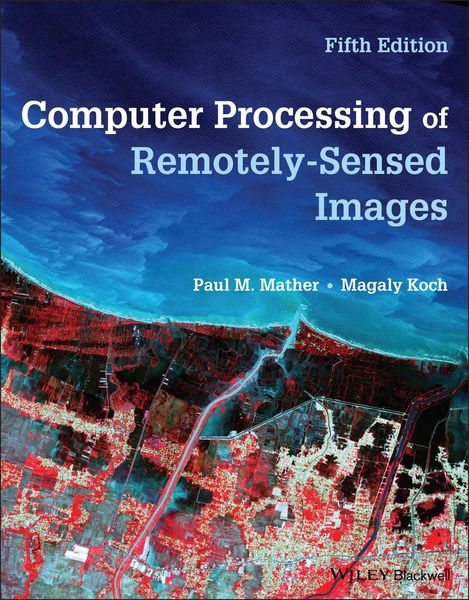
Computer Processing of Remotely-Sensed Images
-
- Hardcover
- Taschenbuch ausgewählt
- eBook
-
Sprache:Englisch
-
Verlag:John Wiley & Sons
-
Auflage:5th edition
- 5th edition Fr. 149.00 ausgewählt
- 1. Auflage Fr. 93.90
Fr. 149.00
inkl. gesetzl. MwSt.,
Beschreibung
Produktdetails
Einband
Taschenbuch
Erscheinungsdatum
11.04.2022
Verlag
John Wiley & SonsSeitenzahl
384
Maße (L/B/H)
27.4/21.4/2 cm
Gewicht
1021 g
Auflage
5th edition
Sprache
Englisch
ISBN
978-1-119-50282-1
Computer Processing of Remotely-Sensed Images
A thorough introduction to computer processing of remotely-sensed images, processing methods, and applications
Remote sensing is a crucial form of measurement that allows for the gauging of an object or space without direct physical contact, allowing for the assessment and recording of a target under conditions which would normally render access difficult or impossible. This is done through the analysis and interpretation of electromagnetic radiation (EMR) that is reflected or emitted by an object, surveyed and recorded by an observer or instrument that is not in contact with the target. This methodology is particularly of importance in Earth observation by remote sensing, wherein airborne or satellite-borne instruments of EMR provide data on the planet's land, seas, ice, and atmosphere. This permits scientists to establish relationships between the measurements and the nature and distribution of phenomena on the Earth's surface or within the atmosphere.
Still relying on a visual and conceptual approach to the material, the fifth edition of this successful textbook provides students with methods of computer processing of remotely sensed data and introduces them to environmental applications which make use of remotely-sensed images. The new edition's content has been rearranged to be more clearly focused on image processing methods and applications in remote sensing with new examples, including material on the Copernicus missions, microsatellites and recently launched SAR satellites, as well as time series analysis methods.
The fifth edition of Computer Processing of Remotely-Sensed Images also contains:
* A cohesive presentation of the fundamental components of Earth observation remote sensing that is easy to understand and highly digestible
* Largely non-technical language providing insights into more advanced topics that may be too difficult for a non-mathematician to understand
* Illustrations and example boxes throughout the book to illustrate concepts, as well as revised examples that reflect the latest information
* References and links to the most up-to-date online and open access sources used by students
Computer Processing of Remotely-Sensed Images is a highly insightful textbook for advanced undergraduates and postgraduate students taking courses in remote sensing and GIS in Geography, Geology, and Earth & Environmental Science departments.
A thorough introduction to computer processing of remotely-sensed images, processing methods, and applications
Remote sensing is a crucial form of measurement that allows for the gauging of an object or space without direct physical contact, allowing for the assessment and recording of a target under conditions which would normally render access difficult or impossible. This is done through the analysis and interpretation of electromagnetic radiation (EMR) that is reflected or emitted by an object, surveyed and recorded by an observer or instrument that is not in contact with the target. This methodology is particularly of importance in Earth observation by remote sensing, wherein airborne or satellite-borne instruments of EMR provide data on the planet's land, seas, ice, and atmosphere. This permits scientists to establish relationships between the measurements and the nature and distribution of phenomena on the Earth's surface or within the atmosphere.
Still relying on a visual and conceptual approach to the material, the fifth edition of this successful textbook provides students with methods of computer processing of remotely sensed data and introduces them to environmental applications which make use of remotely-sensed images. The new edition's content has been rearranged to be more clearly focused on image processing methods and applications in remote sensing with new examples, including material on the Copernicus missions, microsatellites and recently launched SAR satellites, as well as time series analysis methods.
The fifth edition of Computer Processing of Remotely-Sensed Images also contains:
* A cohesive presentation of the fundamental components of Earth observation remote sensing that is easy to understand and highly digestible
* Largely non-technical language providing insights into more advanced topics that may be too difficult for a non-mathematician to understand
* Illustrations and example boxes throughout the book to illustrate concepts, as well as revised examples that reflect the latest information
* References and links to the most up-to-date online and open access sources used by students
Computer Processing of Remotely-Sensed Images is a highly insightful textbook for advanced undergraduates and postgraduate students taking courses in remote sensing and GIS in Geography, Geology, and Earth & Environmental Science departments.
Noch keine Bewertungen vorhanden
Verfassen Sie die erste Bewertung zu diesem Artikel
Helfen Sie anderen Kundinnen und Kunden durch Ihre Meinung.