• Produktbild: Simulations of Decision-Making as Active Learning Tools
  • Produktbild: Simulations of Decision-Making as Active Learning Tools
Band 22

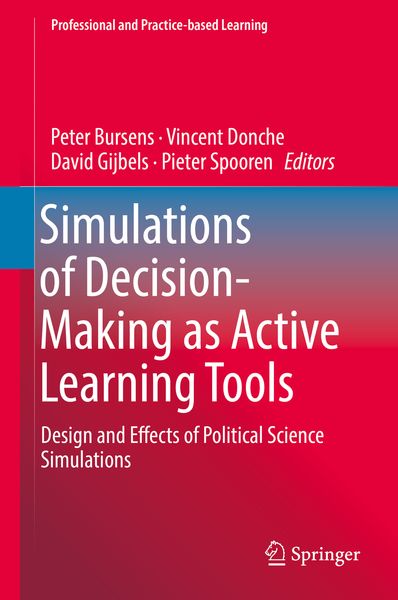
Simulations of Decision-Making as Active Learning Tools Design and Effects of Political Science Simulations

Fr. 73.90

inkl. gesetzl. MwSt., Versandkostenfrei


Beschreibung

Produktdetails

Einband

Gebundene Ausgabe

Erscheinungsdatum

15.03.2018

Abbildungen

XIII, 19 illus., schwarz-weiss Illustrationen

Herausgeber

Peter Bursens + weitere

Verlag

Springer

Seitenzahl

206

Maße (L/B/H)

24.1/16/1.8 cm

Gewicht

500 g

Auflage

1st ed. 2018

Sprache

Englisch

ISBN

978-3-319-74146-8

Beschreibung

Produktdetails

Einband

Gebundene Ausgabe

Erscheinungsdatum

15.03.2018

Abbildungen

XIII, 19 illus., schwarz-weiss Illustrationen

Herausgeber

Verlag

Springer

Seitenzahl

206

Maße (L/B/H)

24.1/16/1.8 cm

Gewicht

500 g

Auflage

1st ed. 2018

Sprache

Englisch

ISBN

978-3-319-74146-8

Herstelleradresse

Springer-Verlag KG
Sachsenplatz 4-6
1201 Wien
AT

Email: ProductSafety@springernature.com

Kundinnen und Kunden meinen

0 Bewertungen

Informationen zu Bewertungen

Zur Abgabe einer Bewertung ist eine Anmeldung im Konto notwendig. Die Authentizität der Bewertungen wird von uns nicht überprüft. Wir behalten uns vor, Bewertungstexte, die unseren Richtlinien widersprechen, entsprechend zu kürzen oder zu löschen.

Die Bewertungen sind nach Format, Anzahl Sterne und Datum sortiert.

Verfassen Sie die erste Bewertung zu diesem Artikel

Helfen Sie anderen Kund*innen durch Ihre Meinung

Kundinnen und Kunden meinen

0 Bewertungen filtern

  • Produktbild: Simulations of Decision-Making as Active Learning Tools
  • Produktbild: Simulations of Decision-Making as Active Learning Tools
  • Chapter 1 Preface: Simulations of decision-making in political science education, Pieter Spooren, Dorothy Duchatelet, Peter Bursens, David Gijbels & Vincent Donche.- Chapter 2 Introduction Part 1: Design and assessment of simulations, Peter Bursens, David Gijbels, Vincent Donche & Pieter Spooren.- Chapter 3 The  costs  and  benefits  of  organizing  a  multi-institutional simulation  on  the European Union, Andreas Sobisch, John Scherpereel, Peter Loedel, Gretchen Van Dyke & Nick Clark.- Chapter 4 Do simulations enhance decision making in the EU Financial Services? John T. Ryan.- Chapter 5 What’s the EU? Achieving learning outcomes and preparing U.S. students for EuroSim, Rebecca Jones.- Chapter 6 Mission impossible? Verisimilitude in EU simulations, Pierpaolo Settembri & Marco Brunazzo.- Chapter 7 "Will it blend?" Combining online and on-site elements in simulation games, Simon Raiser, Björn Warkalla, Annegret Schneider & Konstantin Kaiser.- Chapter 8 Oranges and Apples? Using Comparative Judgement for reliable briefing paper assessment in simulation games, Pierpaolo Settembri,  Roos Van Gasse,  Liesje Coertjens & Sven De Maeyer.- Chapter 9 Assessment Strategies in Simulation Games, Simon Usherwood.- Chapter 10 Introduction Part 2: Investigating student learning and outcomes in simulation-based learning environments, Vincent Donche, David Gijbels, Pieter Spooren & Peter Bursens.- Chapter 11 Simulating European climate policy negotiations in a teacher training seminar – which effects can Be detected? Sophie Wulk.- Chapter 12 Effects of EU simulation games on secondary school pupils` political motivations, attitudes and knowledge – results of an intervention study, Monika Oberle, Sven Ivens & Johanna Leunig.- Chapter 13 Learning effects of negotiation simulations – evidence from different student cohorts , Morten Kallestrup.- Chapter 14 Simulations are no‘one-for-all’ experience: how participants vary in their development of self-efficacy for negotiating, Dorothy Duchatelet.- Chapter 15 Simulations of decision-making in political science education: premises, promises and challenges, David Gijbels, Pieter Spooren, Peter Bursens & Vincent Donche.