• Produktbild: The Oxford Handbook of Historical Ecology and Applied Archaeology
  • Produktbild: The Oxford Handbook of Historical Ecology and Applied Archaeology

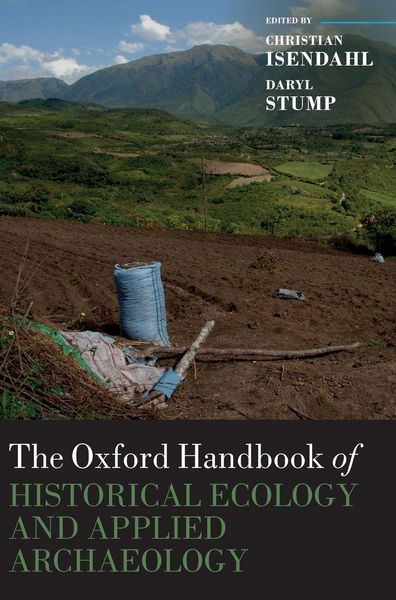
The Oxford Handbook of Historical Ecology and Applied Archaeology

Fr. 213.00

inkl. gesetzl. MwSt., Versandkostenfrei


Beschreibung

Produktdetails

Einband

Gebundene Ausgabe

Erscheinungsdatum

11.01.2019

Herausgeber

Christian Isendahl + weitere

Verlag

Oxford University Press

Seitenzahl

656

Maße (L/B/H)

25/17.5/3.9 cm

Gewicht

1482 g

Sprache

Englisch

ISBN

978-0-19-967269-1

Beschreibung

Produktdetails

Einband

Gebundene Ausgabe

Erscheinungsdatum

11.01.2019

Herausgeber

Verlag

Oxford University Press

Seitenzahl

656

Maße (L/B/H)

25/17.5/3.9 cm

Gewicht

1482 g

Sprache

Englisch

ISBN

978-0-19-967269-1

Herstelleradresse

Libri GmbH
Europaallee 1
36244 Bad Hersfeld
DE

Email: gpsr@libri.de

Kundinnen und Kunden meinen

0 Bewertungen

Informationen zu Bewertungen

Zur Abgabe einer Bewertung ist eine Anmeldung im Konto notwendig. Die Authentizität der Bewertungen wird von uns nicht überprüft. Wir behalten uns vor, Bewertungstexte, die unseren Richtlinien widersprechen, entsprechend zu kürzen oder zu löschen.

Die Bewertungen sind nach Format, Anzahl Sterne und Datum sortiert.

Verfassen Sie die erste Bewertung zu diesem Artikel

Helfen Sie anderen Kund*innen durch Ihre Meinung

Kundinnen und Kunden meinen

0 Bewertungen filtern

Die Leseprobe wird geladen.
  • Produktbild: The Oxford Handbook of Historical Ecology and Applied Archaeology
  • Produktbild: The Oxford Handbook of Historical Ecology and Applied Archaeology
    • Introduction: The Construction of the Present through the Reconstruction of the Past.

    • Part 1: Potential and Pitfalls

    • Introduction

    • 1: Carole Crumley: New Paths into the Anthropocene: Applying Historical Ecologies to the Human Future

    • 2: Paul Minnis: Thinking Like an Archaeologist and Thinking Like an Engineer: A Utilitarian-Perspective Archaeology

    • 3: William E. Doolittle: Expedience, Impermanence, and Unplanned Obsolescence: The Coming-About of Agricultural Features and Landscapes

    • 4: Paul J. Lane: Just How Long Does 'Long-Term' Have to Be? Matters of Temporal Scale as Impediments to Interdisciplinary Understanding in Historical Ecology

    • 5: Anneli Ekblom: Archaeology, Historical Sciences, and Environmental Conservation

    • 6: Manuel Arroyo-Kalin: Landscaping, Landscape Legacies, and Landesque Capital in Pre-Columbian Amazonia

    • 7: Karl Butzer: Integrating Geoarchaeology with Archaeology for Interdisciplinary Understanding of Societal-Environmental Relations

    • Part 2: Approaches and Applications

    • Introduction

    • 8: Daryl Stump: Digging for Indigenous Knowledge: 'Reverse Engineering' and Stratigraphic Sequencing as a Potential Archaeological Contribution to Sustainability Assessments

    • 9: Anabel Ford and Keith C. Clarke: Linking the Past and Present of the Ancient Maya: Lowland Land Use, Population Distribution, and Density in the Late Classic Period

    • 10: R. Lee Lyman: Paleozoology Is Valuable to Conservation Biology

    • 11: Ashley Coutu: Historic Molecules Connect the Past to Modern Conservation

    • 12: Megan Hicks, Árni Einarsson, Kesara Anamthawat-Jónsson, Ágústa Edwald, Ægir Thór Thórsson, and Thomas H. McGovern: Community and Conservation: Documenting Millennial Scale Sustainable Resource Use at Lake Mývatn, Iceland

    • 13: Federica Sulas: Soils, Plants, and Texts: An Archaeologist's Toolbox

    • 14: Charles French: Grappling with Interpreting and Testing People-Landscape Dynamics

    • 15: C. Michael Barton: From Narratives to Algorithms: Extending Archaeological Explanation beyond Archaeology

    • 16: Scott Heckbert, Christian Isendahl, Joel D. Gunn, Simon Brewer, Vernon L. Scarborough, Arlen F. Chase, Diane Z. Chase, Robert Costanza, Nicholas P. Dunning, Timothy Beach, Sheryl Luzzadder-Beach, David Lentz, and Paul Sinclair: Growing the Ancient Maya Social-Ecological System from the Bottom Up

    • 17: Karl-Johan Lindholm: Wells, Land, and History: Archaeology and Rural Development in Southern Africa

    • 18: Camilla Årlin, Lowe Börjeson, and Wilhelm Östberg: Participatory Checking and the Temporality of Landscapes: Increasing Trust and Relevance in Qualitative Research

    • 19: William Balée and Justin Nolan: Freelisting as a Tool for Assessing Cognitive Realities of Landscape Transformation: A Case Study from Amazonia

    • Part 3: Reviving Past Technologies

    • Introduction

    • 20: Matthew Spriggs: A 1980 Attempt at Reviving Ancient Irrigation Practices in the Pacific: Rationale, Failure, and Success

    • 21: Lorenzo Caponetti: The Invisible Landscape: The Etruscan Cuniculi of Tuscania as a Determinant of Present-Day Landscape and a Valuable Tool for Sustainable Water Management

    • 22: Ann Kendall and David Drew: The Rehabilitation of Pre-Hispanic Agricultural Infrastructure to Support Rural Develoment in the Peruvian Andes: The Work of the Cusichaca Trust

    • 23: Jago Cooper and Lindsay Duncan: Applied Archaeology in the Americas: Evaluating Archaeological Solutions to the Impacts of Global Environmental Change

    • 24: Alexander Herrera: Indigenous Technologies, Archaeology, and Rural Development in the Andes: Three Decades of Trials in Bolivia, Ecuador, and Peru

    • Part 4: Bridging the Past and Present

    • Introduction

    • 25: Michael E. Smith: Quality of Life and Prosperity in Ancient Households and Communities

    • 26: Christian Isendahl, Vernon L. Scarborough, Joel D. Gunn, Nicholas P. Dunning, Scott L. Fedick, Gyles Iannone, and Lisa J. Lucero: Applied Perspectives on Pre-Columbian Maya Water Management Systems: What are the Insights for Water Security?

    • 27: Paul Sinclair, Christian Isendahl, and Stephan Barthel: Beyond Rhetoric: Towards a Framework for an Applied Historical Ecology of Urban Planning

    • 28: E. Christian Wells: Culture, Power, History: Implications for Understanding Global Environmental Change

    • 29: Joseph A. Tainter and T. F. H. Allen: Energy Gain and the Evolution of Organization

    • 30: Christian Isendahl and Daryl Stump: Conclusion: Anthropocentric Historical Ecology, Applied Archaeology, and the Future of a Useable Past