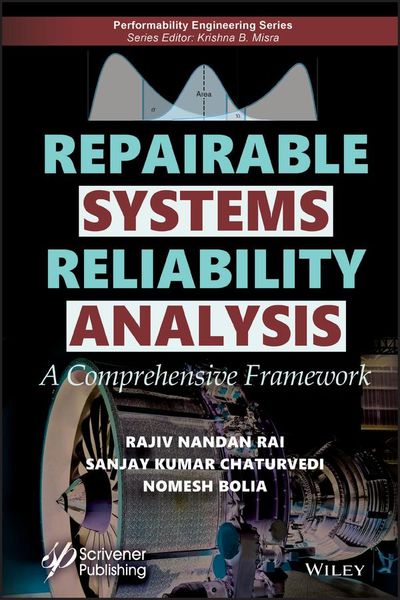
Repairable Systems Reliability Analysis A Comprehensive Framework
Fr. 309.00
inkl. gesetzl. MwSt.,
Beschreibung
Produktdetails
Einband
Gebundene Ausgabe
Erscheinungsdatum
20.10.2020
Verlag
John Wiley & SonsSeitenzahl
400
Maße (L/B/H)
23.9/16/2.5 cm
Gewicht
703 g
Auflage
1. Auflage
Sprache
Englisch
ISBN
978-1-119-52627-8
This book provides an application-oriented framework for reliability modeling and analysis of repairable systems in conjunction with the procurement process of weapon systems and throughput analysis for industries.
Most of the reliability literature is directed towards non-repairable systems, that is, systems that fail are discarded or replaced. This book is mainly dedicated towards providing coverage to the reliability modeling and analysis of repairable systems that undergo failure-repair cycles.
This unique book provides a comprehensive framework for the modeling and analysis of repairable systems considering both the non-parametric and parametric approaches to deal with their failure data. The book presents MCF based non-parametric approach with several illustrative examples and the generalized renewal process (GRP) based arithmetic reduction of age (ARA) models along with its applications to the systems failure data from the aviation industry. A complete chapter on an integrated framework for procurement process is devoted by utilizing the concepts of multi-criteria decision-making (MCDM) techniques which will of a great assistance to the readers in enhancing the potential of their respective organizations. This book also presents FMEA methods tailored for GRP based repairs.
This text has primarily emerged from the industrial experience and research work of the authors. A number of illustrations have been included to make the subject lucid and vivid even to the readers who are relatively new to this area. Besides, various examples have been provided to display the applicability of presented models and methodologies to assist the readers in applying the concepts presented in this book.
Most of the reliability literature is directed towards non-repairable systems, that is, systems that fail are discarded or replaced. This book is mainly dedicated towards providing coverage to the reliability modeling and analysis of repairable systems that undergo failure-repair cycles.
This unique book provides a comprehensive framework for the modeling and analysis of repairable systems considering both the non-parametric and parametric approaches to deal with their failure data. The book presents MCF based non-parametric approach with several illustrative examples and the generalized renewal process (GRP) based arithmetic reduction of age (ARA) models along with its applications to the systems failure data from the aviation industry. A complete chapter on an integrated framework for procurement process is devoted by utilizing the concepts of multi-criteria decision-making (MCDM) techniques which will of a great assistance to the readers in enhancing the potential of their respective organizations. This book also presents FMEA methods tailored for GRP based repairs.
This text has primarily emerged from the industrial experience and research work of the authors. A number of illustrations have been included to make the subject lucid and vivid even to the readers who are relatively new to this area. Besides, various examples have been provided to display the applicability of presented models and methodologies to assist the readers in applying the concepts presented in this book.
Kundinnen und Kunden meinen
Verfassen Sie die erste Bewertung zu diesem Artikel
Helfen Sie anderen Kund*innen durch Ihre Meinung