• Produktbild: Overcoming Students' Misconceptions in Science
  • Produktbild: Overcoming Students' Misconceptions in Science

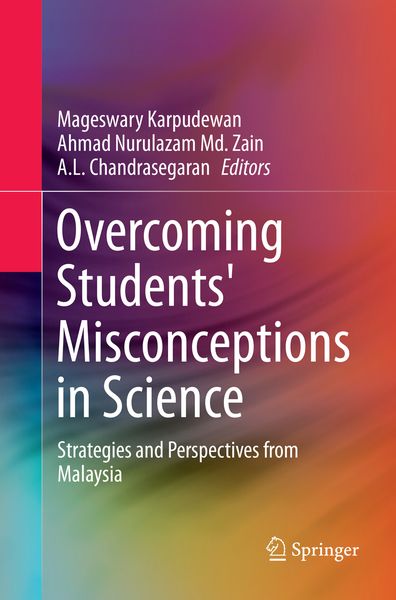
Overcoming Students' Misconceptions in Science Strategies and Perspectives from Malaysia

Fr. 210.00

inkl. gesetzl. MwSt., Versandkostenfrei


Beschreibung

Produktdetails

Einband

Taschenbuch

Erscheinungsdatum

04.05.2018

Abbildungen

XVI, 52 illus., schwarz-weiss Illustrationen

Herausgeber

Mageswary Karpudewan + weitere

Verlag

Springer Singapore

Seitenzahl

344

Maße (L/B/H)

23.5/15.5/2 cm

Gewicht

546 g

Auflage

Softcover reprint of the original 1st edition 2017

Sprache

Englisch

ISBN

978-981-10-9873-4

Beschreibung

Portrait

Dr. Mageswary Karpudewan, co-editor and contributor, is an Associate Professor at the School of Educational Studies, USM. She began her career in education as a chemistry teacher in 1996. Subsequently, she joined USM as a chemistry educator in 2011. Her research interests include integrating green chemistry into teaching and learning of secondary-school science and chemistry and teacher education programs. Dr. Mageswary is an active Editorial Board member for the International Journal of Science and Environmental Education (SCOPUS indexed) and Eurasian Journal of Physics and Chemistry Education.  She is also an active reviewer for various science education journals. Her works have been published in national and international journals, and she has written chapters in books and monographs that have been published at both the national and international level. 

Dr. Ahmad Nurulazam Md. Zain, co-editor, is a Professor at the School of Educational Studies, USM.  He has more than 25 years of teaching and research experience at USM including a short stint at King’s College London. He was Director of the National Higher Education Research Institute, Deputy Dean of the School of Educational Studies, USM and Program Manager at the Centre of Education and Training in Renewable Energy. His research areas include science education, higher education and computer education. His works have been published in national and international journals. He has also written chapters in books and monographs that have been published at boththe national and international level.

Dr. A.L. Chandrasegaran, co-editor, is a Research Associate at the STEM Education Research Group, part of the School of Education at Curtin University in Perth, Australia. After obtaining a BSc (Hons) from the University of Canterbury, Christchurch, NZ and a Teaching Diploma from the Christchurch Teachers’ College on a Colombo Plan scholarship, he began his career in education as a chemistry teacher at English College, Johor Bahru in 1966, then was Johor State Science Supervisor before retiring as Principal of Sultan Ibrahim Secondary School in Kulai. He subsequently taught general science and chemistry in Singapore and Perth before joining Curtin University in 2005 after obtaining an MSc (Sc.Ed.) and PhD from Curtin University. His research interests include evaluating students’ understanding of science concepts and developing two-tier multiple-choice diagnostic assessments in science.

Produktdetails

Einband

Taschenbuch

Erscheinungsdatum

04.05.2018

Abbildungen

XVI, 52 illus., schwarz-weiss Illustrationen

Herausgeber

Verlag

Springer Singapore

Seitenzahl

344

Maße (L/B/H)

23.5/15.5/2 cm

Gewicht

546 g

Auflage

Softcover reprint of the original 1st edition 2017

Sprache

Englisch

ISBN

978-981-10-9873-4

Herstelleradresse

Springer-Verlag GmbH
Tiergartenstr. 17
69121 Heidelberg
DE

Email: ProductSafety@springernature.com

Kundinnen und Kunden meinen

0 Bewertungen

Informationen zu Bewertungen

Zur Abgabe einer Bewertung ist eine Anmeldung im Konto notwendig. Die Authentizität der Bewertungen wird von uns nicht überprüft. Wir behalten uns vor, Bewertungstexte, die unseren Richtlinien widersprechen, entsprechend zu kürzen oder zu löschen.

Die Bewertungen sind nach Format, Anzahl Sterne und Datum sortiert.

Verfassen Sie die erste Bewertung zu diesem Artikel

Helfen Sie anderen Kund*innen durch Ihre Meinung

Kundinnen und Kunden meinen

0 Bewertungen filtern

  • Produktbild: Overcoming Students' Misconceptions in Science
  • Produktbild: Overcoming Students' Misconceptions in Science
  • Chapter 1 Misconceptions in science education: An overview.- Part I: Misconceptions identified during teaching and learning of primary science and strategies used to address the identified misconceptions.- Chapter 2 Utilizing concept cartoons to diagnose and remediate misconceptions related to photosynthesis among primary school students.- Chapter 3 Facilitating primary school students' understanding of water cycle through guided inquiry-based learning.- Chapter 4 A study on addressing students' misconceptions about condensation using the Predict-Discuss-Explain-Observe-Discuss-Explain (PDEODE) strategy.- Chapter 5 Inquiry-discovery teaching approach as a means to remediate primary students' misconceptions about the phases of the moon.- Part II: Misconceptions about Chemistry concepts and strategies to address the identified misconceptions.- Chapter 6 Misconceptions in electrochemistry: How do pedagogical agents help?.- Chapter 7 The effectiveness of Computer-Assisted Instruction (CAI) in promoting pre-university students' understanding of chemical bonding and remediating their misconceptions.- Chapter 8 Green chemistry-based Dual-Situated Learning Model: An approach that reduces students' misconceptions on acids and bases.- Chapter 9 The effectiveness of Physical Education Technology (PhET) interactive simulations in enhancing matriculation students' understanding of chemical equilibrium and remediating their misconceptions.- Part III: Misconceptions about Physics concepts and strategies to address the identified misconceptions.- Chapter 10 The integration of fund of knowledge in the hybridization cognitive strategy to enhance secondary students' understanding of physics optical concepts and remediating their misconceptions.- Chapter 11 Fostering understanding and reducing misconceptions about image formation by a plane mirror using constructivist-based hands-on activities.- Chapter 12 Addressing secondary school students' misconceptions about simple current circuits using the learning cycle approach.- Chapter 13 The use of the Process Oriented Guided-Inquiry Learning (POGIL) approach to address Form One students' misconceptions about weight and mass.- Part IV: Misconceptions relevant to Biology concepts and strategies to address the identified misconceptions.- Chapter 14 Improving understanding and reducing matriculation students' misconceptions in immunity using the flipped classroom.- Chapter 15 Improving understanding and reducing secondary school students' misconceptions on cell division using animation-based instruction.- Chapter 16 Comparison between realistic and non-realistic simulations in reducing secondary school students' misconceptions on mitosis and meiosis processes.- Chapter 17 Climate change activities: A possible means to promote understanding and reduce misconceptions about acid rain, global warming, greenhouse effect and ozone layer depletion among secondary school students.