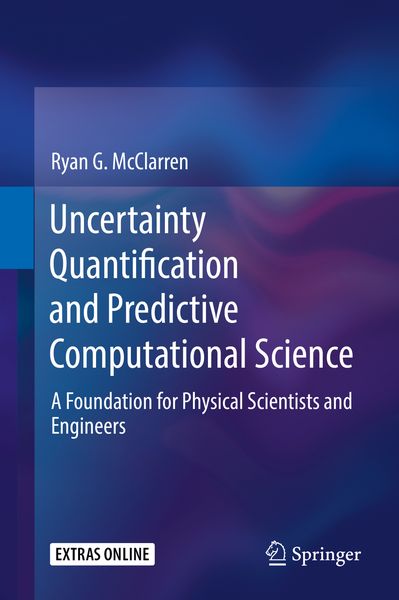
Uncertainty Quantification and Predictive Computational Science A Foundation for Physical Scientists and Engineers
Fr. 138.00
inkl. gesetzl. MwSt.,
Beschreibung
Produktdetails
Einband
Gebundene Ausgabe
Erscheinungsdatum
05.12.2018
Abbildungen
XVII, 141 illus., 99 illus. in color., schwarz-weiss Illustrationen, farbige Illustrationen
Verlag
SpringerSeitenzahl
345
Maße (L/B/H)
24.1/16/2.6 cm
Gewicht
711 g
Auflage
1st ed. 2018
Sprache
Englisch
ISBN
978-3-319-99524-3
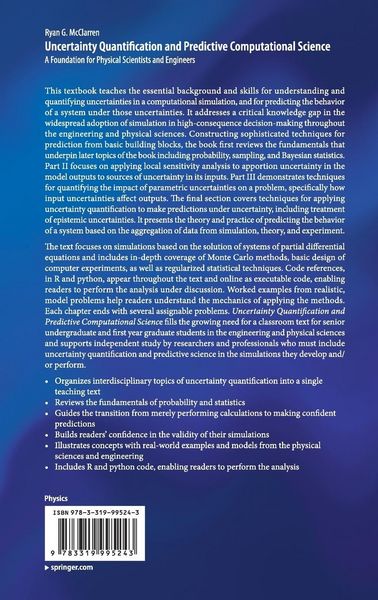
This textbook teaches the essential background and skills for understanding and quantifying uncertainties in a computational simulation, and for predicting the behavior of a system under those uncertainties. It addresses a critical knowledge gap in the widespread adoption of simulation in high-consequence decision-making throughout the engineering and physical sciences.
Constructing sophisticated techniques for prediction from basic building blocks, the book first reviews the fundamentals that underpin later topics of the book including probability, sampling, and Bayesian statistics. Part II focuses on applying Local Sensitivity Analysis to apportion uncertainty in the model outputs to sources of uncertainty in its inputs. Part III demonstrates techniques for quantifying the impact of parametric uncertainties on a problem, specifically how input uncertainties affect outputs. The final section covers techniques for applying uncertainty quantification to make predictions underuncertainty, including treatment of epistemic uncertainties. It presents the theory and practice of predicting the behavior of a system based on the aggregation of data from simulation, theory, and experiment.
The text focuses on simulations based on the solution of systems of partial differential equations and includes in-depth coverage of Monte Carlo methods, basic design of computer experiments, as well as regularized statistical techniques. Code references, in python, appear throughout the text and online as executable code, enabling readers to perform the analysis under discussion. Worked examples from realistic, model problems help readers understand the mechanics of applying the methods. Each chapter ends with several assignable problems.
Uncertainty Quantification and Predictive Computational Scienc e fills the growing need for a classroom text for senior undergraduate and early-career graduate students in the engineering and physical sciences and supports independent study by researchers and professionals who must include uncertainty quantification and predictive science in the simulations they develop and/or perform.
Kundinnen und Kunden meinen
Verfassen Sie die erste Bewertung zu diesem Artikel
Helfen Sie anderen Kund*innen durch Ihre Meinung