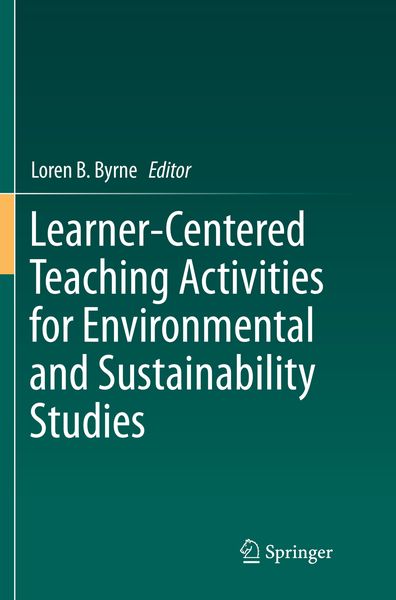
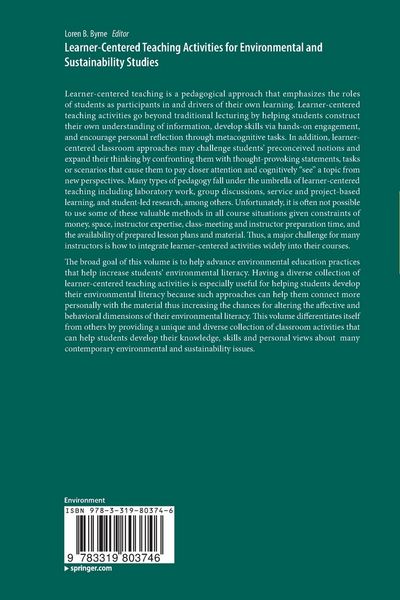
• Produktbild: Learner-Centered Teaching Activities for Environmental and Sustainability Studies
  • Produktbild: Learner-Centered Teaching Activities for Environmental and Sustainability Studies

Learner-Centered Teaching Activities for Environmental and Sustainability Studies

Fr. 87.90

inkl. gesetzl. MwSt., Versandkostenfrei


Beschreibung

Produktdetails

Einband

Taschenbuch

Erscheinungsdatum

25.04.2018

Abbildungen

XX, 3 illus., schwarz-weiss Illustrationen

Herausgeber

Loren B. Byrne

Verlag

Springer

Seitenzahl

322

Maße (L/B/H)

23.5/15.5/1.9 cm

Gewicht

522 g

Auflage

Softcover reprint of the original 1st edition 2016

Sprache

Englisch

ISBN

978-3-319-80374-6

Beschreibung

Portrait

Dr. Loren Byrne is an Associate Professor of Biology & Environmental Science and served as the first Coordinator of the Sustainability Studies Program at Roger Williams University.

Produktdetails

Einband

Taschenbuch

Erscheinungsdatum

25.04.2018

Abbildungen

XX, 3 illus., schwarz-weiss Illustrationen

Herausgeber

Loren B. Byrne

Verlag

Springer

Seitenzahl

322

Maße (L/B/H)

23.5/15.5/1.9 cm

Gewicht

522 g

Auflage

Softcover reprint of the original 1st edition 2016

Sprache

Englisch

ISBN

978-3-319-80374-6

Herstelleradresse

Springer-Verlag GmbH
Tiergartenstr. 17
69121 Heidelberg
DE

Email: ProductSafety@springernature.com

Kundinnen und Kunden meinen

0 Bewertungen

Informationen zu Bewertungen

Zur Abgabe einer Bewertung ist eine Anmeldung im Konto notwendig. Die Authentizität der Bewertungen wird von uns nicht überprüft. Wir behalten uns vor, Bewertungstexte, die unseren Richtlinien widersprechen, entsprechend zu kürzen oder zu löschen.

Die Bewertungen sind nach Format, Anzahl Sterne und Datum sortiert.

Verfassen Sie die erste Bewertung zu diesem Artikel

Helfen Sie anderen Kund*innen durch Ihre Meinung

Kundinnen und Kunden meinen

0 Bewertungen filtern

  • Produktbild: Learner-Centered Teaching Activities for Environmental and Sustainability Studies
  • Produktbild: Learner-Centered Teaching Activities for Environmental and Sustainability Studies
  • Introduction.- Which is Most Sustainable?  Using Everyday Objects to Examine Trade-offs among the “Three Pillars” of Sustainability.- An Introduction to Systems Thinking using Plastic Dinosaurs.- An Introductory Examination of Worldviews and Why They Matter For Environmental and Sustainability Studies.- Building Resilience: Modeling Resilience Concepts Using Legos.- Eco-Crimes and Eco-Redemptions: Discussing the Challenges and Opportunities of Personal Sustainability.- Engaging with Complexity: Exploring the Terrain of Leadership for Sustainability.- Discovering Authentic Hope: Helping Students Reflect on Learning and Living with Purpose.- Teaching How Scientific Consensus is Developed through Simplified Meta-analysis of Peer-reviewed Literature.- Understanding Ecosystems and Their Services through Apollo 13 and Bottle Models.- Using Soil Organisms to Explore Ecosystem Functioning, Services, and Sustainability.- Fire, Pollution and Grazing, Oh My! A Game in which Native and Invasive Plants Compete under Multiple Disturbance Regimes.- Exploring Trophic Cascades in Lake Food Webs with a Spreadsheet Model.- Ants, Elephants, and Experimental Design: Understanding Science and Examining Connections between Species Interactions and Ecosystem Processes.- Teaching Lyme Disease Ecology Through a Primary-Literature Jigsaw Activity.- A Fisheries Activity to Examine the Tragedy of the Common Goldfish Cracker.- Making Biodiversity Stewardship Tangible using a Place-based Approach.- Conservation Triage: Debating Which Species to Save and Why.- Everything Cannot Be Equal: Ranking Priorities and Revealing Worldviews to Guide Watershed Management.- Location, Location, Location! Analyzing Residential Development in Environmentally-Fragile Areas.- Tasting Sustainability: Using Multi-sensory Activities to Retune Food Preferences.- Relationships between Consumption and Sustainability: Assessing the Effect of Life Cycle Costs on Market Price.- Business Sustainability and the Triple Bottom Line: Considering the Interrelationships of People, Profit, and Planet.- A Triple-Bottom-Line Analysis of Energy Efficient Lighting.- Go with the Flow: Analyzing Energy Use and Efficiency in the U.S.- Exploring Complexities of Energy Options through a Jigsaw Activity.- Introducing the Conflicting Meanings of “Justice” Using a Candy-distribution Exercise.- Beyond Band-Aids: Using Systems Thinking to Assess Environmental Justice.- Engaging the Empathic Imagination to Explore Environmental Justice.- Helping Students Envision Justice in the Sustainable City.- Social-ecological Systems Mapping to Enhance Students’ Understanding of Community-Scale Conflicts Related to Industrial Pollution.- The Skies, the Limits: Assessing the Benefits and Drawbacks of Tighter U.S. Soot Emission Standards.- Don’t Blame the Trees: Using Data to Examine how Trees Contribute to Air Pollution.- Evaluating the Effectiveness of Green Roofs: A Case Study for Literature Research and Critical Thinking.- The Story of Source Reliability: Practicing Research and Evaluation Skills Using “The Story of Stuff” Video.- Critically Evaluating Non-scholarly Sources through Team-Based Learning.- Using the Insights, Questions and Challenges (IQC) Framework to Improve Students’ Environmental Communication Skills.- Building Students’ Communication Skills and Understanding of Environmental and Sustainability Issues Interactively and Cumulatively with Pecha Kucha Presentations.- Engaging in Climate Change Conversations: A Role-Playing Exercise to Cultivate Effective Communication.- Writing Letters to the Editor to Promote Environmental Citizenship and Improve Student Writing.- Captioning Political Cartoons from Different Perspectives as a Tool for Student Reflection.- Analyzing Nature as a Persuasive Tool in Advertisements.- Making and Assessing Art in the Sustainability Classroom.